Torque Units Conversion Calculator
Convert any torque value between Newton-meter, kiloNewton-meter, foot-pound, inch-pound, inch-ounce, kilogram-force meter, kilogram-force centimeter and dyne-centimeter. Enter one value, pick a from-unit and a to-unit, and get the answer plus a full convert-to-all table using exact conversion factors.
🎯Quick Conversion Presets
🔧Torque Value and Units
Enter the numeric torque reading in the from-unit selected below.
The unit your entered value is currently in.
The unit you want the answer expressed in.
Controls rounding on the result cards and tables.
Value Expressed in Every Unit
🔢Key Factors to Newton-Meter
📋Conversion Factor to Newton-Meter
| Unit | Symbol | Factor to N-m | 1 Unit Equals |
|---|---|---|---|
| Newton-meter | N-m | 1 | 1 N-m (base) |
| kiloNewton-meter | kN-m | 1000 | 1000 N-m |
| Foot-pound | ft-lb | 1.35582 | 1.35582 N-m |
| Inch-pound | in-lb | 0.112985 | 0.112985 N-m |
| Inch-ounce | in-oz | 0.00706155 | 0.00706155 N-m |
| Kilogram-force meter | kgf-m | 9.80665 | 9.80665 N-m |
| Kilogram-force centimeter | kgf-cm | 0.0980665 | 0.0980665 N-m |
| Dyne-centimeter | dyn-cm | 0.0000001 | 1e-7 N-m |
🔧Common Real-World Torque Specs
| Application | Typical Spec | In N-m | Native Unit |
|---|---|---|---|
| Car lug nuts (passenger) | 100 ft-lb | 135.6 N-m | ft-lb |
| Spark plug (14 mm) | 15 ft-lb | 20.3 N-m | ft-lb |
| Engine oil drain plug | 25 ft-lb | 33.9 N-m | ft-lb |
| Bicycle stem bolt | 60 in-lb | 6.8 N-m | in-lb |
| Bicycle handlebar clamp | 50 in-lb | 5.6 N-m | in-lb |
| Laptop / electronics screw | 3 in-lb | 0.34 N-m | in-lb |
| Cylinder head bolt (final) | 90 N-m | 90 N-m | N-m |
| Wristwatch case screw | 1 in-oz | 0.007 N-m | in-oz |
🌐Which Units by Region and Industry
| Unit | Region | Industry | Typical Use |
|---|---|---|---|
| Newton-meter | Europe, Asia, global | Engineering, OEM | SI standard everywhere |
| Foot-pound | United States | Automotive, construction | Lug nuts, big fasteners |
| Inch-pound | United States | Aviation, electronics | Small precision fasteners |
| Inch-ounce | United States | Watchmaking, micro parts | Very light torque |
| Kilogram-force meter | Japan, older Europe | Legacy service manuals | Older car repair specs |
| Kilogram-force centimeter | Asia | Small motors, hobby | Servo and gearbox ratings |
| Dyne-centimeter | Global (CGS) | Physics, lab research | Tiny scientific torques |
🗃Torque Unit Comparison Grid
| Unit | N-m Equivalent | Ft-Lb Equivalent | Typical Use | Region | Example Spec |
|---|---|---|---|---|---|
| 1 N-m | 1 N-m | 0.7376 ft-lb | General engineering | Global SI | Bike disc rotor bolt |
| 1 kN-m | 1000 N-m | 737.6 ft-lb | Heavy machinery | Global | Large flange bolts |
| 1 ft-lb | 1.3558 N-m | 1 ft-lb | Auto fasteners | United States | Oil drain plug ~25 |
| 1 in-lb | 0.113 N-m | 0.0833 ft-lb | Trim and electronics | United States | Laptop screw ~3 |
| 1 in-oz | 0.00706 N-m | 0.0052 ft-lb | Micro fasteners | United States | Watch screw ~1 |
| 1 kgf-m | 9.8067 N-m | 7.233 ft-lb | Legacy service | Japan / EU | Older engine mount |
| 1 kgf-cm | 0.0981 N-m | 0.0723 ft-lb | Small motors | Asia | Servo rating ~10 |
| 1 dyn-cm | 1e-7 N-m | 7.4e-8 ft-lb | Lab physics | Global CGS | Micro-balance test |
⚙How the Conversion Works
💡Torque Conversion Tips
You’re tightening a bolt, and the manual says to do it with one hundred foot-pounds and your wrench displays values in Newton-meters. Maybe you’re nervous that if you get this wrong, you’ll end up stripping threads or having a loose joint. The problem isn’t physics; it’s the conversion from one set of measurements to another.
If you convert the units of measurement, the torque itself doesn’t change, only its representation do. In fact, one hundred foot-pounds is about 135.6 Newton-meters. That sounds like a lot more than, right? Of course you’re over-tightening! No, you’re not. No matter which unit system you use, the same amount of force are being applied to the fastener.
Why You Need a Torque Converter
Rotational force is also called torque. Torque = Force x Distance (from pivot). Rotational force is linear force multiplied by distance from the pivot point. A unit of torque unites a unit of length with a unit of force. For example, it can absorbs ounce-inches, pound-feet, newton-meters.
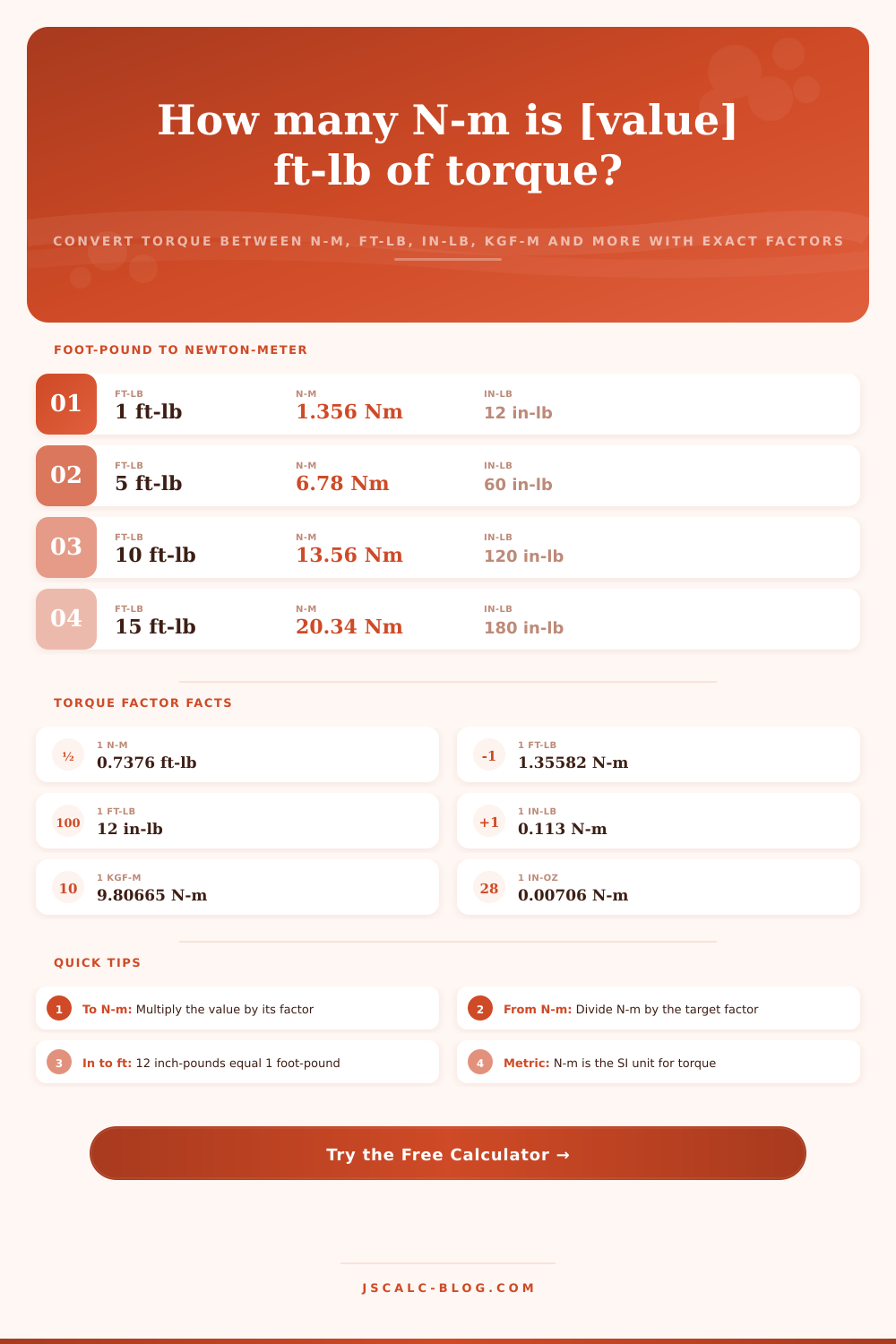
There are eight different units covered by the calculator here, which include common ones like newton-meter and the smaller laboratory unit of dyne-centimeter. Newton-meters is treated as base of all calculations. That way, the calculators is consistent since the other units has precise relationships to the base unit. One kilogram-force meter equals 9.80665 Newton-meters, and one foot-pound equal 1.35582 Newton-meters. These numbers are set constants derived off the definition of length and force.
The other thing is confusion over similar units. Inch-pounds vs foot pounds is a costly error in anyone’s shop. Sounds like the same thing, but they’re a dozen times different than. A spec says fifty foot-pounds but you set it to inch-pounds? You’re applying only one twelfth of the force, and that lug nut come loose on the freeway.
The calculator eliminates that possibility because it display the converted values in every commonly used unit simultaneously. Fifty foot-pounds is clearly six hundred inch-pounds. It’s obvious when you have them both together. No more setting your value too low.
There’s an additional wrinkle with older service manuals. In particular, if you’re working on something realy old (pre-SI adoption particularly for European and Japanese cars), many traditional service manuals will gives the torque value in kilogram-force meters. This is essentially how much force a kilogram of mass applies at a one meter distance away from its center when held under standard gravity. That sounds like a lot of kilograms, but it’s just a metric conversion of torque applied based on weight. If you can do the math in your head, that’s a factor of approximately 9.8, so 50 kgf-m would of be approximately 490 N-m. Your moddern wrench probably won’t use that scale, so save time and protect its calibration by converting the number beforehand.
Numbers are meaningless without context. A few hundred Newton-meters on an engine head bolt is reasonable, and 15 foot-pounds on a spark plug is too. To help put things in perspective, the calculator provides reference tables showing typical torques used in common situation (such as oil drain plugs or even bicycle stems). Using these points of comparison will let you check that the number you converted actualy makes sense in the real world.
You might convert the torque on a small electronics screw and get a massive value in foot-pounds. Chances are good you accidentally transposed your input units, it’s not just doing the math; it’s also a sanity check against your gut feel. Accurate torque application relies on clear communication between the spec sheet and your tool.
Metric Newton-meters, imperial inch-pounds… Whatever it is, it’s all in how you apply it. Having that translation through one basic unit eliminates any confusion that results in failed assemblies and stripped bolts. Enter your number, select your units, and know immediately if your reading is correct. It’s not about spending more time trying to remember what to convert and less time feeling confident you’re tightening each and every bolt just like you want.