Square Meters to Square Feet Converter
Convert square meters, square feet, square yards, acres and hectares with precision control, rounding, room counts, waste and comparison outputs.
Use this grid to compare common interior and land areas across square meters, square feet, square yards, acres and hectares.
| Example Area | Square Meters | Square Feet | Square Yards | Acres | Hectares |
|---|---|---|---|---|---|
| Small bathroom | 4.65 m² | 50.05 ft² | 5.56 yd² | 0.00115 | 0.000465 |
| Bedroom | 12 m² | 129.17 ft² | 14.35 yd² | 0.00297 | 0.0012 |
| Living room | 25 m² | 269.10 ft² | 29.90 yd² | 0.00618 | 0.0025 |
| Apartment | 80 m² | 861.11 ft² | 95.68 yd² | 0.01977 | 0.008 |
| Small house | 150 m² | 1,614.59 ft² | 179.40 yd² | 0.03706 | 0.015 |
| Quarter acre | 1,011.71 m² | 10,890 ft² | 1,210 yd² | 0.25 | 0.1012 |
| Half acre | 2,023.43 m² | 21,780 ft² | 2,420 yd² | 0.50 | 0.2023 |
| One hectare | 10,000 m² | 107,639.10 ft² | 11,959.90 yd² | 2.47105 | 1 |
| Square Meters | Square Feet | Square Yards | Acres | Typical Use |
|---|---|---|---|---|
| 1 m² | 10.7639 ft² | 1.1960 yd² | 0.000247 | Tile sample or cabinet zone |
| 5 m² | 53.8196 ft² | 5.9799 yd² | 0.001236 | Small bath or landing |
| 10 m² | 107.6391 ft² | 11.9599 yd² | 0.002471 | Bedroom or office |
| 25 m² | 269.0978 ft² | 29.8998 yd² | 0.006178 | Living room |
| 50 m² | 538.1955 ft² | 59.7995 yd² | 0.012355 | Garage or small suite |
| 100 m² | 1,076.3910 ft² | 119.5990 yd² | 0.024711 | Apartment or house floor |
| 500 m² | 5,381.9552 ft² | 597.9950 yd² | 0.123553 | Large lot or building pad |
| Square Feet | Square Meters | Square Yards | Acres | Typical Use |
|---|---|---|---|---|
| 50 ft² | 4.6452 m² | 5.5556 yd² | 0.001148 | Bathroom floor |
| 100 ft² | 9.2903 m² | 11.1111 yd² | 0.002296 | Small bedroom |
| 250 ft² | 23.2258 m² | 27.7778 yd² | 0.005739 | Living or dining room |
| 500 ft² | 46.4515 m² | 55.5556 yd² | 0.011478 | Garage or suite |
| 1,000 ft² | 92.9030 m² | 111.1111 yd² | 0.022957 | Apartment floor area |
| 5,000 ft² | 464.5152 m² | 555.5556 yd² | 0.114784 | Building footprint |
| 10,000 ft² | 929.0304 m² | 1,111.1111 yd² | 0.229568 | Small commercial lot |
| Unit | Square Meters | Square Feet | Square Yards | Acres | Hectares |
|---|---|---|---|---|---|
| 1 square yard | 0.8361 m² | 9 ft² | 1 yd² | 0.000207 | 0.0000836 |
| 100 square yards | 83.6127 m² | 900 ft² | 100 yd² | 0.020661 | 0.008361 |
| 0.1 acre | 404.6856 m² | 4,356 ft² | 484 yd² | 0.1 | 0.040469 |
| 1 acre | 4,046.8564 m² | 43,560 ft² | 4,840 yd² | 1 | 0.404686 |
| 1 hectare | 10,000 m² | 107,639.1042 ft² | 11,959.9005 yd² | 2.471054 | 1 |
| 10 hectares | 100,000 m² | 1,076,391.0417 ft² | 119,599.0046 yd² | 24.710538 | 10 |
When it comes to home renovations, you’ll frequently face a combination of diffrent units of measurement. While your tape measure shows you meters, your contractor will quote things in terms of square footage. If you aren’t careful, this disparity can lead to both frustration and wasted money.
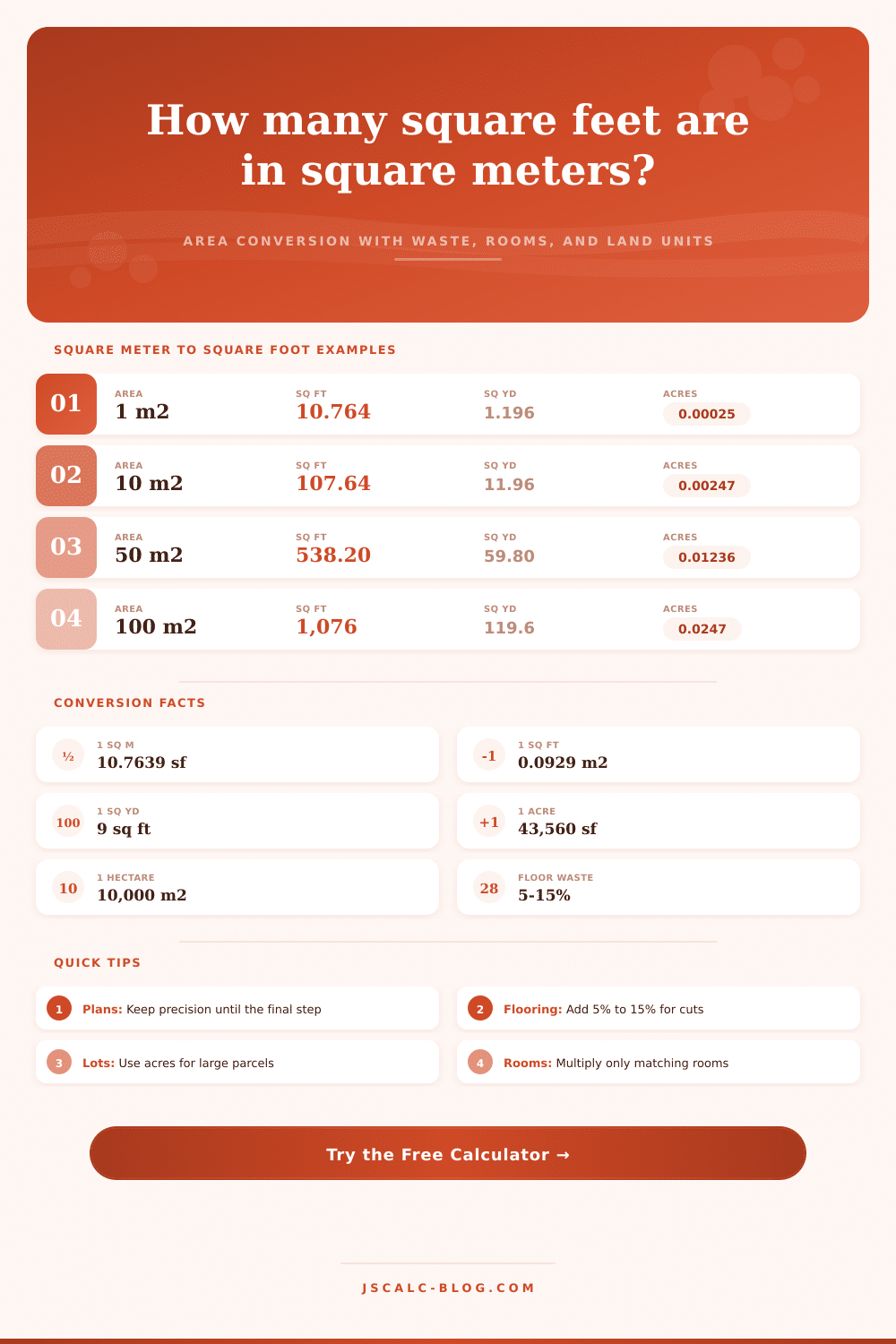
There are approximately ten and three quarter square feet in each square meter. The exact factor is 10.7639. Knowing this helps you know when you’re buying enough (or too much) flooring. It ensures you don’t pay for extra room you don’t own.
Why Area Conversion Is Hard
Enter the dimensions on the calculator above, and let it do the math for you. You save yourself the potential mistakes caused by doing it manualy. Which add up fast when you’re working with more than one room.
Area conversion is a different beast then linear meter-to-foot conversions. In fact, many folks treats area conversion as a simple swap of units, like changing gallons to liters. The issue is that you’re not dealing with one dimension when working with area; instead, area are defined as the product of two length measurements. That means you work with one factor in linear meter/feet conversions, but two factors (the product of two measurements) when converting between square meters and square feet. As your space increases in size, this discrepancy becomes greater.
If you err in a small bathroom, you might be off by a few bucks due to rounding error. But in a big living room or whole apartment floor? Hundreds of square units. Here precision makes a difference. Flooring isn’t typically a cheap thing. It’s hard to get a refund after cutting materials to fit.
Beyond simple unit swapping, there are other practical aspects of construction to consider that this tool includes. You’ll notice options to enter your percentage of waste and number of rooms. Why? Because installable area doesn’t equal theoretical area. Tile and plank flooring require cutting to accommodate doors, walls, and awkward areas. Industry standards suggests buying 5. 15% more material to cover these cuts.
In some cases, like a simple room with straight walls, 5% may suffice. In others, such as kitchens with diagonal layouts, patterns, and cabinets/islands, 15+ may be necessary. This allows you to switch between waste factors to get a sense of what the actual quantity required would be (rather than simply geometric area). It helps you get a sense of the cost impact before committing to a purchase.
The same reasoning applies to land size (though it’s at a much), much larger scale. Property listings are often unwieldy when expressed in square feet. Enter the acre and hectare. An acre equals 43,560 square feet. A hectare equals 10,000 square meters. They’re shorthand ways to express very large numbers in more readable forms.
The table above shows this well. It provides conversion table for a half-acre lot: what that equals across various systems of measure. By knowing those landmarks, you can easily compare properties listed under different areas without having to do math gymnastics in your head. Just look at the converted sizes and you’ll immediately know if you’re looking at a generous plot of land or a tight urban strip.
Another sneaky pitfall is rounding. You may be rounding too soon, which causes loss of precision that could become critical later on. Best practice would be to maintain decimal digits all the way through your calculations then just round at the end. The calculator has an option to specify how many decimals to display. For most home projects, two should do fine. Commercial construction or land records may need more.
If you want to know what the correct rounding mode is, it depends on whether you want to save a little money (round down) vs. Knowing you’ll have material available (round up). If you’re doing this as part of a job, most pros will lean toward caution because sometimes months after installation, you won’t be able to find exactly the same style flooring again.
Switching between metrics and the imperial system can be cumbersome initially. Most of us learn at an early age that a yard is slightly shorter than a meter, but the relationships for areas don’t come as intuitively. One square meter isn’t just a little bit bigger than a square foot. It’s much bigger in terms of total area covered.
If you’re trying to estimate how much material it will take to cover something, try visualizing it. Take a typical king size bed. That takes roughly three or four square meters to cover. Now picture a single one-foot tile. How many could you lay down to cover the same surface? The answer is close to 40 of them. That’s the kind of volume leap that throws off our mental math.
Using reliable conversion calculators removes guesswork from your spatial calculations. In the end, it’s all about confidence. Whether you are measuring land to invest in or hardwood for your hall, knowing the exact amount of space you’re working with saves you money. If you work with the numbers right, they don’t lie. Measure what’s real, multiply with the appropriate factor, add physical wastage and presto, a genuine total. A little bit of math can save your sanity and your wallet.
Keep in mind though, regardless of how many rooms you tack on to the list, one square meter will always give you slightly more than ten square feet. That unchanging ratio becomes your guide amidst different layouts and mixed units.