Acres to Square Feet Converter
Convert acres, square feet, square yards, square meters and hectares with parcel counts, usable area, overage, precision and rounding controls.
| Acres | Square Feet | Square Yards | Square Meters | Hectares | Common Context |
|---|---|---|---|---|---|
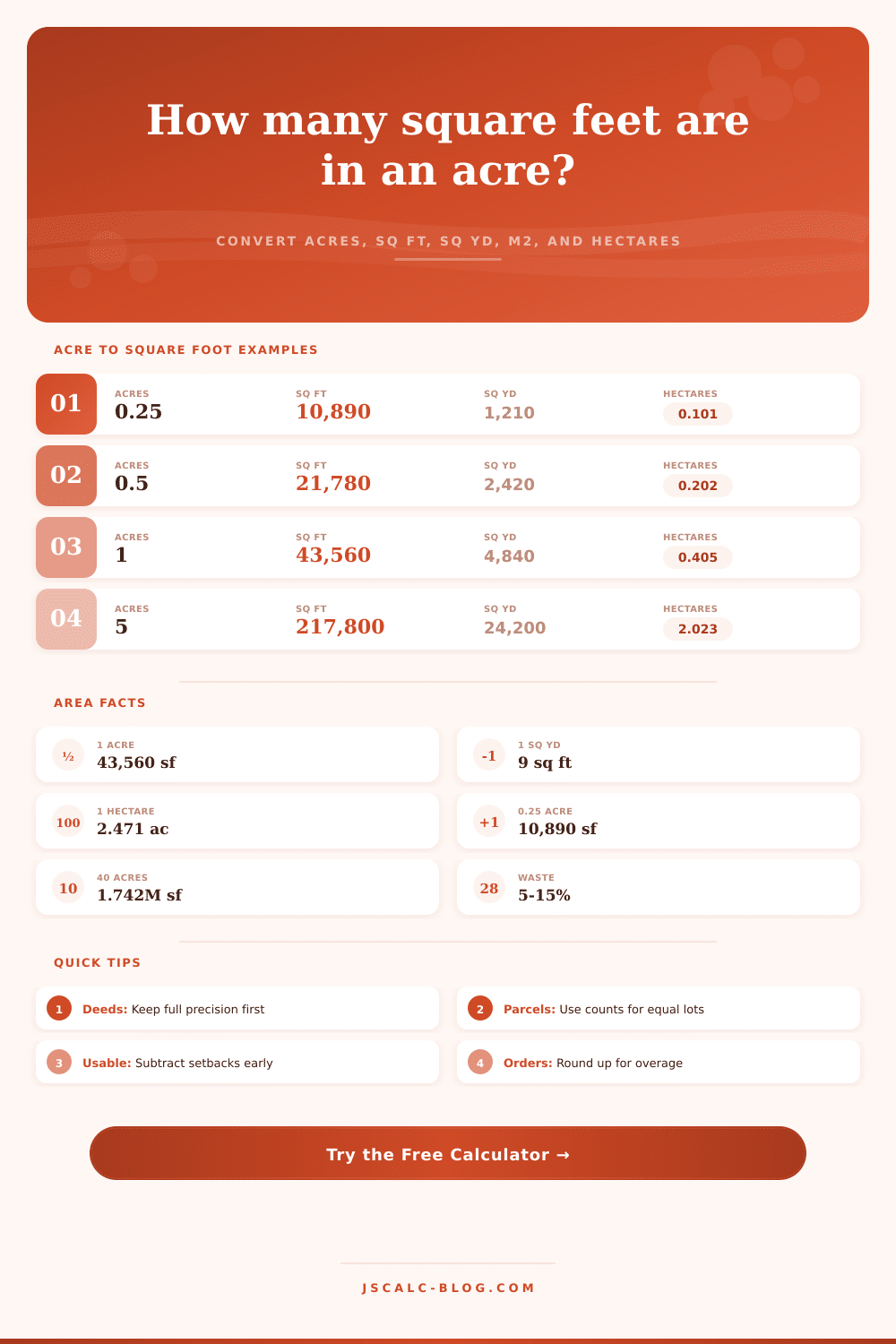
| 0.10 acre | 4,356 ft² | 484 yd² | 404.69 m² | 0.0405 ha | Small urban lot or garden parcel |
| 0.25 acre | 10,890 ft² | 1,210 yd² | 1,011.71 m² | 0.1012 ha | Quarter acre residential lot |
| 0.50 acre | 21,780 ft² | 2,420 yd² | 2,023.43 m² | 0.2023 ha | Half acre home site |
| 1 acre | 43,560 ft² | 4,840 yd² | 4,046.86 m² | 0.4047 ha | Standard acre reference |
| 2 acres | 87,120 ft² | 9,680 yd² | 8,093.71 m² | 0.8094 ha | Large estate lot |
| 5 acres | 217,800 ft² | 24,200 yd² | 20,234.28 m² | 2.0234 ha | Small rural parcel |
| 10 acres | 435,600 ft² | 48,400 yd² | 40,468.56 m² | 4.0469 ha | Hobby farm or land holding |
| 40 acres | 1,742,400 ft² | 193,600 yd² | 161,874.26 m² | 16.1874 ha | Quarter quarter section tract |
| Square Feet | Acres | Square Yards | Square Meters | Hectares | Common Context |
|---|---|---|---|---|---|
| 1,000 ft² | 0.02296 ac | 111.11 yd² | 92.90 m² | 0.0093 ha | Small building footprint |
| 5,000 ft² | 0.11478 ac | 555.56 yd² | 464.52 m² | 0.0465 ha | Compact residential lot |
| 7,500 ft² | 0.17218 ac | 833.33 yd² | 696.77 m² | 0.0697 ha | Subdivision lot |
| 10,890 ft² | 0.25 ac | 1,210 yd² | 1,011.71 m² | 0.1012 ha | Quarter acre lot |
| 21,780 ft² | 0.50 ac | 2,420 yd² | 2,023.43 m² | 0.2023 ha | Half acre lot |
| 43,560 ft² | 1 ac | 4,840 yd² | 4,046.86 m² | 0.4047 ha | One acre |
| 100,000 ft² | 2.29568 ac | 11,111.11 yd² | 9,290.30 m² | 0.9290 ha | Large commercial site |
| Scenario | Input Area | Parcel Count | Usable Percent | Net Square Feet | Use This For |
|---|---|---|---|---|---|
| Four quarter acre lots | 0.25 acre | 4 | 100% | 43,560 ft² | Checking a lot split total |
| Half acre with setbacks | 0.50 acre | 1 | 78% | 16,988 ft² | Buildable area estimate |
| 5-acre parcel, 85% usable | 5 acres | 1 | 85% | 185,130 ft² | Field, pasture or site planning |
| Three 1-acre pads | 1 acre | 3 | 92% | 120,226 ft² | Repeated pad or phase estimate |
| 40-acre tract, 70% usable | 40 acres | 1 | 70% | 1,219,680 ft² | Broad tract screening |
| 100,000 ft² survey | 100,000 ft² | 1 | 100% | 100,000 ft² | Back-convert survey area to acres |
| Unit | Square Feet | Acres | Square Meters | Hectares | Best Display Use |
|---|---|---|---|---|---|
| 1 square foot | 1 ft² | 0.00002296 ac | 0.092903 m² | 0.00000929 ha | Plans, rooms, building pads |
| 1 square yard | 9 ft² | 0.00020661 ac | 0.836127 m² | 0.00008361 ha | Landscape and turf quantities |
| 1 acre | 43,560 ft² | 1 ac | 4,046.856 m² | 0.404686 ha | Lots, parcels and tracts |
| 1 hectare | 107,639.104 ft² | 2.471054 ac | 10,000 m² | 1 ha | Metric land records |
| 1 square mile | 27,878,400 ft² | 640 ac | 2,589,988 m² | 258.999 ha | Large land sections |
You stand on A parcel of land, which at first seems small… But then again how can you visualize its real space? Forty-three thousand square feet; it’s hard for your brain to imagine unless you draw it.” That’s where many people go awry in their plans for property, between the abstract number and the physical reality: They think they have an idea of their lot size, right up until they want to put down something that doesn’t quite match there imagination. Acres is turned into square feet in an exercise of translation that transforms legalese into size. It’s an exact ratio between these two units, so converting from one to another is easy. But it is also often confusing when used.
An acre are always equal to 43,560 square feet. Always. Always. And always equal to 43,560 square feet, period. There’s no wiggle room with this value. Other factors might reduces how much land you’ll actualy put a concrete slab on, such as easements, setbacks, or the slope of the terrain.
Why Usable Space Is More Important Than Total Area
The calculator up top does all the simple multiplication/division for you so that you don’t need a spreadsheet to figure out if you’re going to fit within a proposed new fence line. It take away the mental math of converting units so you can focus instead on if your plan will work in reality. The gross area is where most novices end their calculations, but it doesn’t always correspond to what will actualy be built upon.
Sure, a half-acre lot may seem like plenty. However, you has to remember the minimum front-yard setback, the utility easement on one side, and the steep incline running up against the back property line. By entering your usable percent, you’re forced to consider these limitations early on in the exercise. Better to learn only 70% of your site can be developed *before* you’ve commissioned an architect, not *after* you’ve spent time sketching blueprints! This tweak brings your theoretical max down to earth, preventing costly re-designs later.
There’s nothing worse then trying to divide up several lots (or figure out how much material you’ll need for big jobs) only to realize that you rounded too soon, and now all those little mistakes add up to a BIG mistake. By maintaining complete accuracy through to the end, you know that what you’ve got will match the legal description and official surveys. And it’s nice to have an interface that lets you pick whether you want to round up or down, and how many decimal points is important to you. For pros who can’t afford to be off a few squares here or there in estimating where property lines should fall, or how much landscape materials they’re going to need, that kind of control are key.
This is the moral of all this. Understanding the distinction between gross area and net usable space is the key to avoiding disappointment with your land project. I’ve laid out some common scenarios in the reference table below. When you plug in actual, real-world constraints (e.g., non-buildable zones, setbacks). As opposed to theory-only acreage; you’ll quickly see how those theoretical acres vanishes. It’s a simple sanity check to run your own calculations by, and it helps you catch an error before it turns into a more expensive mistake.
For example, you’ll see that your quarter-acre lot becomes a very different size after you consider normal building codes… A good lesson for every new homeowner. But really, it all comes down to space. Space matters less then what you DO with it; the land planner cares more about the amount of usable space than the overall area (even when subdividing a farm into parcels). If you’re looking at your backyard to see if you can fit a pool or any other house addition, then this math applies as well.
It’s the framework, and you fill in the details. The converter connects the real earth underfoot and the paper deed by giving you the specific measurements you’ll need to begin visualizing. From there you can figure out precisely what’s possible and what isn’t, transforming vague ideas of “size” to something concrete: square feet. That’s what takes the guesswork out of things and lets you plan confidentely, instead of second-guessing yourself and wondering whether there is enough space for your dreams.