Motor Torque Calculator
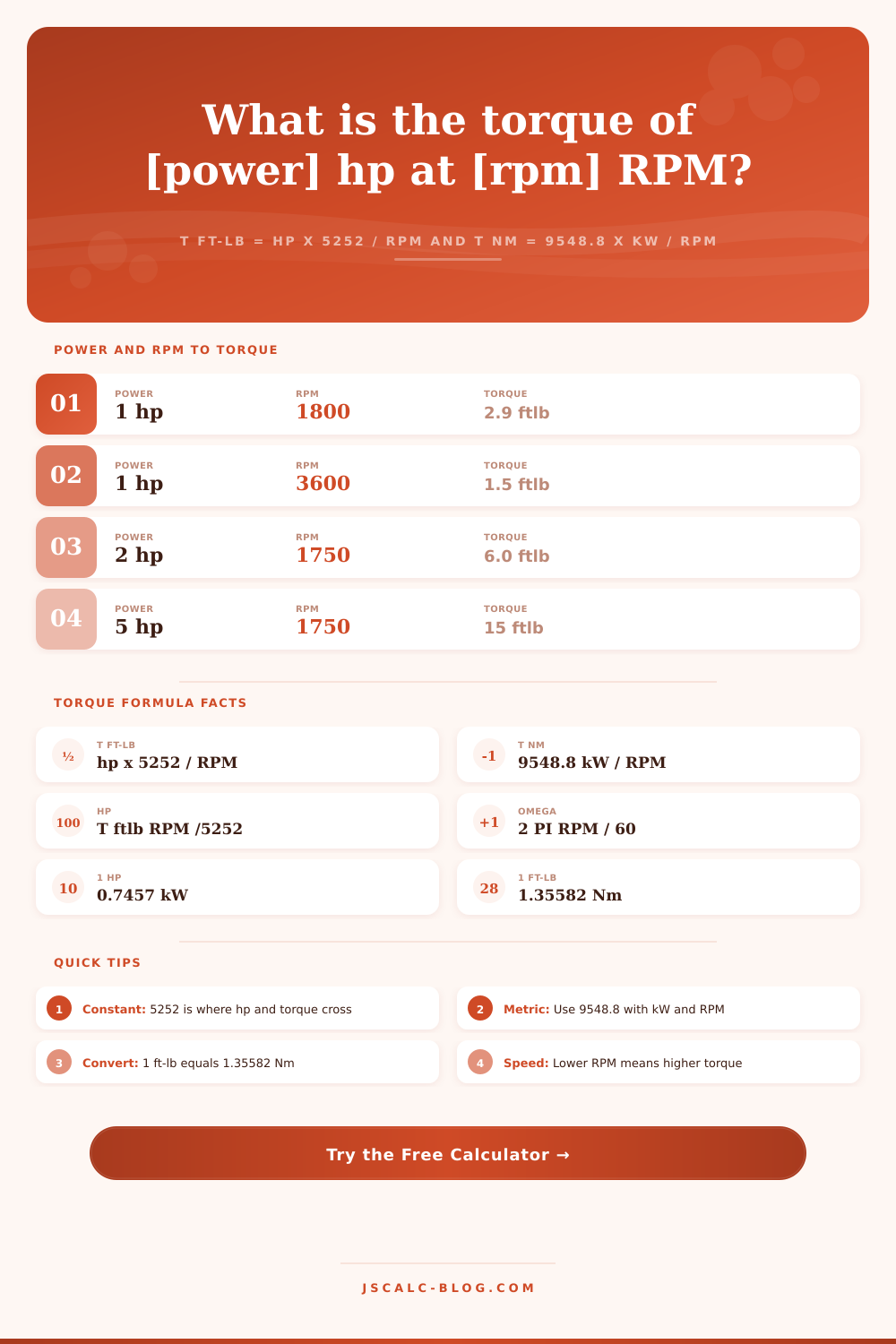
Find shaft torque from motor power and speed using T ft-lb = hp x 5252 / RPM and the metric form T Nm = 9548.8 x kW / RPM. Flip the calculation to solve for horsepower from torque and speed, or find the RPM a motor must spin to deliver a target torque, with instant conversion between Nm, ft-lb, kW, and hp.
⚙Choose What to Solve For
🔧Real Motor Presets
📝Motor Inputs
Rated shaft power the motor delivers.
1 hp = 0.7457 kW = 745.7 W.
Shaft speed in revolutions per minute.
Used when solving for power or speed.
Applies to the torque field above.
Controls rounding on every result card.
🔢Formula Snapshot
📋Horsepower and RPM to Torque
| Power | Speed (RPM) | Torque (ft-lb) | Torque (Nm) |
|---|---|---|---|
| 0.5 hp | 1725 | 1.52 ft-lb | 2.06 Nm |
| 1 hp | 1800 | 2.92 ft-lb | 3.96 Nm |
| 1 hp | 3600 | 1.46 ft-lb | 1.98 Nm |
| 2 hp | 1750 | 6.00 ft-lb | 8.14 Nm |
| 5 hp | 1750 | 15.01 ft-lb | 20.35 Nm |
| 10 hp | 1800 | 29.18 ft-lb | 39.57 Nm |
| 25 hp | 1180 | 111.3 ft-lb | 150.9 Nm |
| 50 hp | 1770 | 148.4 ft-lb | 201.2 Nm |
🧭Kilowatts and RPM to Torque
| Power (kW) | Speed (RPM) | Torque (Nm) | Torque (ft-lb) |
|---|---|---|---|
| 0.75 kW | 1440 | 4.97 Nm | 3.67 ft-lb |
| 1.5 kW | 1450 | 9.88 Nm | 7.29 ft-lb |
| 2.2 kW | 2880 | 7.30 Nm | 5.38 ft-lb |
| 3 kW | 1450 | 19.76 Nm | 14.57 ft-lb |
| 4 kW | 1465 | 26.07 Nm | 19.23 ft-lb |
| 5.5 kW | 2900 | 18.11 Nm | 13.36 ft-lb |
| 7.5 kW | 1470 | 48.72 Nm | 35.94 ft-lb |
| 11 kW | 1460 | 71.94 Nm | 53.06 ft-lb |
📏Unit Conversions and Constants
| Quantity | Equals | Reverse | Note |
|---|---|---|---|
| 1 hp | 0.7457 kW | 1 kW = 1.341 hp | Mechanical horsepower |
| 1 hp | 745.7 W | 1 W = 0.001341 hp | Watt form of hp |
| 1 ft-lb | 1.35582 Nm | 1 Nm = 0.73756 ft-lb | Torque conversion |
| hp constant | 5252 hp-rpm | 33000 / (2 PI) | ft-lb basis |
| kW constant | 9548.8 kW-rpm | 60000 / (2 PI) | Nm basis |
| 1 RPM | 0.10472 rad/s | 2 PI / 60 | Angular speed |
🔁RPM to Angular Speed
| Speed (RPM) | Omega (rad/s) | Revolutions/s | Common Use |
|---|---|---|---|
| 750 | 78.54 rad/s | 12.5 rev/s | 8-pole 60Hz motor |
| 1180 | 123.6 rad/s | 19.7 rev/s | 6-pole load rating |
| 1450 | 151.8 rad/s | 24.2 rev/s | 4-pole 50Hz motor |
| 1750 | 183.3 rad/s | 29.2 rev/s | 4-pole 60Hz motor |
| 3000 | 314.2 rad/s | 50.0 rev/s | 2-pole 50Hz servo |
| 3600 | 377.0 rad/s | 60.0 rev/s | 2-pole 60Hz motor |
🗃Power vs Torque Comparison Grid
| Power (hp) | Power (kW) | Torque @ 1800 rpm | Torque @ 3600 rpm | Omega @ 1800 | Typical Use |
|---|---|---|---|---|---|
| 0.5 hp | 0.37 kW | 1.46 ft-lb | 0.73 ft-lb | 188.5 rad/s | Small fan, blower |
| 1 hp | 0.75 kW | 2.92 ft-lb | 1.46 ft-lb | 188.5 rad/s | Bench grinder |
| 2 hp | 1.49 kW | 5.84 ft-lb | 2.92 ft-lb | 188.5 rad/s | Air compressor |
| 3 hp | 2.24 kW | 8.75 ft-lb | 4.38 ft-lb | 188.5 rad/s | Table saw, pump |
| 5 hp | 3.73 kW | 14.59 ft-lb | 7.29 ft-lb | 188.5 rad/s | Dust collector |
| 7.5 hp | 5.59 kW | 21.88 ft-lb | 10.94 ft-lb | 188.5 rad/s | Conveyor drive |
| 10 hp | 7.46 kW | 29.18 ft-lb | 14.59 ft-lb | 188.5 rad/s | Hydraulic pump |
| 15 hp | 11.19 kW | 43.77 ft-lb | 21.88 ft-lb | 188.5 rad/s | Machine tool |
| 25 hp | 18.64 kW | 72.94 ft-lb | 36.47 ft-lb | 188.5 rad/s | Large blower |
| 50 hp | 37.29 kW | 145.9 ft-lb | 72.94 ft-lb | 188.5 rad/s | Process pump |
🔧Formula Breakdown
💡Motor Sizing Tips
In motors, we don’t pick them by their horsepower rating. We pick them by amount of torque they deliver so that as load increases, the motor won’t stall out. Torque is what let the motor begin working immediately. Power is how much work the motor can do over time. In industry, this makes all the difference because a stalled motor will cost more then an hour’s worth of someone’s time.
Once you know speed and rated power, calculator does the math for you. Removing the conversions and coefficients from equation allows it to stay physically accurate without the guesswork. Power is torque times rotational speed. The standard SI units for that equation are Newtons-meter × Radians/second, which works out to watts. Since no one displays their nameplate with radians on a motor, or often even watts, engineers simply bake some unit conversion into a couple handy constants.
How to Choose the Right Motor Torque
The constant 5252 ties horsepower to pound-feet; 9548.8 links newton-meters to kilowatts. These values comes from dividing the usual power-per-minute definition by two pi radians. It’s not magic, it’s just arithmetic expressed in terms you’re used to. One of those handy numbers to remember when trying to get your head around things is the magic 5252.
For example, if you have a motor turning 5,252 RPM, it’s producing an equal amount of pounds of torque as it is horsepower. Anything over or under will see the horsepower and torque figure flip-flop. Why is that important? On some dyno charts, you’ll notice where two lines cross somewhere in the mid-range speeds. That crossover number happen to be 5,252 RPM. So what does that tell us? Not to assume something is high horsepower because it must also have high torque at low rpm.
Mostly it’s solving for torque. Multiply rated power by constant and divide by speed. At 1750 RPM, a five horsepower motor will generate roughly fifteen pound-feet of torque. Double that speed to 3500 RPM and the torque halve to seven point five pound-feet while power output stays the same. It figures out your answer in imperial units as well as metric, letting you read newton-meters without having to run a conversion on a different calculator. That’s good since it’s easy to make transcription errors when copying values from spec sheets.
Sometimes we must make those reverse calculations. Perhaps you know the amount of twist in a shaft, measured by some sort of load cell. Or maybe you want to calculate how much power is demanded by given torque. Or perhaps you have a desired torque, but you already have a motor and it cannot spin any faster. What gear ratio should be used to multiply the force and slow the shaft? The calculator will rearrange it with ease. If you feed in all but one variable, it will make that variable the output rather than the input. This allows for flexibility when specs is missing or conflicting.
Whenever there’s power, there’s a tradeoff between speed and torque. Add more power, and you can give up some rotation speed or get more turning force. That’s where gearboxes comes into play. Reducing the output speed by 10:1 multiplies the torque by almost 10:1, before any losses from heat and friction.
Remember when sizing a drive (use nameplate RPM), not the theoretical synchronous speed. Induction motors will slip one to three percent under load, which if ignored will shift your torque estimate enough to cause startup trouble. Experienced engineers are surprised at how often they gets confused by unit conversions. A pound-foot is approximately equal to 1.36 newton-meters. Similarly, one horsepower is about 0.75 of a kilowatt. When browsing an international datasheet, it can help to remember those ratios.
Fortunately, most common motor sizes convert between systems as shown in the reference tables on page. If the tool will do the conversion for you then there’s no need to memorize, but understanding the rough ratios allows you to catch glaring mistakes in your input data. Torque matters, too little and your motor will stall when loaded down; too much and it’s wasted money and energy from an oversized motor. Getting torque wrong is actualy expensive.
What this tool does well is that it provides answers for either torque or speed needs. From a technician sizing a conveyor drive to a student studying the fifty-two-fifty-two rule, you can input variables and have confidence in quick results. It starts where it should of: with physics and ends at the appropriate motor selection.