Electric Motor Torque Calculator
Work out the full-load torque of an electric motor straight from its electrical nameplate. Enter supply type, line voltage, full-load amps, power factor and efficiency, then either type the full-load RPM or var the tool build it from poles, frequency and slip. Get torque in newton-metres and pound-feet plus mechanical power and synchronous speed.
🎯Real Motor Nameplate Presets
🔌Electrical Inputs
Sets the power formula and whether power factor is used.
Line-to-line volts for AC, or terminal volts for DC.
Full-load amps (FLA) read from the motor nameplate.
AC only. Ignored for DC, where it is treated as 1.
Shaft output over electrical input, usually 82 to 96 pct.
Choose how the shaft speed used for torque is found.
Nameplate running speed. Used when speed source is direct.
Even pole count that sets synchronous speed.
Mains frequency, 60 Hz in North America, 50 Hz elsewhere.
Drop below sync speed at load, typically 2 to 5 pct.
🔢Formula Constants
📏Synchronous Speed by Poles
| Poles | Sync RPM at 60 Hz | Sync RPM at 50 Hz | Rev per Second 60 Hz |
|---|---|---|---|
| 2 | 3600 | 3000 | 60.0 |
| 4 | 1800 | 1500 | 30.0 |
| 6 | 1200 | 1000 | 20.0 |
| 8 | 900 | 750 | 15.0 |
| 10 | 720 | 600 | 12.0 |
| 12 | 600 | 500 | 10.0 |
| 16 | 450 | 375 | 7.5 |
📋Typical Power Factor and Efficiency by Size
| Motor Size | Typical Power Factor | Typical Efficiency | Common Use |
|---|---|---|---|
| Under 1 hp | 0.72 to 0.80 | 75 to 82 pct | Small fans, pumps |
| 1 to 5 hp | 0.80 to 0.86 | 82 to 88 pct | Conveyors, blowers |
| 5 to 20 hp | 0.84 to 0.88 | 87 to 91 pct | Compressors, mills |
| 20 to 50 hp | 0.86 to 0.90 | 90 to 93 pct | Large pumps |
| 50 to 200 hp | 0.87 to 0.91 | 93 to 95 pct | Industrial drives |
| Over 200 hp | 0.88 to 0.92 | 94 to 96 pct | Crushers, cooling |
⚙NEMA Design Torque Classes
| NEMA Design | Starting Torque | Slip at Full Load | Typical Load |
|---|---|---|---|
| Design A | 100 to 200 pct | 0.5 to 3 pct | High-inertia, low slip |
| Design B | 100 to 200 pct | Under 5 pct | General purpose |
| Design C | 200 to 250 pct | Under 5 pct | Conveyors, crushers |
| Design D | Up to 275 pct | 5 to 13 pct | Punch press, hoists |
| Design E | 75 to 190 pct | Under 3 pct | Premium efficiency |
🗃Poles, Speed and Use Comparison Grid
| Poles | Sync RPM 60 Hz | Sync RPM 50 Hz | Typical Full-Load RPM | Torque vs 2-Pole | Common Application |
|---|---|---|---|---|---|
| 2 | 3600 | 3000 | 3450 to 3500 | 1.0x (baseline) | Pumps, high-speed fans |
| 4 | 1800 | 1500 | 1725 to 1760 | About 2.0x | General industrial |
| 6 | 1200 | 1000 | 1140 to 1170 | About 3.0x | Compressors, mixers |
| 8 | 900 | 750 | 850 to 870 | About 4.0x | Conveyors, agitators |
| 10 | 720 | 600 | 680 to 700 | About 5.0x | Ball mills, kilns |
| 12 | 600 | 500 | 560 to 580 | About 6.0x | Low-speed crushers |
📑How the Torque Is Built
💡Motor Torque Tips
When you read the nameplate on a motor, what do you see? You see the amperage and volts. What about the torque? Torque is the twisting force that moves your equipment around. And this calculator gets it for you. It take the values from the nameplate into pounds-feet or newton-metres of torque. It also provide the synchronous speed and the shaft power.
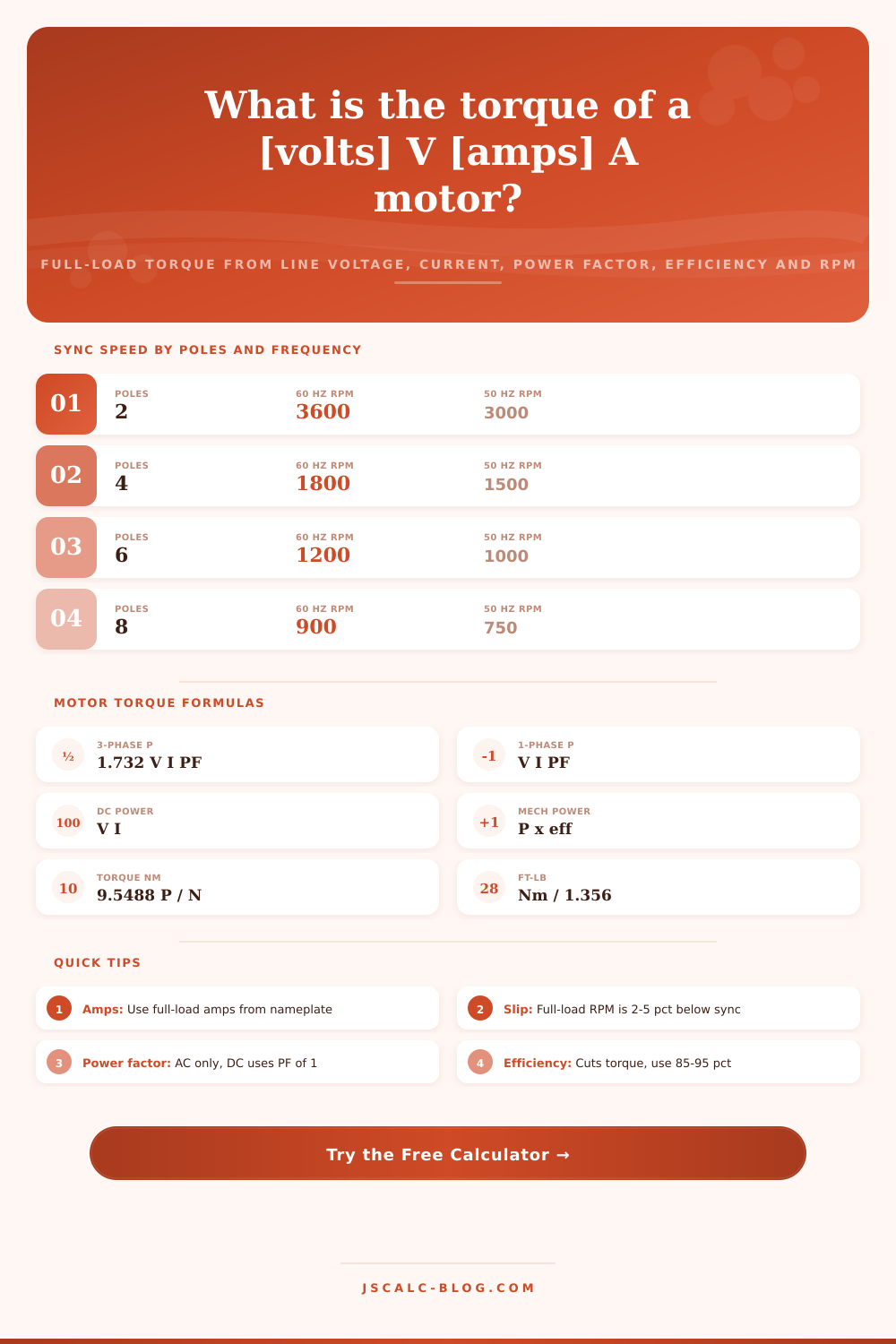
So what’s first? Power. How many amps and volts is coming in? Motor type matter here. For three phase, this is multiplied by approximately 1.732. For single phase it’s your power factor. And for DC motors, it’s voltage times current. This calculator will selects the appropriate equation for you. If you pick the wrong one, you’re off to a bad start.
How to Calculate Motor Torque
The second factor are efficiency. Not all of the power drawn by a motor gets used. Windings lose some power as heat. Drag and friction losses occurs. What we care about is how much power makes it to the shaft. That’s called the nameplate efficiency. So if your motor draws 4000 watts with 90 percent efficiency then you’re getting 3600 watts on the shaft. You would of calculate torque based off that assumption and miss five to twenty percent, which can cause the drive to fail when loaded.
The last component of the equation is speed. Power divided by speed equal torque. When a motor is loaded it will slow down. This is called slip, which is true for an AC motor. An example would be that a 4-pole motor operating off 60 hertz only operates at approximately 1750 RPM as opposed to 1800 RPM. This synchronous speed makes the torque too low. If possible, use the actual running speed.
The other constant is: Watts = (RPM/9.5488) X Newton-Metres. So it do the math for you in units. Divide the result by 1.35582 for pound-feet. And that’s how we know slow motors is more torquey. A two-pole motor spinning at 3600 RPM has only half as much torque than an eight-pole motor running at 900 RPM. Both would be rated the same for power.
If the name plate is illegible, reference tables shows the usual efficiencies and power factors. The NEMA design chart clarifies expected slip and starting torque. These details makes the calculator more useful when sizing.
Two practices will ensure accuracy. First, use full-load amps. Do not use the locked-rotor current because it is much higher. Second, use the true running speed. That’s the one that accounts for slip. If you do this you’ll have a good torque number to work with. From there you can verify your gear ratios or size couplings. This makes electrical data turn into mechanical answers.