Rack Power Load Calculator
Add up the watts drawn by every device in your server rack, convert the total to amps at your input voltage, and check the current against your PDU or circuit rating using the 80 percent NEC continuous-load rule. Plan single feeds or A plus B redundant power so each feed can carry the full rack if its partner fails.
🎯Real Rack Load Presets
🔌Rack & Power Inputs
How many identical devices in the rack.
Real running draw, not nameplate max.
Switches, KVM, PDU overhead, misc gear.
Higher voltage means fewer amps for the same watts.
Modern PSUs are 0.95 to 0.99. Amps = W / (V x PF).
Breaker size of the circuit feeding the rack.
NEC caps continuous load at 80% of the breaker.
A+B: each feed must carry 100% if one fails.
Total rack height, usually 42U or 48U.
U already filled by mounted equipment.
🔢Key Formulas At A Glance
🔋Circuit Ratings & Usable Amps (80%)
| Breaker Rating | Usable Amps (80%) | kW at 120V | kW at 208V |
|---|---|---|---|
| 15 A | 12.0 A | 1.44 kW | 2.50 kW |
| 20 A | 16.0 A | 1.92 kW | 3.33 kW |
| 30 A | 24.0 A | 2.88 kW | 4.99 kW |
| 40 A | 32.0 A | 3.84 kW | 6.66 kW |
| 50 A | 40.0 A | 4.80 kW | 8.32 kW |
| 60 A | 48.0 A | 5.76 kW | 9.98 kW |
| 100 A | 80.0 A | 9.60 kW | 16.64 kW |
🖥Typical Device Wattages
| Device Type | Rack Units | Typical Watts | Notes |
|---|---|---|---|
| 1U web / app server | 1U | 250 - 450 W | Dual midrange CPU |
| 2U database server | 2U | 500 - 800 W | More drives and RAM |
| 4U storage / JBOD | 4U | 400 - 900 W | Scales with disk count |
| GPU server (4-8 GPU) | 4U | 3000 - 6500 W | NVIDIA DGX class |
| Blade chassis (full) | 10U | 4000 - 7000 W | Shared power and cooling |
| Top-of-rack switch | 1U | 150 - 500 W | Depends on optics |
| KVM / console | 1U | 15 - 40 W | Low overhead |
⚡Same Power, Different Voltage (Current Draw)
| Rack Load | Amps at 120V | Amps at 208V | Amps at 240V |
|---|---|---|---|
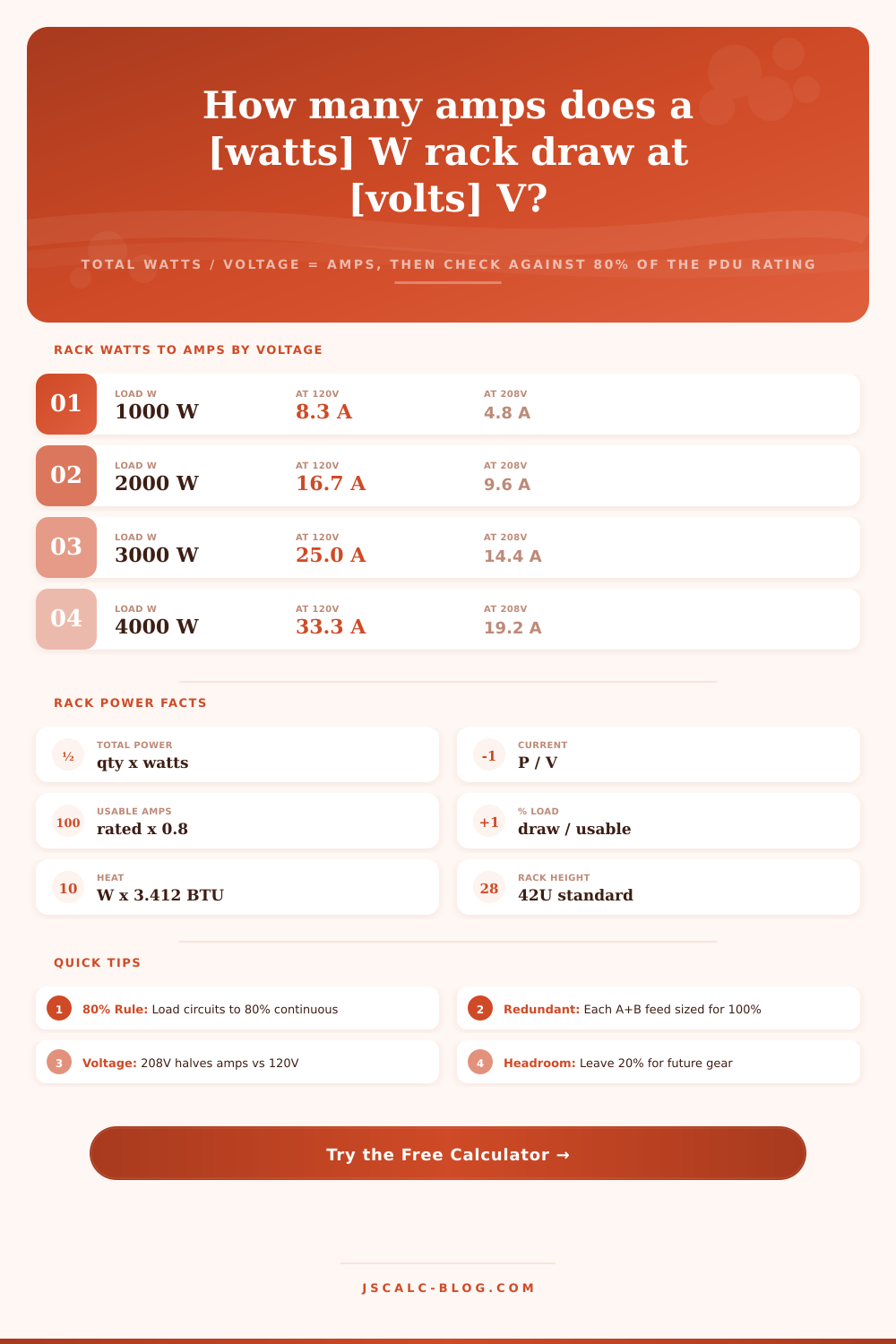
| 2 kW | 16.7 A | 9.6 A | 8.3 A |
| 3 kW | 25.0 A | 14.4 A | 12.5 A |
| 5 kW | 41.7 A | 24.0 A | 20.8 A |
| 7 kW | 58.3 A | 33.7 A | 29.2 A |
| 10 kW | 83.3 A | 48.1 A | 41.7 A |
| 15 kW | 125.0 A | 72.1 A | 62.5 A |
📊Rack Load Comparison Grid
| Rack Profile | Total Power | Voltage | Amps / Feed | PDU Rating | Load vs 80% |
|---|---|---|---|---|---|
| 20x 1U web | 7.15 kW | 208 V | 35.1 A | 50 A | 87.7% |
| Half rack storage | 3.60 kW | 208 V | 17.7 A | 30 A | 73.6% |
| GPU 8x DGX | 26.4 kW | 415 V | 36.7 A | 60 A | 76.5% |
| 42U mixed | 9.80 kW | 208 V | 48.1 A | 60 A | 100.2% |
| 2x blade | 11.0 kW | 208 V | 54.0 A | 60 A | 112.4% |
| Network core | 2.40 kW | 120 V | 20.4 A | 30 A | 85.0% |
| Colo 5kW cabinet | 5.00 kW | 208 V | 24.5 A | 30 A | 102.2% |
| 12-node HCI | 6.60 kW | 208 V | 32.4 A | 40 A | 101.2% |
| Small edge | 1.20 kW | 120 V | 10.2 A | 20 A | 63.7% |
| Dense HPC | 17.0 kW | 415 V | 23.6 A | 32 A | 92.3% |
⚙Formula Breakdown
💡Rack Power Planning Tips
How do you know when to stop adding hardware? How do you size a rack? Before you put anything in a server rack, go to JSCalc-Blog.com for its Rack Power Load Calculator. That’s because a rack are sized by how much electrical current it has available, as well as the available physical space on the rails. Each piece of hardware will have a wattage; add them all up and convert that into amps at your input voltage. Compare that number with the branch circuit or PDU rating. The tool does it all for you (and it even handles redundancy calculations that will surprise some operators).
Power starts at the rack. A basic addition is that total power equal the number of devices multiplied by the actual wattage drawn by each one. And that’s the key word: actualy. Power supplies has nameplate ratings that are the maximum under worst case; not the operating load they’ll draw steadily. Designing to nameplate wastes expensive circuit capacity. If you’re designing 20 x 1U servers drawing a realistic 350 watts apiece, it comes out at 7,150 watts. That’s the real running number; that’s how much your circuit must haul, hour after hour. The maximum draw in amps can then be calculated by dividing the power by the voltage. Power factor is typically around.95,.99 on moddern servers and this has to be factored into the equation as well. On a single phase feed it’s power/voltage * power factor. So a 7,150 watt rack on a 120 volt feed will draw more than 60 amps whereas the same rack on a 208 volt feed will only draw roughly 35 amps. Why? Because higher voltages is used when wiring up denser racks.
How to Size Your Server Rack Power
That doesn’t mean you should of run a circuit breaker at its rated amperage all day long. According to the NEC, anything over three hours is considered continuous use and limited to 80 percent of the breaker’s rated amperage. That means you can only use 24 amps on a 30 amp circuit. Your breaker rating becomes an actual usable amp when we apply your derating factor. When it exceed 100 percent, it flags the feed as OVER. TIGHT is flagged if it’s between 90 and 100 percent. This lets you know there isn’t much head room before you commit hardware.
Redundancy is a common problem in rack power planning. An A plus B design means every rack has two feeds from separate circuits. If one feed drops, the survivor must carry the entire load by itself. Now you can’t just divide the load by two, and then size both feeds for half the watts! One feed dropping mean the survivor must immediately pick up the whole amp draw by itself. Choose the dual feed option and the tool will size each path for full rack load. For normal operations, you want each feed at about 40 percent so that neither exceeds its capacity alone when there’s a fault.
But the math becomes fast look-ups from these tables of references. There’s one that lists common breaker sizes, including how many amps are available and what kilowatts those can deliver at various voltages. Another one list the same rack load in amps (the same number) but at 120, 208 and 240 volts.
The tool also reports the heat output in BTU per hour… Because most if not all electrical power that goes into a rack comes out as heat. That’s the number you have to be able to remove by cooling. And there’s physical fill… A count of used versus total rack units. Space planning has to stay in sync with power planning.
These are realistic presets. The presets load a realistic configuration on demand. They range from web servers to GPU racks of eight DGX-class systems. All presets fills in Wattage and Device Counts for you to understand how a given build lands on its circuits.
Rack Power done right is critical; Done wrong it’s dangerous and expensive. An overloaded circuit trips the breaker, which drops all production loads. One underloaded circuit leaves valuable capacity unused. This calculator puts all three elements, Watt sum, Amp conversion, & Redundancy Sizing into one view. Run from a preset, add your real Device draw and look at the cards. Do they fit? Will it hold up? Know before mounting a server.