Cooling BTU for Server Room Calculator
Size the air conditioning for a server room by adding every heat source: IT equipment at 3.412 BTU/hr per watt, people, lighting, and the room envelope. The tool totals the heat load in BTU/hr, converts it to tons of cooling and kW, and applies a safety margin plus N+1 redundancy so you buy the right AC capacity.
🎯Real Server Room Presets
📝Heat Load Inputs
Total power drawn by servers, switches and storage.
The dominant heat source in almost every room.
Used for lighting and envelope heat gain.
Converted internally at 10.764 sq ft per m2.
Each occupant adds about 500 BTU/hr.
Leave 0 to estimate at 4.25 BTU/hr per sq ft.
Solar and conduction gain through walls and roof.
Headroom for growth and hot days, typically 20-25%.
N+1 sizes each unit to carry the whole room alone.
Controls tons and kW display precision.
🔢Conversion Snapshot
🔋IT Load to BTU and Tons
| IT Load | Watts | BTU/hr (W x 3.412) | Tons (BTU / 12000) |
|---|---|---|---|
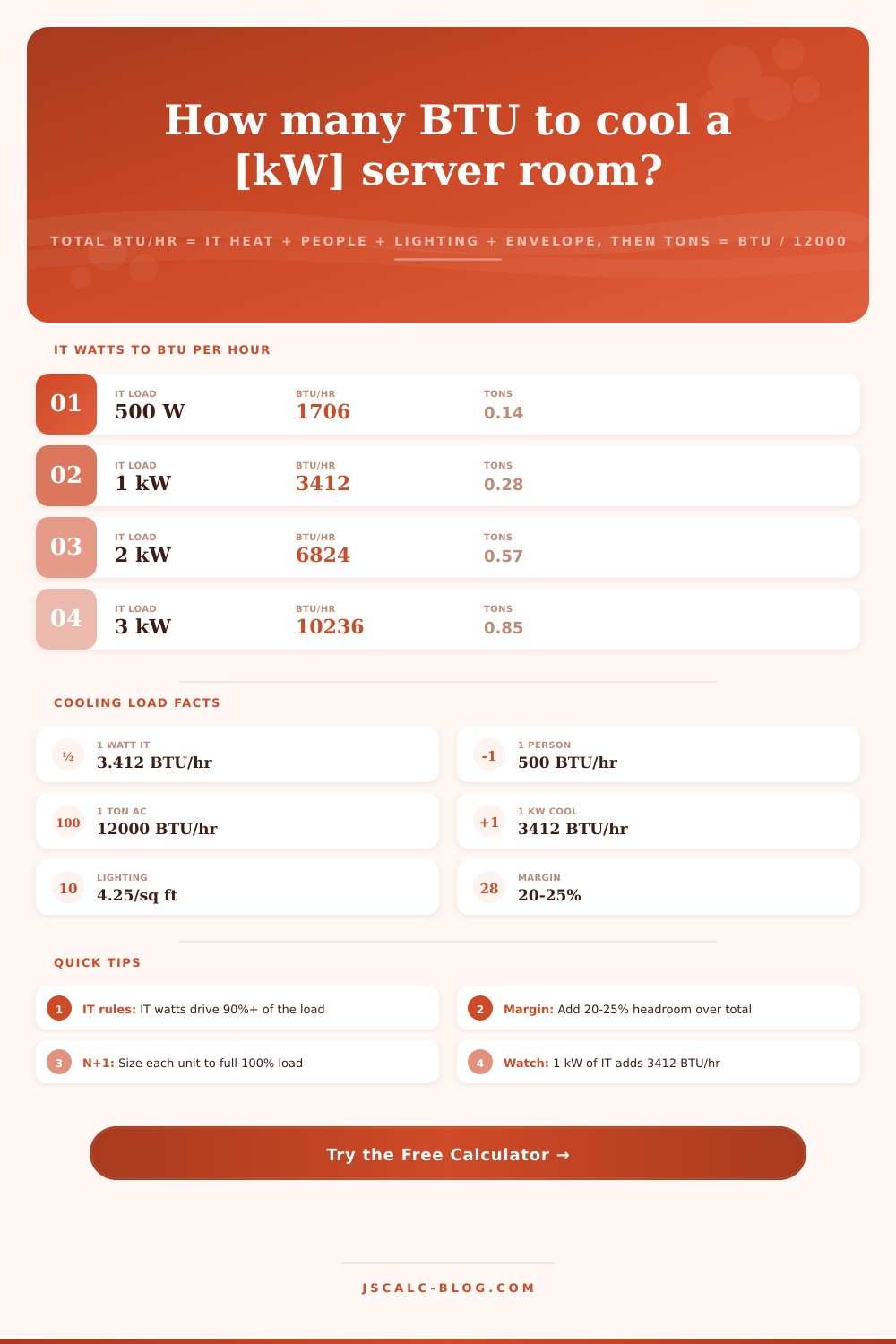
| 0.5 kW | 500 W | 1,706 | 0.14 |
| 1 kW | 1,000 W | 3,412 | 0.28 |
| 2 kW | 2,000 W | 6,824 | 0.57 |
| 3 kW | 3,000 W | 10,236 | 0.85 |
| 5 kW | 5,000 W | 17,060 | 1.42 |
| 8 kW | 8,000 W | 27,296 | 2.27 |
| 10 kW | 10,000 W | 34,120 | 2.84 |
| 20 kW | 20,000 W | 68,240 | 5.69 |
📊Tonnage Reference Table
| Tons | BTU/hr | Cooling kW | Rough IT Load Covered |
|---|---|---|---|
| 0.5 ton | 6,000 | 1.76 | Up to 1.5 kW IT |
| 1 ton | 12,000 | 3.52 | Up to 3 kW IT |
| 1.5 ton | 18,000 | 5.28 | Up to 5 kW IT |
| 2 ton | 24,000 | 7.03 | Up to 6.5 kW IT |
| 3 ton | 36,000 | 10.55 | Up to 10 kW IT |
| 5 ton | 60,000 | 17.58 | Up to 16 kW IT |
| 10 ton | 120,000 | 35.17 | Up to 33 kW IT |
🔥Heat Source Contribution
| Heat Source | Rule of Thumb | Example Input | BTU/hr Added |
|---|---|---|---|
| IT equipment | watts x 3.412 | 5,000 W | 17,060 |
| People | 500 per person | 2 people | 1,000 |
| Lighting (rule) | 4.25 per sq ft | 200 sq ft | 850 |
| Lighting (watts) | watts x 3.412 | 300 W | 1,024 |
| Envelope average | 20 per sq ft | 200 sq ft | 4,000 |
| Envelope exterior | 30 per sq ft | 200 sq ft | 6,000 |
| Envelope poor | 40 per sq ft | 200 sq ft | 8,000 |
🗃Typical Room Cooling Comparison Grid
| Room Type | IT Load | Area | People | Total BTU/hr | Tons | AC + 20% |
|---|---|---|---|---|---|---|
| Wiring closet | 1 kW | 60 sq ft | 0 | 4,867 | 0.41 | 5,840 |
| Office IDF cabinet | 2 kW | 80 sq ft | 0 | 8,564 | 0.71 | 10,277 |
| Branch server room | 3 kW | 120 sq ft | 1 | 13,146 | 1.10 | 15,776 |
| Single rack | 5 kW | 150 sq ft | 1 | 20,748 | 1.73 | 24,898 |
| Comms room | 8 kW | 200 sq ft | 1 | 32,868 | 2.74 | 39,442 |
| 10-rack room | 15 kW | 400 sq ft | 2 | 61,880 | 5.16 | 74,256 |
| Edge micro DC | 20 kW | 500 sq ft | 2 | 81,865 | 6.82 | 98,238 |
| Server hall | 30 kW | 800 sq ft | 3 | 122,760 | 10.23 | 147,312 |
⚙Formula Breakdown
💡Server Room Cooling Tips
The server room is a hostile place for computers. It’s not only hot, it’s aggressively full off heat. Each watt of electricity flow into a rack containing storage arrays, switches, and server arrays. This energy also exits in form of heat. When this heat exceeds what the cooling systems can handle, the temperature rise until servers either throttle down their own performance, trip over their thermal protections or die outright. That’s why facility managers is looking at power usage effectiveness numbers late at night. They’re trying to do one thing, but it’s very unforgiving.
They want to cool the space faster then the heat builds up inside. To do that, you need to know exactly how many BTUs of heat are being generated by the space each hour. This allows you to pair it with an air conditioning unit capable of pulling those BTUs out each hour. The British Thermal Unit (BTU) measures energy transfer. Air conditioners is rated by how many BTUs they remove from the air per hour, because that’s what cooling is: constantly taking away heat.
How to Choose the Right Air Conditioner for Your Server Room
The goal is to size your AC to remove as much heat as your room creates. If you get this correct, the room will have a constant temperature near seventy degrees. If you undersize it, the room becomes a bake oven. If you oversize it dramatically, the AC controls the humidity poorly. It also short cycles, which waste energy and causes it to run too frequent. You want to hit the sweet spot, one where the compressor cycle on frequently enough to keep things comfy, but stays on long enough to remove the humidity.
The biggest factor by far is the IT load. Power used by computing gear is converted into heat within the room almost completely, following the law of conservation of energy. It’s a perfect conversion; every watt consumed becomes three point four twelve BTUs per hour. A rack consuming five kilowatts convert to seventeen thousand six hundred BTUs per hour into the air. Typically in a sealed server room the IT heat represent eighty-five to ninety-five percent of total load. This is why it matters so much to measure real power draw at the PDU rather than nameplate ratings (which are typically twice what you’re really using, leading to over-sized units that don’t run long enough to dehumidify the air).
These three account for the rest. Body heat is approximately five hundred BTUs per hour per person. A tech in the same room contribute a minor but real amount. Electricity turns into heat whenever it powers something, including lighting and IT gear. About four point two five BTUs per hour per square foot is a reasonable guess to use as a rule of thumb if you don’t have the actual watts on your fixtures. Lastly, some of the heat leaks in from outdoors and is absorbed by building envelope. The calculator scales this by floor area and an insulation quality factor. A super-insulated room inside would contribute maybe ten BTUs per square foot; a poorly insulated sunny room could be closer to forty.
The sum of the four is your total heat load. To get it into the language that equipment is sold in there are two more conversions. Divide the total by twelve thousand and we has our tons of cooling. Why? Because a ton of refrigeration remove that many BTUs of heat from the air per hour. Divide the total by three thousand four hundred twelve and we have our kilowatts of cooling. Thus a thirty-four thousand BTU room would require about two point eight tons of cooling. These is shown side by side so you can speak with your HVAC vendor in their preferred units.
The other problem with sizing equipment exactly as needed (the way they are designed) is that heat spikes in the outdoors and equipment loads grows. It’s always best to size a system by adding a safety margin, usually twenty or twenty-five percent above the total. You should of accounted for this. If it can’t go down, then redundancy is even more important. That means installing a spare unit (called an N-plus-one design). In this setup, all the units shares the entire load, but if one goes out, there are still enough to cover it all. The key point is that each unit has to be sized at one hundred percent of the load, not half. Two thirty-thousand BTU units is required for a thirty-thousand BTU room.
It has presets for common situations, ranging from a thirty-kilowatt server hall to a small wiring closet. Drop it into one, tweak the inputs to suit your actual situation, then let it do the math. Seconds later, you’ve got a defensible number instead of a nervous guess. Planning is better than panic every time, and heat doesn’t stop at the door. The process feel naturaly easy once you get it. It makes everything more comfortabley.