Encryption Key Bit Strength Calculator
Convert any AES, 3DES, RSA, Diffie-Hellman, DSA, or elliptic-curve key size into one common symmetric security level using the NIST SP 800-57 equivalence tables, then see the work factor, an estimated time to break at your chosen attack rate, and the standards classification.
🔑Real Algorithm Presets
📝Key and Attack Inputs
Selects which NIST equivalence rule is applied.
Options change to match the selected algorithm family.
Break attempts tested per second across all attack hardware.
Grover roughly halves symmetric security; Shor collapses RSA and ECC.
Optional. Finds the minimum key size for this level in the current family.
How the estimated break time is shown on the card.
🔢Equivalence Snapshot
📋NIST SP 800-57 Equivalence Table
| Security Level | Symmetric (AES) | RSA / DH / DSA Modulus | ECC Field Size | Status |
|---|---|---|---|---|
| 80-bit | SKIPJACK / 80 | 1024-bit | 160-bit | Disallowed |
| 112-bit | 3DES / 112 | 2048-bit | 224-bit | Legacy to 2030 |
| 128-bit | AES-128 | 3072-bit | 256-bit | Acceptable |
| 192-bit | AES-192 | 7680-bit | 384-bit | Acceptable |
| 256-bit | AES-256 | 15360-bit | 512 to 521-bit | Acceptable |
📊Common Algorithm Configurations
| Algorithm | Key Size | Security Level | Typical Use |
|---|---|---|---|
| AES-128 | 128-bit | 128-bit | TLS, disk encryption |
| AES-256 | 256-bit | 256-bit | Top secret, VPN |
| 3DES | 112-bit effective | 112-bit | Legacy payments |
| RSA-2048 | 2048-bit | 112-bit | Certificates, PKI |
| RSA-3072 | 3072-bit | 128-bit | Long-term signing |
| RSA-4096 | 4096-bit | ~140-bit | Root CAs |
| ECDSA P-256 | 256-bit | 128-bit | TLS, mobile, JWT |
| ECDSA P-384 | 384-bit | 192-bit | CNSA suite B |
| ECDSA P-521 | 521-bit | 256-bit | High assurance |
⏳Time to Break by Attack Rate
| Security Level | Work Factor | At 1e12 ops/s | At 1e15 ops/s | At 1e18 ops/s | At 1e21 ops/s |
|---|---|---|---|---|---|
| 64-bit | 2^64 | ~213 days | ~5 hours | ~18 sec | < 1 sec |
| 80-bit | 2^80 | ~38K years | ~38 years | ~14 days | ~20 min |
| 112-bit | 2^112 | 1.6e14 yr | 1.6e11 yr | 1.6e8 yr | 1.6e5 yr |
| 128-bit | 2^128 | 1.1e19 yr | 1.1e16 yr | 1.1e13 yr | 1.1e10 yr |
| 192-bit | 2^192 | 2.0e38 yr | 2.0e35 yr | 2.0e32 yr | 2.0e29 yr |
| 256-bit | 2^256 | 3.7e57 yr | 3.7e54 yr | 3.7e51 yr | 3.7e48 yr |
🔒Security Level Classification
| Level | NIST Verdict | Horizon | Guidance |
|---|---|---|---|
| < 80-bit | Broken | Now | Never deploy |
| 80-bit | Disallowed | Past 2013 | Retire immediately |
| 112-bit | Acceptable | Through 2030 | Migrate soon |
| 128-bit | Recommended | Beyond 2030 | Modern baseline |
| 192-bit | Strong | Long-term | High assurance |
| 256-bit | Maximum | Long-term | Top secret data |
⚙Formula Breakdown
💡Key Selection Tips
Use the Encryption Key Bit Strength Calculator to compare your crypto keys and see what all those bits mean. Sometimes when looking at a configuration sheet you may find yourself wondering: “How does an AES key with 128 bits compare to an elliptic-curve key with 256 bits? How about one with 2048 bits like that other kind of RSA key?” Those digits dont even look similar. So which is strongest? And why is that?
This is because different mathematics protect symmetric ciphers, integer-factoring systems, and elliptic curves. Elliptic curves use a different sort of math than symmetric ciphers and integer-factoring systems (and only within their own families of algorithms does key size matter). This tool will convert each key into one common standard based off a symmetric security level as defined in NIST Special Publication 800-57. Now you’ll be able to make an informed choice instead of just guessing between them and know exactly what you’re getting.
How to Compare Different Crypto Key Strengths
For symmetric ciphers such as AES, there’s no shortcut attack that’s better then simply trying all the keys. The security level of a symmetric cipher depend directly on its key length. An AES-128 cipher is therefore delivering 128 bits of security.
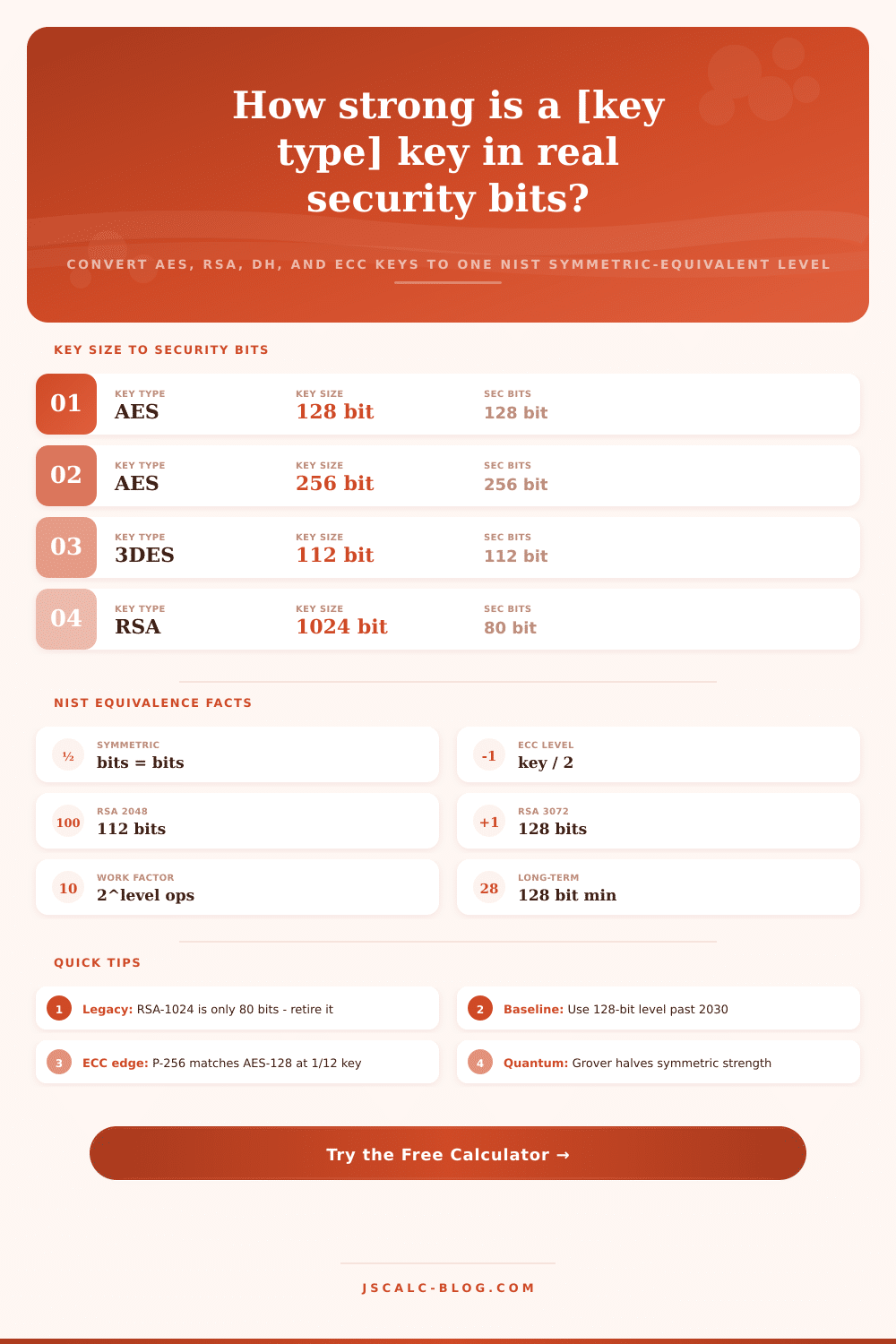
With public-key systems, it’s different. Systems such as RSA rely on the hardness of factoring large numbers, while Diffie-Hellman can also be implemented using elliptic curves. Solving this problem cannot be done in polynomial time; the current best-known attacks are sub-exponential. That means their effective strength rise far more slowly than the size of their key. A 2048-bit RSA key thus offers only around 112 bits of actual security instead of 2048.
Elliptic curves sits somewhere in-between. The best known attacks require approximately the square root of the key space. An elliptic-curve key therefore achieves half its bit length in security. A 256-bit curve yields 128 bits. It doesn’t make sense to compare raw key lengths between members of these families, which is precisely why this calculator normalizes the data.
Once you understand these rules, it’s easy to use. Symmetric keys has a level equal to their key length (e.g. 256 bits). Elliptic curve keys have a level equal to half of the field size (e.g. 256-bit field = level 128). RSA and Diffie-Hellman keys have NIST-mandated conversions between modulus size and security level. This is based off an estimate of how expensive it would be to run complex factoring algorithms. The calculator looks this up for you. There is no need to remember the table. It uses interpolation with anchor points for in-betweens, giving all your weirdly-sized key a fair shake.
The tool then converts the work factor into a number like this: It’s two raised to the effective security level. If the effective security level is 128 bits, it tells you that an attacker would need about 3.4 times ten to the 38th guess on average. To ground that number further, it divides it by your selected attacker operation rate. Do you want to represent one CPU core? Or do you want to imagine a nation-state operating at exabyte scale? It shows the number in human-readable form. For instance, even for huge attack rates, a 128-bit level would require trillions of years.
So 128 bits is thought to be a solid long-term floor for most types of data. But that’s just numbers. Is it OK? To put that into perspective, the verdict from NIST comes on the fourth result card. You’ll want more than 80 bits because anything less is broken and shouldn’t be used under any circumstance. Anything in the 80-bit range (which would include 1024-bit RSA) has been off-limits since 2013, so get rid of it now. Next up, the 112-bit tier, covering 2048-bit RSA and 3DES, is acceptable only through 2030. From 128 bits upward you are in recommended, long-term territory. That ranking turns an abstract bit count into a clear deploy, migrate, or retire decision.
It’s got some handy practical applications too. In a real system you can spot when the key strengths dont match. If you’re using an RSA-2048 handshake to protect an AES-256 session then the entire exchange will be no stronger than 112 bits (the RSA key is the weakest link). The optional target-level input lets you reverse the math for planning purposes. Choose the level of security you want to achieve, and it’ll tell you what minimum key sizes in each family you’ll need. That shows why everyone moved away from RSA: matching AES-256 would require an absurdly large 15360-bit modulus. Knowing these equivalences helps you come up with standards-based, defensible numbers in seconds whether you’re writing a compliance policy or hardening your own TLS.
You should of checked the math earlier to be safe. It could of helped too. All that moddern technology requires careful attention. It is naturaly easy to miss something if you are not looking closeley at the details. Making sure your security level is luxurius and strong is actualy important for any system.