Mortgage Total Interest Calculator
See the true lifetime cost of a fixed-rate mortgage. Enter the home price, down payment, term, and APR to get your monthly principal and interest payment, the total interest paid over the whole loan, the total of all payments, and how many dollars of interest you pay for every dollar borrowed.
🎯Real Loan Scenario Presets
📝Loan Details
A name for this loan, shown in results and print.
Purchase price or appraised value of the property.
Choose how you want to enter the down payment.
Amount in dollars, or a percent if that mode is chosen.
Length of the mortgage, typically 15, 20, or 30 years.
The fixed annual percentage rate on the loan.
Used only to estimate the final payoff month.
Controls decimals on the result cards.
🔢Formula Snapshot
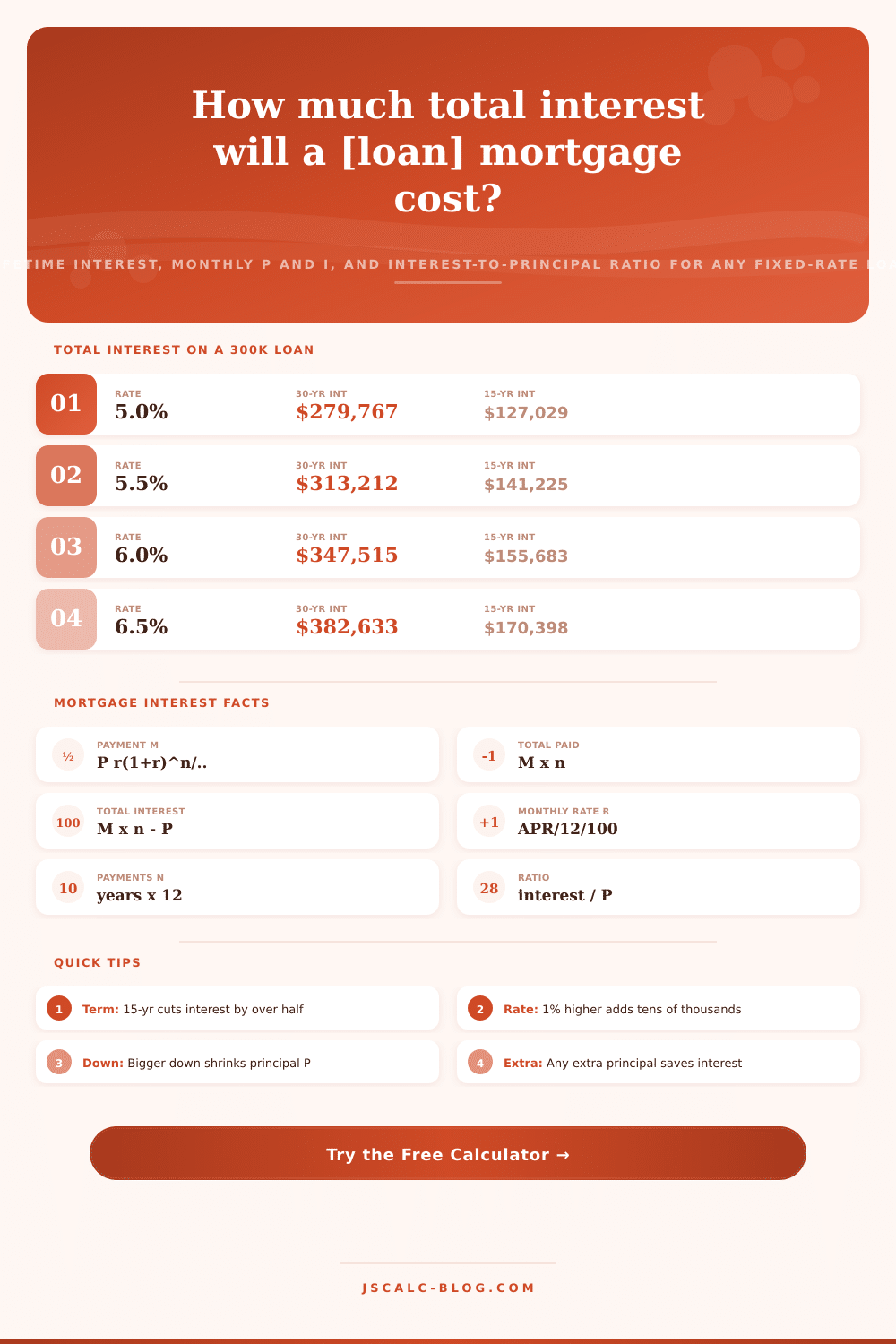
📊Total Interest by Rate on a $300,000 Loan
| APR | 30-yr Payment | 30-yr Total Interest | 15-yr Payment | 15-yr Total Interest | 30-yr Ratio |
|---|---|---|---|---|---|
| 5.0% | $1,610 | $279,767 | $2,372 | $127,029 | 0.93x |
| 5.5% | $1,703 | $313,212 | $2,451 | $141,225 | 1.04x |
| 6.0% | $1,799 | $347,515 | $2,532 | $155,683 | 1.16x |
| 6.5% | $1,896 | $382,633 | $2,613 | $170,398 | 1.28x |
| 7.0% | $1,996 | $418,527 | $2,696 | $185,367 | 1.40x |
| 7.5% | $2,098 | $455,152 | $2,781 | $200,587 | 1.52x |
| 8.0% | $2,201 | $492,466 | $2,867 | $216,052 | 1.64x |
📅How Term Length Changes Interest ($300k at 6.5%)
| Term | Monthly Payment | Total Interest | Total Paid | Interest Ratio |
|---|---|---|---|---|
| 10 years | $3,406 | $108,773 | $408,773 | 0.36x |
| 15 years | $2,613 | $170,398 | $470,398 | 0.57x |
| 20 years | $2,237 | $236,813 | $536,813 | 0.79x |
| 25 years | $2,026 | $307,686 | $607,686 | 1.03x |
| 30 years | $1,896 | $382,633 | $682,633 | 1.28x |
💰Total Interest by Loan Size (30-yr at 7%)
| Loan Principal | Monthly Payment | Total Interest | Total Paid |
|---|---|---|---|
| $150,000 | $998 | $209,263 | $359,263 |
| $200,000 | $1,331 | $279,018 | $479,018 |
| $300,000 | $1,996 | $418,527 | $718,527 |
| $400,000 | $2,661 | $558,036 | $958,036 |
| $600,000 | $3,992 | $837,053 | $1,437,053 |
| $800,000 | $5,322 | $1,116,071 | $1,916,071 |
📋Down Payment Effect on a $400,000 Home at 7% for 30 Years
| Down Payment | Loan Principal P | Monthly Payment | Total Interest |
|---|---|---|---|
| 3.5% ($14,000) | $386,000 | $2,568 | $538,505 |
| 5% ($20,000) | $380,000 | $2,528 | $530,134 |
| 10% ($40,000) | $360,000 | $2,395 | $502,232 |
| 20% ($80,000) | $320,000 | $2,129 | $446,428 |
| 25% ($100,000) | $300,000 | $1,996 | $418,527 |
| 30% ($120,000) | $280,000 | $1,863 | $390,625 |
⚙Formula Breakdown
💡Cut Your Lifetime Interest
It seems like a doable number. Your lender approves it because it works. It also fit into your budget. But what the monthly payment doesn’t show is full cost of borrowing that money. In fact, the interest part of your mortgage could end up equaling (or even surpassing) the amount you borrow.
That’s what the mortgage calculator on this page illustrate. You plug in the purchase price of the home, the down payment, the length of the loan (known as the “term”), and the annual percentage rate (“APR”). Then the calculator spits out four numbers that explain real cost: the monthly principal + interest payment, total interest you’ll pay throughout the loan, the grand total of every payment, and how much is paid in interest compared to principal.
The Real Cost of Your Mortgage
Principal. A fixed-rate mortgage shrink the balance at a known rate. Every payment consists of two parts: one part pays down principal, while the other part covers the interest charge. When you first borrow money, the bank figures out the interest charge based off the full initial loan amount, which means that it get most of your money in those early years. Later on, as the term nears its end, it flips and most of each payment are applied to principal. The total interest equals the sum of all of these interest parts throughout the life of the schedule.
No need for a spreadsheet to compute this figure. Here’s a simple formula: Multiply the monthly payment (M) by the number of payments (n). That shows how much money will leave your bank account over the life of the loan. Next, subtract the principal P (the original amount you borrowed). The difference equals interest paid during your lifetime. That subtraction shows a complicated cost expressed in simple arithmetic.
To arrive at its figures, the calculator assumes that amortization conforms to common methods. First, compute the principal borrowed (the home purchase price less your down payment). Convert the annual interest rate into a decimal (divide the APR by 100; divide again by 12 to get a monthly rate). The total number of payments n is twelve times the length of the loan, in years. Then it calculates the monthly payment using a formula involving powers of one plus r. When the interest rate is zero, this reduces to plain old division, since you’ll just be paying back principal in each installment.
Imagine that you buy a house for two hundred fifty thousand dollars and put down twenty five thousand dollars. You take out a mortgage on the remaining two hundred twenty five thousand dollars over thirty years at a six point five percent annual rate. That gives us following parameters: n = three hundred sixty (total number of payments) r ≈ zero point zero zero five four one six seven (monthly rate) Plug those into our equation, and we find that your monthly payment will be approximately one thousand four hundred twenty two dollars.
Multiply that by three hundred sixty months, and you have spent nearly half a million dollars. Subtract the principal of two hundred twenty five thousand dollars, and you’ve paid two hundred eighty seven thousand dollars in interest over your lifetime. This gives you a ratio of one point two eight between interest and principal. In other words, you’re paying more than a dollar of interest for each dollar you borrow.
Here’s how it breaks down, and the tool explains it well:
• This is the total amount you’ll be paying each month.
• That’s the total amount of interest you’ll be paying. It’s the main part of this calculation.
• This is the sum of #1 and #2. This tells you exactly how much money will flow out of your pocket over time.
• This is a ratio of the interest to your original principal. You can use this to compare loans of different sizes fairly.
If your ratio is below one point zero, you are borrowing money with a short enough term that you repay less interest than you received. Short-term loans typically have this kind of ratio. If your ratio is greater than one point zero, you’re borrowing money with such a long term or high-interest rate that you repay more interest than you receive. (This is true of most 30-year mortgage products at higher rates.)
That’s it! These are sensitive numbers (see reference tables on page). They also show how small adjustments makes such a big difference. For example, if you borrow three hundred thousand dollars over thirty years at six point five percent, you’ll pay about three hundred eighty three thousand dollars of interest. But if you take out the exact same loan for fifteen years instead, you’ll end up paying about a third less: just one hundred seventy thousand dollars, or less than half the amount.
The other critical variable is the interest rate. On a $300,000 loan, adding each half-percentage-point to the rate adds approximately another thirty-five thousand dollars in interest, all else being equal. These variables compound. Small tweaks on both sides have huge implications. Reducing your principal by making a bigger down payment will save you money on each subsequent interest payment. And a lower principal translates into less interest paid on every single future mortgage payment.
For instance, if you raise your down payment from five percent to twenty percent on a four-hundred-thousand-dollar house, you could of shaved tens of thousands off the grand total. You’ll find 10 realistic preset scenarios that let you play with typical situations in a hurry, everything from FHA to jumbo loans to a starter home. Run ’em through to understand how different rates, terms and loan sizes work together … without doing the math yourself.
The calculator also shows you in cold hard dollars what it will actualy cost to take on debt over time. That’s the abstract concept of “lifetime interest.” Now it’s tangible. What’s more: It doesn’t just spit out your monthly payment capacity. It spits out your life-of-the-loan capacity.
Does the total amount of interest help you decide if it’s worth taking on a lower mortgage? Or do you want to know whether it’s better to shave years off and save some serious money in the process? All this comes down to one number most people never see. When you plug your details into the calculator, you get clarity about that hidden figure.