Mortgage Payoff Date Calculator
Find out exactly when your mortgage will be paid off. Enter your current outstanding balance, annual interest rate, and monthly principal and interest payment to solve for the number of months remaining, your payoff calendar date, and the interest still to pay. Add an optional extra monthly payment or a one-time lump sum to see how much sooner you finish.
🎯Real Mid-Loan Scenarios
📝Your Loan Details
The principal you still owe today, not the original loan amount.
Your note rate as a yearly percentage, for example 6.5.
Principal and interest only. Exclude taxes, insurance, and escrow.
The month of your next scheduled payment (as-of date).
The year your payoff clock begins.
Added to every payment. Set 0 to ignore. Shows the sooner date.
Applied to principal immediately and subtracted from the balance.
Controls how dollar amounts display on the result cards.
🔢Formula Snapshot
⚙Formula Breakdown
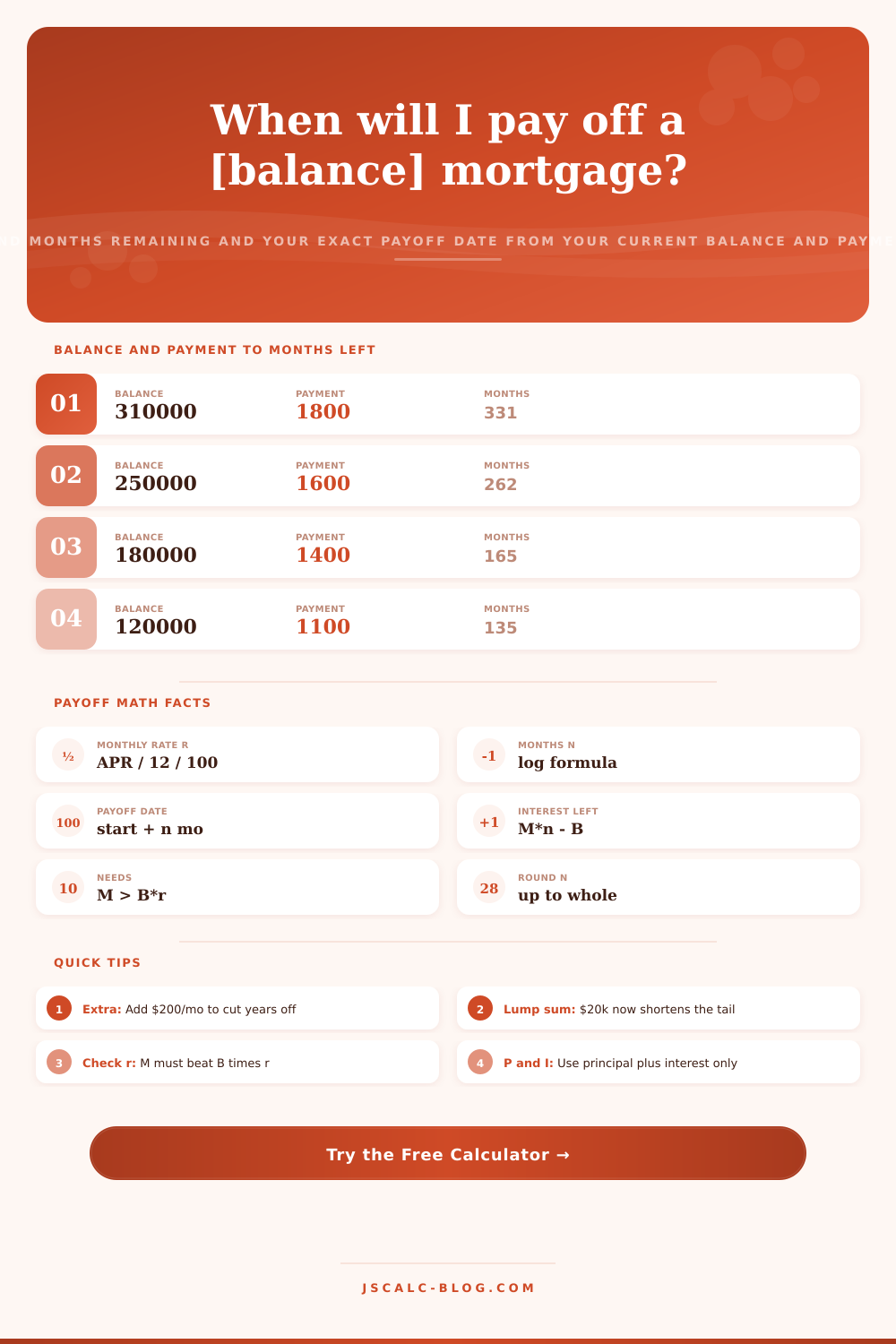
📋Balance and Payment to Months Remaining
| Balance Left | APR | Monthly P and I | Months Left | Years and Months |
|---|---|---|---|---|
| $310,000 | 6.5% | $1,800 | 331 | 27y 7m |
| $250,000 | 6.0% | $1,600 | 262 | 21y 10m |
| $180,000 | 5.5% | $1,400 | 165 | 13y 9m |
| $120,000 | 6.0% | $1,100 | 135 | 11y 3m |
| $90,000 | 5.0% | $950 | 110 | 9y 2m |
| $60,000 | 6.5% | $750 | 94 | 7y 10m |
| $45,000 | 4.5% | $900 | 53 | 4y 5m |
| $30,000 | 5.5% | $800 | 39 | 3y 3m |
💸Extra Payment Impact ($250k at 6% APR)
| Extra per Month | New Payment | Months Left | Time Saved | Interest Left |
|---|---|---|---|---|
| $0 | $1,600 | 262 | none | $169,200 |
| $100 | $1,700 | 236 | 26 months | $151,200 |
| $200 | $1,800 | 215 | 47 months | $137,000 |
| $300 | $1,900 | 198 | 64 months | $126,200 |
| $500 | $2,100 | 172 | 90 months | $111,200 |
| $750 | $2,350 | 149 | 113 months | $100,150 |
| $1,000 | $2,600 | 131 | 131 months | $90,600 |
💵Lump Sum Applied Now ($180k at 5.5%, $1,400/mo)
| Lump Sum | New Balance | Months Left | Time Saved | Interest Left |
|---|---|---|---|---|
| $0 | $180,000 | 165 | none | $51,000 |
| $5,000 | $175,000 | 158 | 7 months | $46,200 |
| $10,000 | $170,000 | 151 | 14 months | $41,400 |
| $20,000 | $160,000 | 137 | 28 months | $31,800 |
| $30,000 | $150,000 | 124 | 41 months | $23,600 |
| $50,000 | $130,000 | 98 | 67 months | $7,200 |
🗃Payoff Timeline Comparison Grid
| Balance | APR | Payment | Extra/Mo | Months Left | Years Left | Interest Left |
|---|---|---|---|---|---|---|
| $310,000 | 6.5% | $1,800 | $0 | 331 | 27y 7m | $285,800 |
| $310,000 | 6.5% | $1,800 | $200 | 247 | 20y 7m | $183,000 |
| $280,000 | 6.0% | $1,750 | $0 | 274 | 22y 10m | $199,500 |
| $250,000 | 6.0% | $1,600 | $0 | 262 | 21y 10m | $169,200 |
| $220,000 | 7.0% | $1,650 | $0 | 253 | 21y 1m | $197,450 |
| $150,000 | 5.75% | $1,250 | $0 | 181 | 15y 1m | $76,250 |
| $95,000 | 4.25% | $1,100 | $0 | 96 | 8y 0m | $10,600 |
| $45,000 | 4.5% | $900 | $0 | 53 | 4y 5m | $2,700 |
| $30,000 | 5.5% | $800 | $0 | 39 | 3y 3m | $1,200 |
| $30,000 | 5.5% | $1,050 | $0 | 29 | 2y 5m | $450 |
💡Payoff Strategy Tips
How long until my mortgage is paid off? When’s it going to be over? This is the question all homeowners ask themselves at some point. Your amortization schedule (and your lender statement) tells you how much you owe now. But not exacty when it’ll be zero.
This tool solves directly for the number of months left; you type in amount currently owed, your annual interest rate, and your monthly principal + interest payment, and it calculates the remainder for you. From there, it displays how much additional interest you’ll pay before the debt vanishes… And translates that into an exact month and year that you’ll reach your payoff goal.
How This Mortgage Calculator Works
It’s a simple twist of perspective. Turning abstract numbers into a concrete deadline. So, what does this mean? Why might the payoff date differ from what was on your initial loan estimate? The reason why: At the time you took out your mortgage, estimates were made over its original term. Except that’s not always how it goes; life occurs. Maybe you’ve paid off some extra money, refinanced, or forgotten about it entirey because of years of auto-drafts.
Today’s question isn’t “What was your balance when you signed your loan years ago?” It’s, “What do you owe today?” And so the calculator begins with your present balance, treats that as your actual principal, then calculates from there to your upcoming payment. This answer is correct whether you’re a borrower on day one or somewhere midway through your loan. It ignores everything that came before, and zeroes in on nothing but the future.
The hidden part of the math is that it turns the amortization equation on its head. A traditional mortgage calc take the term and balance as input and calculates the payment. What this calc does is take the payment and balance as input and calculate the term. To do so, it uses natural logarithms. A loan balance reduces in a compounding manner. Logarithms are the only function that reverses this type of curve. They are a beautiful application of algebra to account for interest’s non-linearity.
Then, since the last partial payment still consumes an entire billing cycle, we round up to the next full month. Even if you only use a fraction of a payment, you still pay for that time. The only hard rule the tool applies is this: The first month’s interest cannot be greater than amount of your monthly payment. If so, then all your payments goes toward interest and the balance doesn’t drop.
On a loan with a 250,000 dollar balance at 6 percent, the initial month’s interest is roughly 1,250 dollars. So any payment in excess of that will pay down the loan. If a payment doesn’t cover that interest, the calculator calls out the shortfall, letting you know you’re not on track. It protects you from running after a finish line that keeps getting farther away from you, which is what happens if your payments don’t exceed the accrued interest.
Taken together, these four cards paint a clear portrait of what you still owe. The first indicates how many more payments are left. The next one adds that number of months to your current month, turning the count into an actual payoff date. The next card shows the time in years and months instead of just a number like 331. Finally, the last card tells you how much more interest you’ll pay if you carry this thing to term. The real cost of borrowing money.
The single best tool for a homeowner’s belt: Test the power of an extra monthly payment The optional extra monthly field can add any number of dollars to each payment. It then re-runs the calculation from scratch with a new payoff. In this example, we start with a 310,000 dollar mortgage at 6.5 percent, paid down at 1,800 per month. Adding only 200 dollars per month advances the payoff date about seven years (saving close to 100),000 dollars in interest.
Why? Because extra dollars reduces your principal immediately, so there’s less principal to compound into next month’s interest. A tiny tweak, but huge results. A lump sum is applied once and targets the principal immediately. If you recieve a windfall; like a tax refund or bonus, you can bend the timeline with one shot.
The calculator subtracts this from your balance before running the formula. So if your balance is 180k and you apply a 20k lump, it displays how much shorter the payoff becomes. Since lumps are applied up front when interest rates is highest, they have an outsized effect. Applying a lump to a loan pulls the finish line in by over two years for a 180k balance. This skips the month-by-month slog toward amortizing your debt. It’s effective debt-reduction.
It has built-in models of situations that real borrowers face: near-finished balances; five years into a thirty-year loan, etc. It populates the form and spits out an answer in seconds. This provides a reasonable place to start tweaking, with a starting point that is realistic. The reference tables take it further, with lookups for lump-sum effects and extra-payment impacts. From there, it lets you line up scenarios against each other, to see which trades money for time. In short, it makes guesswork into something you can shop around for yourself.
Transforming debt from an unclear concept into a tangible target makes it more manageable by adding a hard date to work towards. This calculator uses your starting balance and payment amount to solve the log-based payoff equation. It instantly shows how much further ahead you’ll get each time you make an additional payment. It also provides a specific calendar date so you have something tangible to shoot toward.
Enter some presets, add in your actual numbers and play around with making additional payments until you find one you can stick to. Got a big goal like retiring without a mortgage? Or maybe you’re just curious when you’ll be done paying? Now you’ve got a number to work toward and the finish line comes into view. Half the battle is won once you see where you’re going.