Land Loan Payment Calculator
Estimate a land loan payment with down payment, amortized or interest-only structure, balloon balance, property taxes, annual parcel fees, closing costs, and total interest.
Choose a realistic land purchase scenario, then adjust the numbers to match your quote or term sheet.
Land loan results
This table shows beginning balance, scheduled payment, interest, principal, extra principal, and ending balance for the selected number of payments.
| Payment | Beginning Balance | Scheduled Payment | Interest | Principal | Extra Principal | Ending Balance |
|---|
| Line item | Formula | Per payment | Annualized | Modeled total |
|---|
| Land use | Typical down | Common term | Payment style | What to stress test |
|---|---|---|---|---|
| Build-ready lot | 15% to 25% | 10 to 20 years | Amortized | Construction start date and tax change |
| Rural homesite | 20% to 30% | 10 to 20 years | Amortized or balloon | Well, septic, road, and utility access |
| Farm tract | 20% to 35% | 15 to 25 years | Amortized | Seasonal income and insurance needs |
| Hunting acreage | 25% to 40% | 7 to 15 years | Amortized or balloon | Lease income and road maintenance |
| Raw unimproved land | 30% to 50% | 5 to 15 years | Balloon common | Exit financing and entitlement timing |
| Timber parcel | 25% to 40% | 10 to 20 years | Amortized | Harvest timing and property taxes |
| Step | Formula | Used for | Calculator detail |
|---|---|---|---|
| Principal | Price - down payment | Starting loan balance | Down can be percent or dollar amount. |
| Periodic rate | APR / payments per year | Payment and interest | Monthly, quarterly, or annual payments supported. |
| Amortized payment | M=P*r(1+r)^n/((1+r)^n-1) | Principal and interest payment | Uses full amortization term for scheduled payment. |
| Interest-only payment | P * r | Interest-only option | Principal stays level unless extra principal is paid. |
| Balloon balance | Remaining balance after payoff payments | Payoff planning | Computed payment by payment with interest and principal. |
| Total carry | Payment + tax + annual fees | Cash flow estimate | Taxes and fees are spread across the payment frequency. |
Purchasing raw land looks easy enough on paper until you must finance it. If you simply consider the acres instead of interest rate, the math becomes complex. Unlike a mortgage, land loans is not home loans. While you’re paying for the land, it’s not producing any income. In other words, you have an asset that cost you money. Renting out a property, on the other hand, pay for itself.
So, getting the numbers correct is tricky. One minor mistake with term length or down payment could transform a reasonable monthly bill into a financial anchor that sucks your savings dry.
How to Calculate Land Loan Costs
A quick example: The calculator up top calculates it for you, but here’s how to think about the inputs in real-world terms. First, put in your purchase price and then the parcel size. Divide the second by the first. What do you get? This is the price per acre. This is your starting point of value.
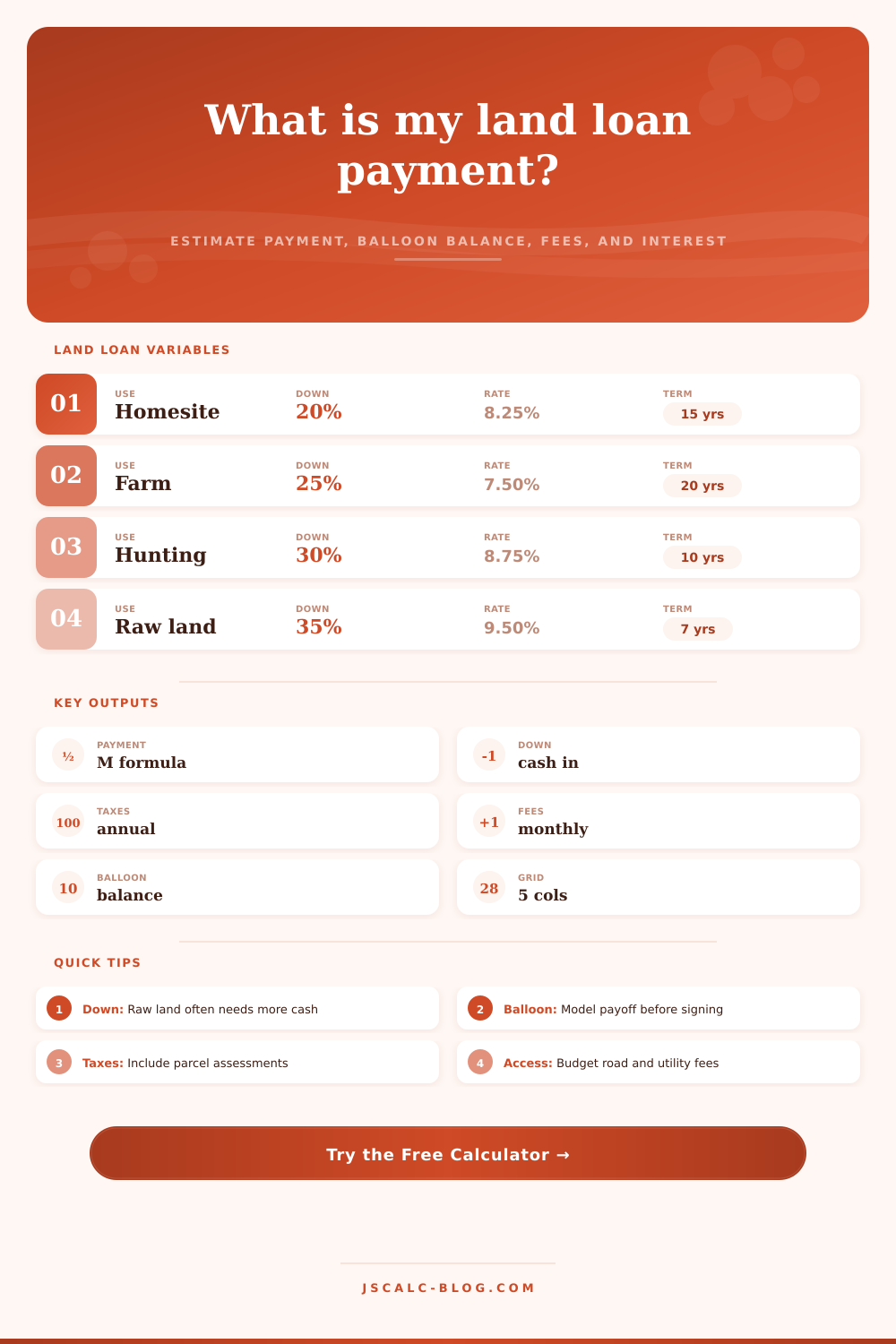
Next, depending on what you’re purchasing (a rural homesite versus raw, unimproved hunting land), you’ll have to come up with 20% or 35% (or more) down payment. Why? Because lenders considers raw land riskier than a home with something to secure the loan. More cash up front. Here’s where many buyers is shocked for the first time.
Next, consider the term and the interest rate. Speculative lots typically comes with a higher rate relative to typical residential mortgages. Eight or nine percent isn’t uncommon.
Your amortization term (i.e., your payment structure) are important, too. If you have a fifteen-year amortization on a loan with a five-year balloon, your monthly payment is reduced but you still owe the remaining principal balance at year five. Interest-only structures start to look appealing here; it reduces your cash flow demands in the near-term, but it doesn’t cut into the principal. In effect, you’re renting the land from the bank at a super-high interest rate, until the balloon payment arrives.
The table below show how these different land uses relate to each other. Property taxes and annual fees are the silent killers of land deals. Yes, there’s an assessment on every parcel, plus dues from each road district or association. Those don’t go away because you’re not building, in fact, those taxes tend to increase when you zone or improve the land. Add these recurring costs into your payment estimate to understand what the carry cost realy is. Too much? It’s no longer an investment; it’s a liability. You’re holding a dirt patch that doesn’t pays you back.
What’s important to stress test is the balloon balance. That’s the lump sum that you’ll owe at the end of the short term. Do you think you can refi at that point? Or do you think you’ll sell the property? Or do you think you’ll put a house on it and turn the land loan into a regular mortgage? If the answer is no to any of these questions, then you’ve got a problem.
The amortization preview shows exactly what percentage of every dollar you pay goes toward principal versus interest. Almost all of your first few payments go towards interest. This isn’t a bad thing, this is normal. But it does mean that you’re building equity extremly slowly. The right tweak of extra principal payments can make all the difference. Chip away at that balloon payment by throwing a few hundred bucks at it per year. That’s a little bit of a habit now, but avoids a big one down the road. This is easy for the calculator, just model in your extra payments and you’ll see how even a small amount tapers off the total payoff.
It is the difference between being able to wait (option) or being forced to sell (no choice). Buying land is a numbers game, a cashflow/ waiting game. It’s a bet on the future, not an investment in current income.
Your numbers needs to check out now, not just in your head. These tools will show you the whole picture before you sign. Do you really want to know how much money you’ll spend before you buy? Do you want to know the total interest, the balloon payment, and the exact carry cost? If you do, then it won’t feel like such a gamble and more like a plan once you’ve got those numbers.
You should of checked them earlier.