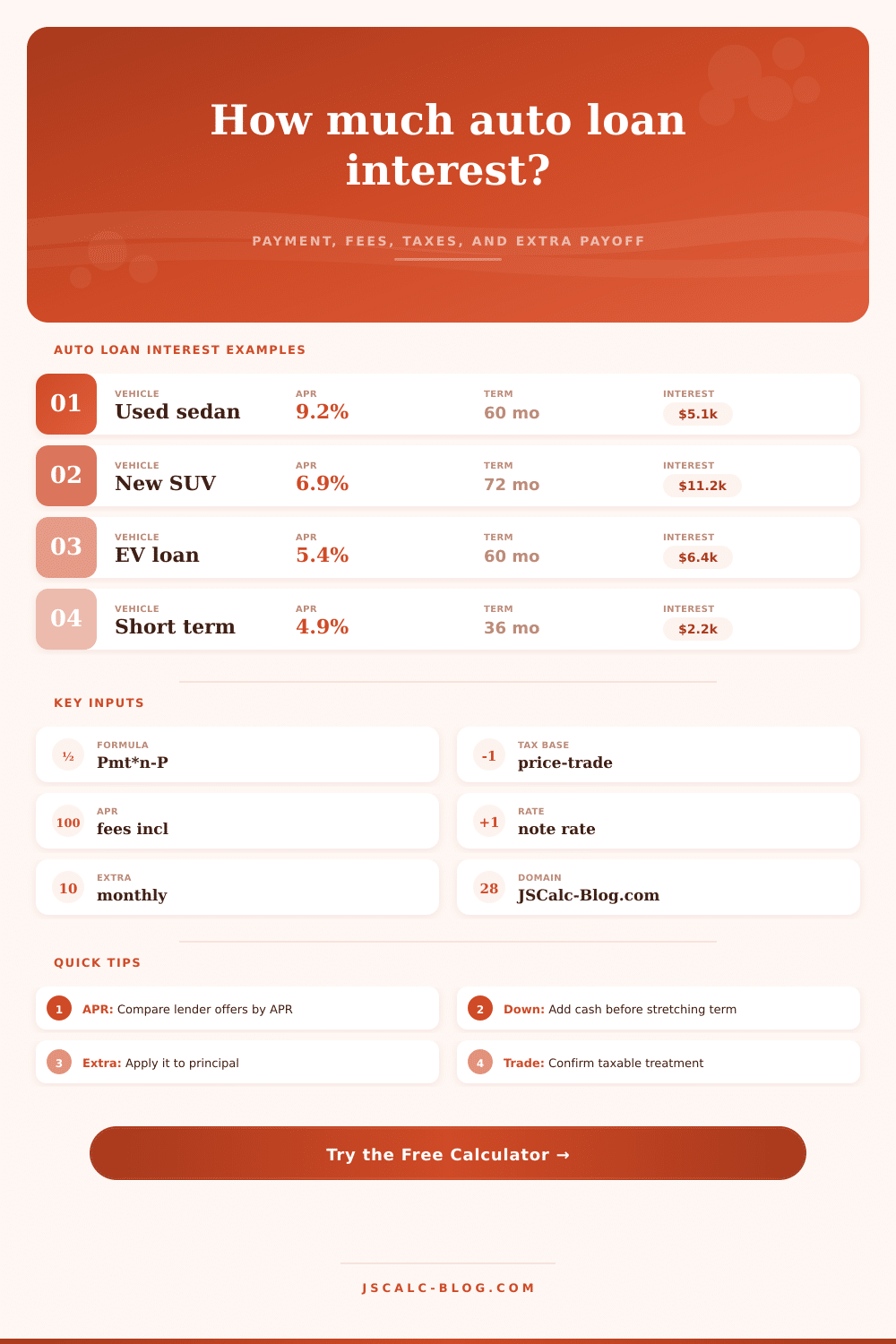
Auto Loan Total Interest Calculator
Estimate the true interest on a car loan after down payment, trade-in, taxes, fees, APR, term length, and an optional extra principal payment.
🚗Choose a loan preset
Each preset loads a realistic car-financing profile. You can change every field afterward.
📝Loan inputs
Agreed selling price before tax, fees, down payment, and trade-in.
If payoff exceeds trade value, the difference is rolled in as negative equity.
Deferred options add estimated pre-amortization interest to principal.
Loan interest estimate
Based on your financed amount, rate, and amortized payment schedule.
📊Five-factor loan grid
Estimated from the selected taxable amount and tax treatment.
Trade value minus payoff; negative equity increases the loan.
Down payment plus rebate applied before the financed balance.
Total interest as a percentage of the amount financed.
Estimated final month count with the extra principal payment.
📅Amortization and scenario tables
The scheduled loan uses the standard amortized payment formula. Total interest equals monthly payment multiplied by number of months, minus principal. The extra-payment schedule then applies the added amount to principal each month.
| Scenario | Principal | Payment | Months | Total interest | Total paid | Interest share |
|---|---|---|---|---|---|---|
| Calculate to compare scheduled and extra-payment payoff. | ||||||
| Checkpoint | Month | Payment | Interest paid | Principal paid | Balance |
|---|---|---|---|---|---|
| Your payoff checkpoints will appear here. | |||||
🚗Common auto loan reference
| Borrower or vehicle profile | Typical term range | Interest pressure | Watch item | Useful comparison |
|---|---|---|---|---|
| New car, strong credit | 36 to 72 months | Lower rate, larger principal | Long terms can hide interest | 36, 48, and 60 months |
| Used car, average credit | 48 to 72 months | Higher APR than new loans | Vehicle age and lender cap | APR against credit union offer |
| Private-party purchase | 36 to 60 months | Often higher lender spread | Tax and registration due date | Dealer loan with same APR basis |
| Negative equity trade | 60 to 84 months | Old loan balance adds interest | Rolled payoff amount | Cash down versus roll-in |
| Low-rate promotion | 36 to 60 months | Low interest, possible rebate tradeoff | APR versus rebate choice | Total paid after lost rebate |
| Large down payment | 36 to 60 months | Lower principal and interest | Liquidity after purchase | Down payment versus extra monthly |
| Line item | Usually financed? | Affects interest? | Calculator treatment | Note |
|---|---|---|---|---|
| Vehicle price | Yes | Yes | Starts principal | Use negotiated selling price |
| Sales tax | Often | Yes if financed | Added to loan balance | Trade tax rules vary by location |
| Doc, title, registration | Often | Yes if financed | Added as fees | Enter all required closing fees |
| Warranty and add-ons | Often | Yes if financed | Added as financed add-ons | Remove if paid outside the loan |
| Down payment | No | Reduces interest | Subtracts from amount financed | Cash paid upfront lowers principal |
| Trade equity | No | Reduces or raises interest | Trade minus payoff | Negative equity increases principal |
💡Practical tips
This JSCalc-Blog.com calculator estimates amortized loan interest for planning. It does not replace a lender disclosure, tax advice, or a signed retail installment contract.
You sit down in the dealer’s finance office. They pulls up a screen with some numbers. They appear easy enough to understand, but there’s more than meets the eye.
Four-hundred bucks per month? That doesn’t sound too bad. For seven years. Uh-oh.
How to Save Money on Your Car Loan
See, folks gets focused on monthly figure. They don’t pay attention to how much money is being siphoned off as interest; reducing equity.
Enter your loan details into the above calculator and let it crunch the numbers for you. No need to guess at conversions or coefficients here. Just see the cold hard cost of financing.
This is the killer variable: Term Length. Long terms is better for lenders; the longer you’re paying them back, the more interest they collects. A brand new vehicle with a seven year term typically has greater total interest charges then the car itself cost!
Stretching your term from six to seven years can save you fifty bucks per month, but could of cost you thousands more in interest payments. As terms grow so does the interest pressure (see chart on that page).
Before you sign, you want to get whole picture. Your best protection from compounding costs are down payments and trade-ins. Each dollar you put down toward the principal shrinks loan amount, which in turn shrinks the interest calculation.
When you have negative equity on a trade-in, that balance doesn’t get paid off; it gets rolled into your next loan. It becomes an invisible anchor dragging your payments down and your costs up. The tool factors this in, deducts your trade value, and adds back any deficit. You’ll see exactly what your negative-equity penalty is.
Many folks don’t catch this one so they end up trading cars rather than debt.
Then there’s taxes. In most states, sales tax is applied based off the total cost of the vehicle (not what you’re financing) unless you get a trade-in credit from your state. If it doesn’t, this could mean tens of dollars difference in your monthly payments.
Other fees like documentation and title charges typically gets tacked onto the loan amount, which means you’ll pay interest on money that didn’t go towards purchasing car. These fees are broken out in calculator, so you know where your hard-earned money is heading. Always request an itemization of these expenses.
The interest rate will also change based on several factors: Is it a new or used vehicle? How old is it? What’s your credit score? For example, lenders may charge you more if you’re buying a used sedan than if you were purchasing new SUV. This is just an estimate of what they think their risk is.
The tool has presets that mimic all those scenarios, everything from promotional rates to fair credit. Toggle back and forth and compare how a lower rate affects your overall savings during the course of the loan. It’s usually more than you’d think; as in hundreds of dollars if the difference is just a half-percentage point.
To lower the cost, the easiest thing is to make extra payments. Say you have an extra $50/month. Apply that to principal. That doesn’t stretch your loan out; it makes it shorter. The calculator shows you the savings, it calculates how much of the term you can shave off.
It transforms a six-year loan into a four-year loan, and your monthly payment isn’t increased by that much. Less time means less interest, which translates in paying less. This is basic arithmetic, something lenders don’t want you to do, but hey: they’re in business to collect money from you.
You don’t want to buy a car; you want to own it. You want the loan paid off, for your payments to cease. To reach that finish line, you need a way to visualize it. And you need a calculator that transforms abstract percentages into tangible dollars saved, like this.
Armed with a map (not just a wallet), you enter that finance office. You haggle the price of convenience: the interest you’ll pay. But you only do so if you look at total cost (not just the monthly installment).