Retirement Date Calculator
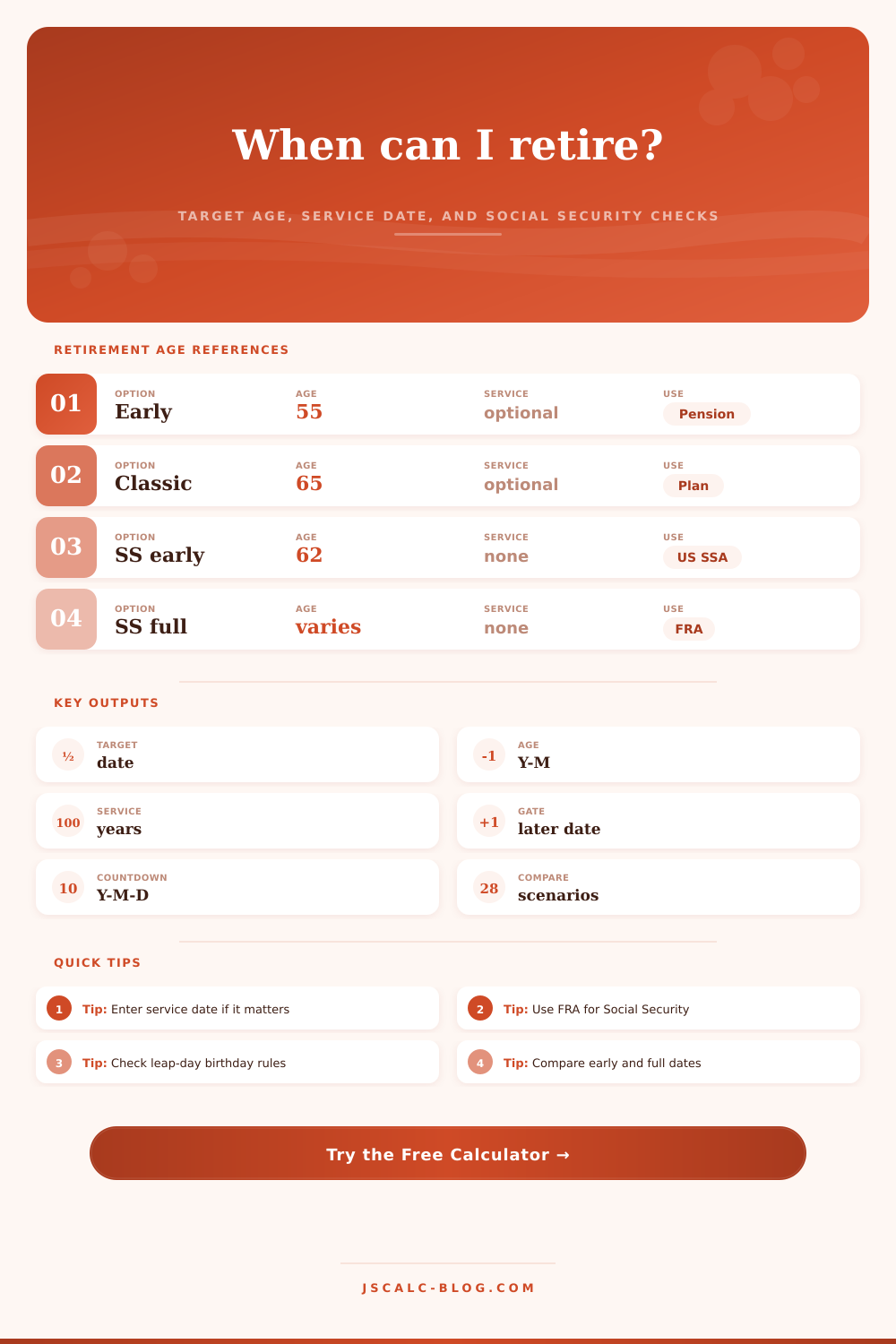
Find a retirement date from birth date plus target retirement age, then compare it with service-years eligibility, early retirement, full retirement, and Social Security reference ages.
| Reference | Target Age | Retirement Date | Days From As-Of | Use Case |
|---|
| Service Rule | Eligibility Date | Service On Date | Age On Date | Status |
|---|
| Scenario | Target Age | Age Date | Service Date Used | Final Eligibility Date |
|---|
| Checkpoint | Date | Age | Service | Days From As-Of |
|---|
One-third of your life will be spent at work. That’s a big chunk of time to dedicate to a job.
So how do you know when it’s “time” to retire? Most people guess. They use hunches instead of facts, but with this calculator we’ll do the date math for you. Just plug in your birthday and desired retirement age to get a specific day.
When to Retire
What does that day tell you about money? Most people assume they retire when they turn that magical birthday number. But many employer policies (and pension plans) is based on certain qualification gates, and crossing those gates are where the danger lies.
Sure, maybe you’ve passed the age of 65. But what about the service? Do you need twenty-five year of credited service before the cash comes? The tool allows you to enter in a date for your service start date and see how your service requirement compare with your age requirement. Does it show one is the controlling factor?
In other words, will you cross the service threshold in an additional six months’ time … or will you wait another year until you’re good-to-go?
There’s yet another wrinkle here: the government doesn’t consider anyone on one set retirement age. Depending on your birth year, full retirement age vary. If you were born in 1960s or later, full retirement age is sixty-seven. If you were born before that, you may be able to recieve full benefits as young as sixty-five or as old as sixty-six. (The Social Security ages are referenced in the calculator’s table.)
This allows you to understand at what point you’d reach full retirement age different than when you’re eligible to claim benefits starting at age sixty-two. Early claiming will decrease your monthly benefit amount forever, which means delaying will increase it. Knowing precisely when those levers open and close will allow you to make this trade-off knowingly.
Date math has little quirks that catch people off guard. A classic example is a leap year birthday. Depending on the system, they’ll either put it on the previous day (February twenty-eighth) or next (March first). You can override this with a special rule which the calculator will apply.
A minor point, yes, but one that could of change your eligibility date by a day or two. That could be important, such as for a pension plan where the cutoff is strict.
Finally, there’s the rule of eighty-five… Which is a fairly popular clause in public sector pensions requiring that “your age plus years of service equals 85 or higher.” If so, you can retire early if you’ve been working for a long time. Enter it into the tool to determine whether it outperforms a typical age-based pension plan.
This is good for those who began working early. Such individuals may be eligible to retire years ahead of age sixty-five.
The computed date isn’t a directive. It’s a “what-if.” Life gets in the way; markets crash; someone gets sick. Plug in other retirement ages into the comparison grid. How would it feel to work until age 62? Or would you work until age 67?
View the countdown clock under both scenarios. There’s a world of difference between an eight-year wait and a three-year wait, this will impact your savings rate now.
Retirement isn’t one moment in time. It’s a shift, and the day you stop earning an income may not be the day you stop participating. For many, retirement means a downshifting, not an end. You collect a portion of your pension while working part-time.
That’s where the calculator comes into play. It provides the tough outlines of what is possible. It tells you the legal day you could begin, then you construct your own plan.
Clarity means knowing the rules. Before playing the game, know the rules. The “when” applies to anything: whether it’s Social Security, a public pension, a private 401k, whatever. The specific date of eligibility affects when you file.
If you don’t know exactly what day you can start drawing your benefit(s), you might actualy delay your start date… Or you might be tempted to start too early (and lock in lower benefits).
Plan the exit strategy. You’ve spent decades building this career, so don’t leave the timing up to chance!