Marginal Tax Bracket Calculator
Estimate taxable income, federal progressive income tax, marginal bracket, effective rate, and how much room remains before the next bracket.
📌Quick Presets
🧮Income and Deduction Inputs
Federal Tax Estimate
📊Comparison Grid
🧱Progressive Tax Stack
| Rate | Taxable layer | Income taxed in layer | Tax from layer | Share of total tax |
|---|
📘Selected Bracket Reference
| Tax rate | Taxable income from | Taxable income up to | Base tax at floor | Status check |
|---|
Reference data covers federal ordinary income brackets for 2024, 2025, and 2026. State tax, AMT, qualified dividends, capital gains, self-employment tax, and phaseouts are outside this estimate.
👥Filing Status Comparison
| Filing status | Standard deduction | Taxable income | Marginal rate | Estimated tax |
|---|
🔬Income Change What-If
| Scenario | Taxable income | Marginal rate | Estimated tax | Change vs current |
|---|
📝Standard Deduction Reference
| Tax year | Single | Married filing jointly | Married filing separately | Head of household |
|---|
💡Calculation Tips
The Raise: You receive the raise. The paycheck appears larger; the deposit into your bank account doesn’t seem quite so large as you’d thought. Your tax bracket has increased, and you’re certain that government’s taking an enormous bite out of your income. It’s frustrating (and it happens often).
But it’s also a misunderstanding about how the system actualy works. The marginal tax rate isn’t a flat fee charged against all of your income. It’s a series of rungs on a ladder, and you’ll only be subject to the higher rate if you step onto the uppermost one(s) from where you current stand.
How the Tax Calculator Works
Above is a handy little tool that does all this math, and more, progressively, so you can see exactly where the money go at every level. All you do is enter in your gross income (along with your filing status) and it’ll calculate how much you owe based off your marginal tax rate.
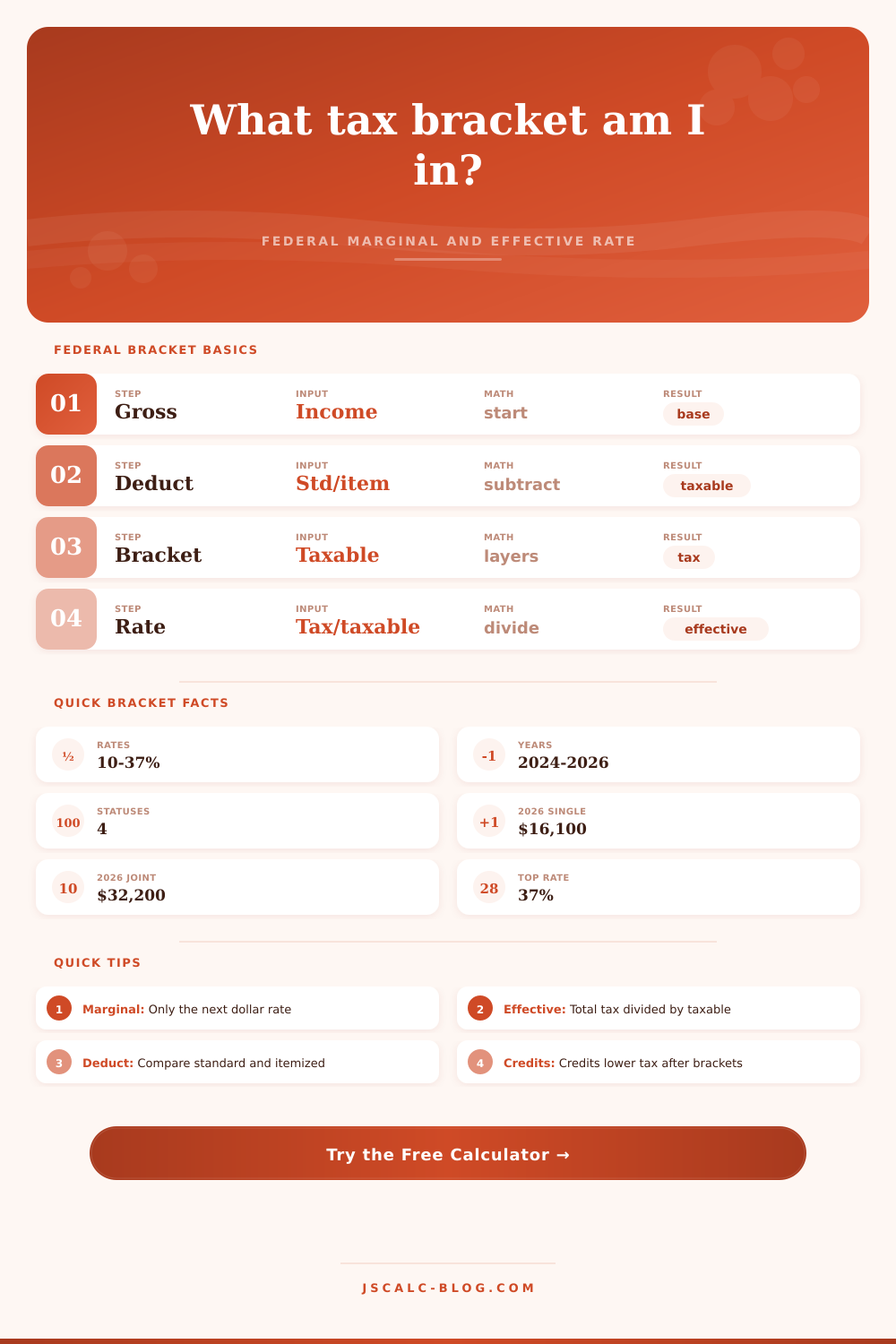
Your standard deduction will be subtracted from your gross income to establish your taxable income. That’s your first line of defense against taxes, since it takes a big bite out of your income before any other deductions are applied to your taxable amount.
Next, if you’re an itemizer, the calculator will compare those actual costs versus that standard floor and apply whichever is highest. This is something you want to use to your advantage, since it reduces your income that falls under the bracket rate.
Next, it calculates the taxable income. Then the government applies federal tax rates in sequence. It applies ten percent on the first few bucks, then 12 percent, then 22 percent, and so on.
That’s what’s called your marginal bracket, the rate that’s charged on the last buck of your income. Not your first buck. Not your second. That’s an important distinction when you’re making money-related decisions.
If you know your marginal rate, you know how much it really costs you to earn an extra dollar (whether through a Roth conversion, a side hustle or a bonus). That’s where the effective rate comes in. Rather than dividing your tax bill by your gross income, this calculates what fraction of your taxable income you get to retain. That figure’s typically much lower then your marginal bracket (because it’s an average of everything below).
There’s a lot of confusion between these two numbers. People freak out at the prospect of getting paid more, but they’ll only barely be paying more in taxes. The calculator breaks them out cleanly so you can look at big picture as well as the next-dollar effect.
Or maybe you’re considering another stream of income. Try plugging in an extra $10k. How would that boost your return? What’s the tax on that? That’s your actual marginal effect. And the tool will tell you exactly how far you’ve moved within the existing bracket, what remains as your margin before sliding up to next rate. That can inform your decision about accelerating income this year versus deferring to next. Depending on how near to the top of the bracket you are, waiting could of been worthwhile.
Deductions and credits function in different ways. Deductions subtract from your taxable income; credits are what simply subtract from your tax bill. For example, $100 of charitable contributions doesn’t push you into the 25% bracket instead of the 12% bracket. That happens during the bracket calculation. Only then do the calculator’s deductions kicks in.
As such, a credit can decrease your effective tax rate while leaving your marginal bracket unchanged. That’s an extremely useful tool, yet credits are what don’t alter the ladder upon which you’re standing.
Tax brackets differs depending on who you are. This is one reason why it matters if you’re married or single, because you generally get a bigger deduction with joint filing but broader brackets. The tool also includes the ability to compare scenarios side by side: How would it look if I changed my deductions? Or if I changed my status? You can even test out different tax years; the brackets gets adjusted each year for inflation.
Here’s the catch: Ignore the headline number. It’s only one piece of information within your overall finances. Run the numbers through the calculator, but keep in mind that other factors, like state taxes and self-employment fees; will change the total… Will shift the grand total.
When you understand the layers, you can begin to plan with precision. Guessing isn’t good enough; you want to know precisely what a raise will cost. Then when you break it down, the fear of the next bracket typically dissapears, you simply see your true take-home pay.