Cat Age in Human Years Calculator
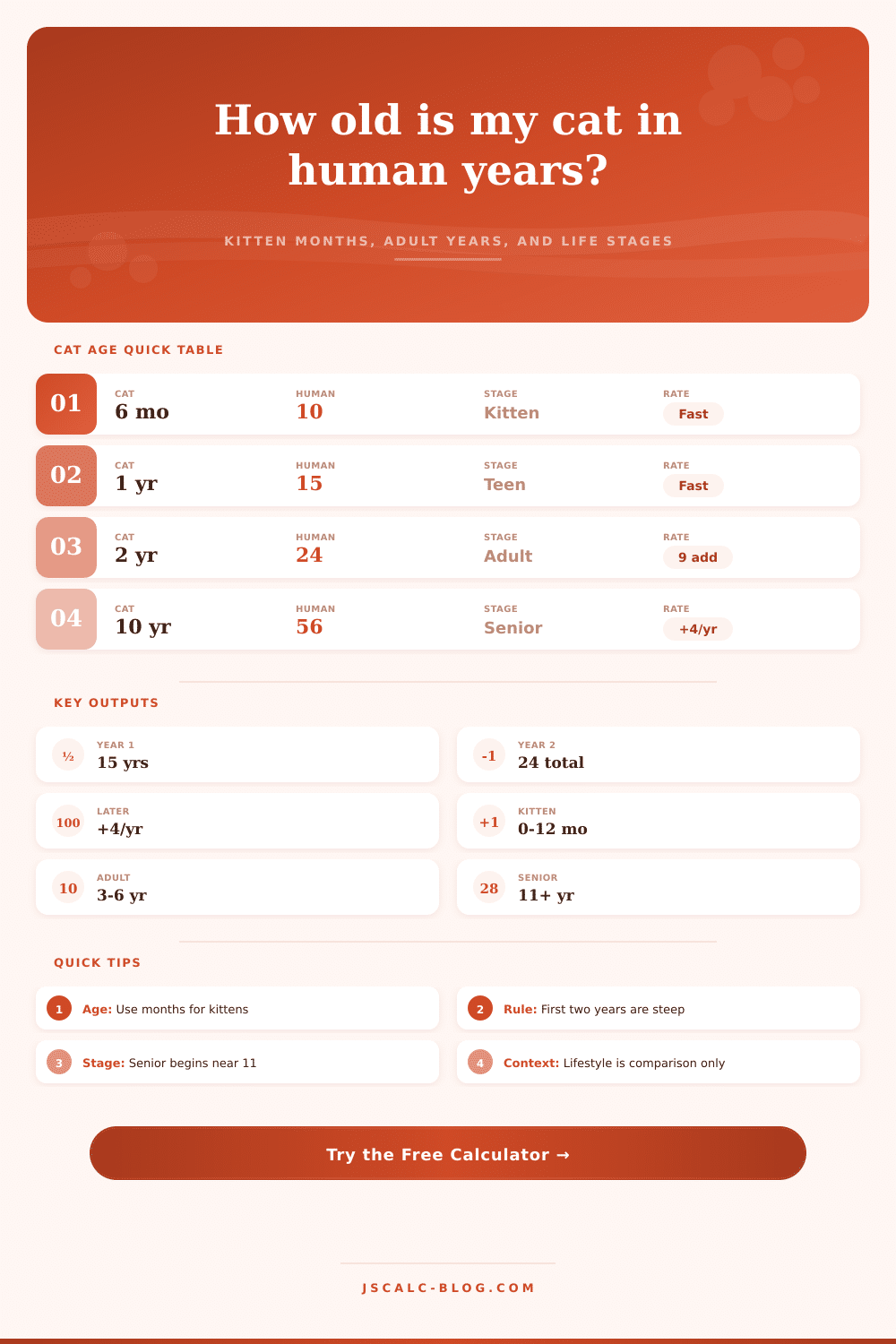
Convert kitten months or cat years into human-year equivalents using the common cat aging rule: year one is about 15, year two totals about 24, and each later year adds about 4.
📌Cat Age Presets
🧮Age Inputs
Used in result wording and the comparison rows.
Kitten mode keeps early-month results smoother.
Use 0 for kittens younger than one year.
This is added to completed years.
For kittens and young cats up to 24 months.
Example: 3.5 means 3 years and 6 months.
Context only; it does not change the accepted human-year conversion.
Adds a note in the comparison grid only.
Used only for percent-of-reference-life cards.
The breakdown always shows the unrounded value.
Builds the future comparison card and timeline row.
📊Age Snapshot Cards
🔍Comparison Grid
Main heuristic result.
Context signal only.
Shown to compare against the common shortcut.
Human years at age one.
📋Selected Cat Timeline
| Point | Cat Age | Human Years | Life Stage | Formula Used | Note |
|---|
📘Cat Age Reference Table
| Cat Age | Human Years | Life Stage | Conversion Note |
|---|---|---|---|
| 3 months | about 4 | Kitten | Linear kitten interpolation toward year one. |
| 6 months | about 8 | Kitten | Halfway through the fast first-year curve. |
| 1 year | about 15 | Junior | First cat year is about 15 human years. |
| 2 years | about 24 | Young adult | Second year adds about 9 human years. |
| 5 years | about 36 | Adult | 24 + 3 x 4 human years. |
| 10 years | about 56 | Mature | 24 + 8 x 4 human years. |
| 15 years | about 76 | Senior | Later years continue at about +4 each. |
| 20 years | about 96 | Geriatric | A very long-lived cat on the same heuristic. |
📑Life Stage Categories
| Stage | Cat Age Range | Approx Human Range | What The Calculator Labels |
|---|---|---|---|
| Kitten | 0 to 6 months | 0 to 8 | Rapid growth and early development. |
| Junior | 7 months to 2 years | 9 to 24 | Adolescent to young-adult transition. |
| Prime adult | 3 to 6 years | 28 to 40 | Fully adult in the steady +4 zone. |
| Mature | 7 to 10 years | 44 to 56 | Middle-age comparison range. |
| Senior | 11 to 14 years | 60 to 72 | Senior label begins near age 11. |
| Geriatric | 15 years and up | 76 and up | Long-lived senior comparison range. |
🧪Lifestyle Context Table
| Lifestyle Setting | Main Human-Year Math | Context Comparison | Use In Results |
|---|---|---|---|
| Indoor-only baseline | Unchanged | Baseline care context | Shows the accepted heuristic without adjustment. |
| Supervised outdoor time | Unchanged | Low added exposure note | Flags enrichment without changing the age number. |
| Mixed indoor/outdoor | Unchanged | Moderate exposure note | Shows a contextual comparison beside the main result. |
| Mostly outdoor context | Unchanged | Higher exposure note | Highlights that lifestyle is not part of the conversion formula. |
🔢Formula Method
💡Calculator Tips
The old math that say a cat’s age multiplied by seven equals human years is not correct. It seems easy: just multiply your cats age by seven and there you go! But this assumes that cats ages at a steady rate. Nope, not true.
By the time a cat reaches its first birthday, it has grown up, like a fifteen-year-old human rather than a seven-year-old. One year of kitty equals around fifteen years for us. The second year equal another nine, making two year equal to twenty-four human years. And then things start slowing down. From there on out, each new year add maybe four years to our own human odometer. That makes sense, since kittenhood happen quickly and then, once a cat become an adult, he ages steadily from there.
The True Age of Your Cat
To see the progression in action for your own pet, try out our cat age calculator above. It also accounts for the fact that a kitten of four months will be vastly different than one of eight in terms of dental growth and skeletal structure. No worries about crunching the numbers yourself; just input your information, and the calculator plot out the aging curve to indicate where your cat falls within normal range.
Here’s the deal: In the world of Veterinary Medicine, there are names for each stage in an animal’s life (kitten, senior, etc). Those category will tell you what might be coming up medically for your pet. For example, kittens need shots, prime adult should be kept at their ideal weight, and senior cats should has their blood drawn for thyroid or kidney testing. The calculator use veterinary guidelines to define these categories. This helps you know where your pet fits and lets you plan for care ahead of time rather than just reacting once a problem develop.
While a cat’s age won’t alter the math behind the conversion, its lifestyle will impact its health. For example, an indoor cat is likely to live longer than an outdoor cat (fewer dangers from traffic and disease). Lifestyle context is also included in the tool. While it doesn’t affect the human-year estimate, it does remind you that this is simply a baseline number. A young outdoor cat might be less healthy than an old indoor cat. Quality of life depend on more than just how long you live; it also depends on your environment.
With rescue cats, however, who knows what their actual birthday is? By eyeballing their eyes and teeth, maybe you can guess how old they are. The calculator lets you make some guesses using a wide age range or even a decimal year estimate. It better than nothing.
The closer you get to figuring out that your cat is probably somewhere in the mature phase, the more prepared you will be to provide senior care. You will have more informed conversations with your veterinarian. You will base decisions more on biological probabilities rather then guesswork.
Why? Why do we cling to the seven-times rule? Because it’s simple to recall. The problem is that it’s inaccurate, creating an image of steady aging where there isn’t any. In nature, cats mature fast and then stay that way for a very long time, and then they declines. Knowing about this curve shifts your perspective on your cat’s lifespan. It emphasizes the importance of the middle years. It also shows how significant the early ones are, which is so intense. Life is different for them than it is for us.
A cat is a long term commitment. As cats gets older, you will grow closer to them. That playful kitten grows up into a steadfast companion. That steadfast companion grows old. Knowing how old they are let you know when those milestones occur. It helps you give the best care to your cat at the correct stage in life. From that first birthday or that twentieth birthday it’s all about making your cats life healthy and comfortabley. The numbers show the way, but what you do with them makes the journey.