Punnett Square Eye Color Calculator
Predict a child's eye color odds by crossing the parents on a simplified two-allele model where brown beats green and green beats blue. Set each parent's eye color and genotype, or infer hidden carrier alleles from the grandparents, then read the chance of brown, green, and blue eyes with the Punnett grid drawn out for you.
👀How Do You Know the Genotypes?
🎯Common Parent Crosses
👨Parent Details
Observed phenotype limits the possible genotypes.
Blue is always the recessive pair b b.
Only genotypes matching the color above are used.
A brown parent may secretly carry green or blue.
A blue or green grandparent reveals a hidden allele.
Parent 1 inherits one allele from each of these.
Used to infer Parent 2's carrier alleles.
Parent 2 inherits one allele from each of these.
Controls how every eye-color percentage is shown.
Punnett Grid
| B | b | |
| B | BB | Bb |
| b | bB | bb |
🔢Model Snapshot
📋Allele Dominance Order
| Allele | Symbol | Codes For | Rank | Behaviour |
|---|---|---|---|---|
| Brown | B | Brown pigment | 1 highest | Masks green and blue |
| Green | g | Green / hazel | 2 middle | Masks blue, hidden by B |
| Blue | b | Blue / light | 3 lowest | Only shows as b b |
🧬Genotype to Phenotype Map
| Genotype | Contains B? | Contains g? | Eye Color | Carrier Note |
|---|---|---|---|---|
| BB | Yes | No | Brown | Pure, carries nothing |
| Bg | Yes | Yes | Brown | Brown carrying green |
| Bb | Yes | No | Brown | Brown carrying blue |
| gg | No | Yes | Green | Pure green |
| gb | No | Yes | Green | Green carrying blue |
| bb | No | No | Blue | Fully recessive |
📊Textbook Cross Ratios
| Cross | Offspring Genotypes | Brown | Green | Blue |
|---|---|---|---|---|
| BB x bb | All Bb | 100% | 0% | 0% |
| Bb x Bb | 1 BB : 2 Bb : 1 bb | 75% | 0% | 25% |
| Bb x bb | 1 Bb : 1 bb | 50% | 0% | 50% |
| Bg x Bg | 1 BB : 2 Bg : 1 gg | 75% | 25% | 0% |
| gg x gg | All gg | 0% | 100% | 0% |
| gb x gb | 1 gg : 2 gb : 1 bb | 0% | 75% | 25% |
| bb x bb | All bb | 0% | 0% | 100% |
🗃Parent Combo Comparison Grid
| Parent 1 | Parent 2 | Brown % | Green % | Blue % | Note |
|---|---|---|---|---|---|
| BB brown | bb blue | 100% | 0% | 0% | All brown carriers of blue |
| Bb brown | bb blue | 50% | 0% | 50% | Even brown to blue split |
| Bb brown | Bb brown | 75% | 0% | 25% | Two blue-carrier browns |
| Bg brown | gg green | 50% | 50% | 0% | Brown or green, no blue |
| Bg brown | Bg brown | 75% | 25% | 0% | Green-carrier browns |
| gg green | bb blue | 0% | 50% | 50% | Green over blue shows |
| gb green | gb green | 0% | 75% | 25% | Both carry blue |
| Bb brown | gb green | 50% | 25% | 25% | All three colors possible |
| Bg brown | bb blue | 50% | 0% | 50% | g hidden then paired to b |
| bb blue | bb blue | 0% | 0% | 100% | Two blue parents |
⚙How the Cross Works
💡Reading the Odds Wisely
It’s back: the great family discussion of eyes. A blue-eyed kid comes from two brown-eyed parents; now what? And that messes up family tree. Blame it on a skipped-generation recessive gene. But biological systems is never so dramatic. More often it’s carriers with an unexpected hidden allele that are completely different from how they look.
Using this calculator’s simple model (green vs. Blue vs. Green beats brown, which beats blue. It creates the classic Punnett square, crosses those alleles over, counts them up, and spits out the probabilities for any given color without needing a genetics degree. For teaching purposes, this model is adequate, though it’s the same one from most high school textbooks. And it works well enough to illustrate the concept of dominance.
How to Predict Eye Color Using Simple Genetics
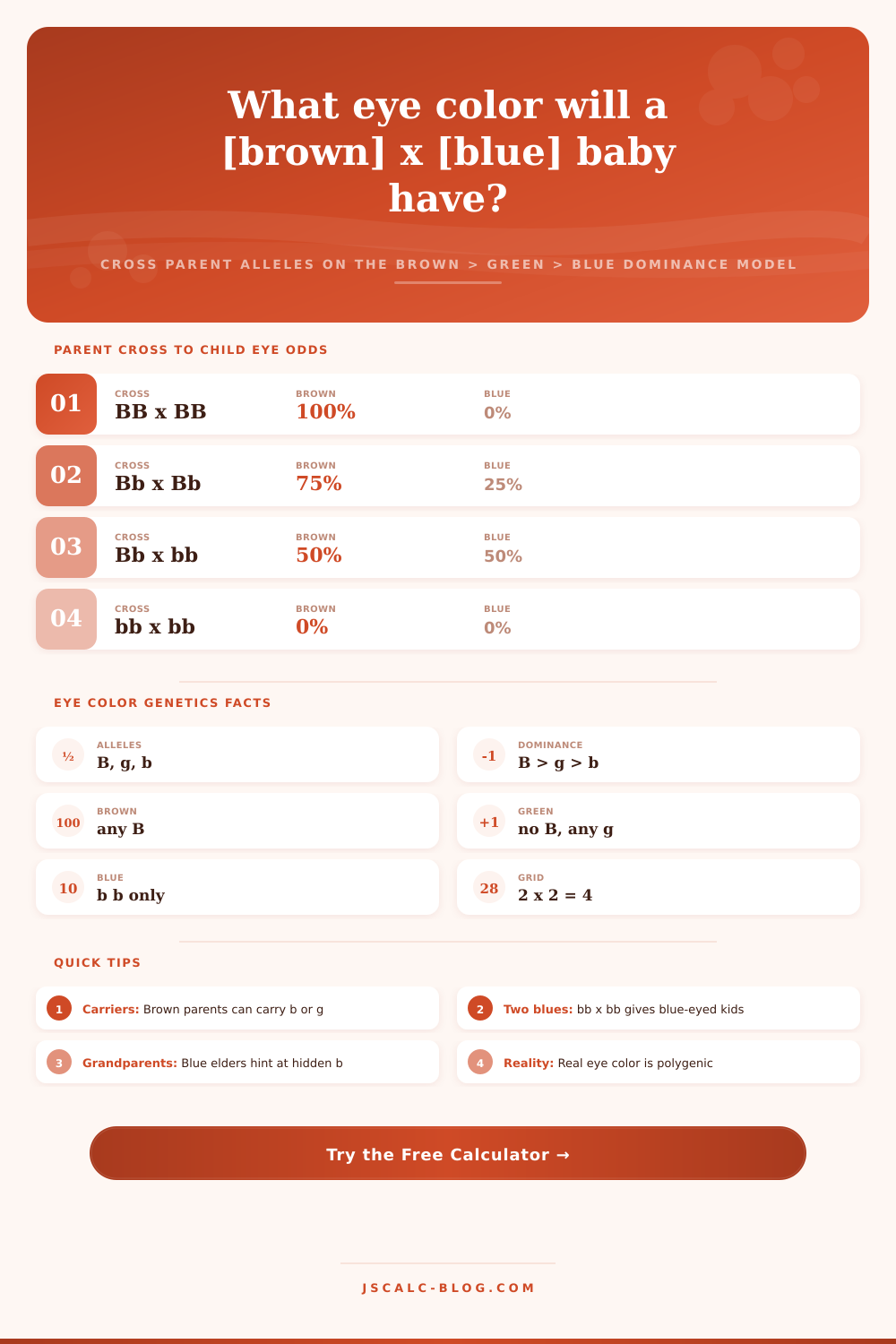
In this case, B stands for brown; it’s on top. G (for green) is middle-of-the-pack: It’s dominated by B but dominates blue. And b (blue) are completely recessive. One thing is true: A B anywhere in the equation makes the eyes brown. No Bs, but a g? Green. Two bs make the eyes blue. That sequence rules all of the percentages that the tool spits out.
Two alleles per gene: Parents each inherit one allele from each parent and pass only one on to their offspring. The calculator shows all possibilities by placing each parent’s alleles along the sides of a square (above) with Parent 1 on top and Parent 2 on left. Each of these four squares is equally probable. The fraction of times you’ll get any given color is the number of matching squares over four. This simple math explains how it’s possible for two brown-eyed parents to produce a blue-eyed baby.
Both parents might be carriers (genotype Bb). Their children will inherit either a dominant B allele that makes them brown-eyed, as shown in three of the four squares, or an allele pair that’s recessive and will make them blue-eyed (bb). That twenty-five percent chance for blue eyes is real and frequently surprises families who assume eye color works like eye shape or height.
The difficult element is knowing the genetic makeup; the physical appearance (the actual eye color) are visible in front of your eyes, but not the hidden recessive genes. Here’s where the grandparents mode comes into play. Because they inherit one allele from each of their two parents, family history lets us know what they must carry. Even if that doesn’t manifest in their facial appearance, a brown-eyed person with a blue-eyed grandparent must carry a b allele in his or her genes. The tool automatically uses this logic to guess genotypes from even the vaguest family story, turning them into actual odds.
The diagram above simplifies a complicated trait. It is also helpful to remember that eye color is an incredibly complex thing. It involves not just one gene but several, including HERC2 and OCA2. These combine across many variations to create a range from amber and light brown to hazel tones that do not easily fit into the three categories of blue, brown, and green. Nature piles additional variables on top of that basic system of inheritance. But the Punnett square framework gives us words to use when talking about heredity. It illuminates both how traits are passed along, and how recessive genes can lurk undiscovered in plain sight.
The reference tables provided in this calculator list typical crosses such as pure brown against blue, or green versus green, and so on. These illustrate what the resulting colors would be depending of which alleles is dominant over one another. For instance, green vs. Blue carriers will always result in either green offspring or blue; they will not have brown eyes. That’s because neither of them carries the dominant B allele to make brown pigment. If you don’t have that piece of the puzzle, it means only those alternatives remain.
But when used properly, the tool doesn’t ignore the answer you’re most likely to get. The numbers speak to a larger picture: there are many genes at work in your family’s genetics. Just because there’s a 99 percent chance you have brown eyes doesn’t mean you do. It only suggests the dominant allele is doing what it does. Having a smaller number for blue eyes, however, suggests that while recessive, that pairing is also possible. These are numbers of statistical likelihood, based off the idea that one gene equals one thing and those things add up.
In the end, predicting eye color isn’t as much about predicting what exact color your child will have, as it is about knowing the odds. When you enter in the alleles, the calculator up top does the math for you. You do not need to remember complicated ratios. It explains perfectly how carriers and dominant alleles combine to produce possible results.
Real life makes it all more complex; there are also polygenes at work, and environment matters too. But this model gets at the underlying mechanics of genetics: It ends arguments by making your guess based on something besides your gut. That doesn’t mean you won’t get eyes just like Grandpa’s in your kid, but it does give you an idea of why such a thing would statistically be unlikely. You should of used this sooner.