EPA Household Carbon Footprint Calculator
Estimate your household's annual carbon footprint in tons of CO2e per year using EPA-style emission factors. Add electricity, natural gas, heating oil, propane, two vehicles, and air travel, then see a source-by-source breakdown, per-person tons, and how you compare to the US average of about 16 tons per person.
🏠Real Household Presets
📋Household Energy and Travel Inputs
Used to split the total into per-person tons.
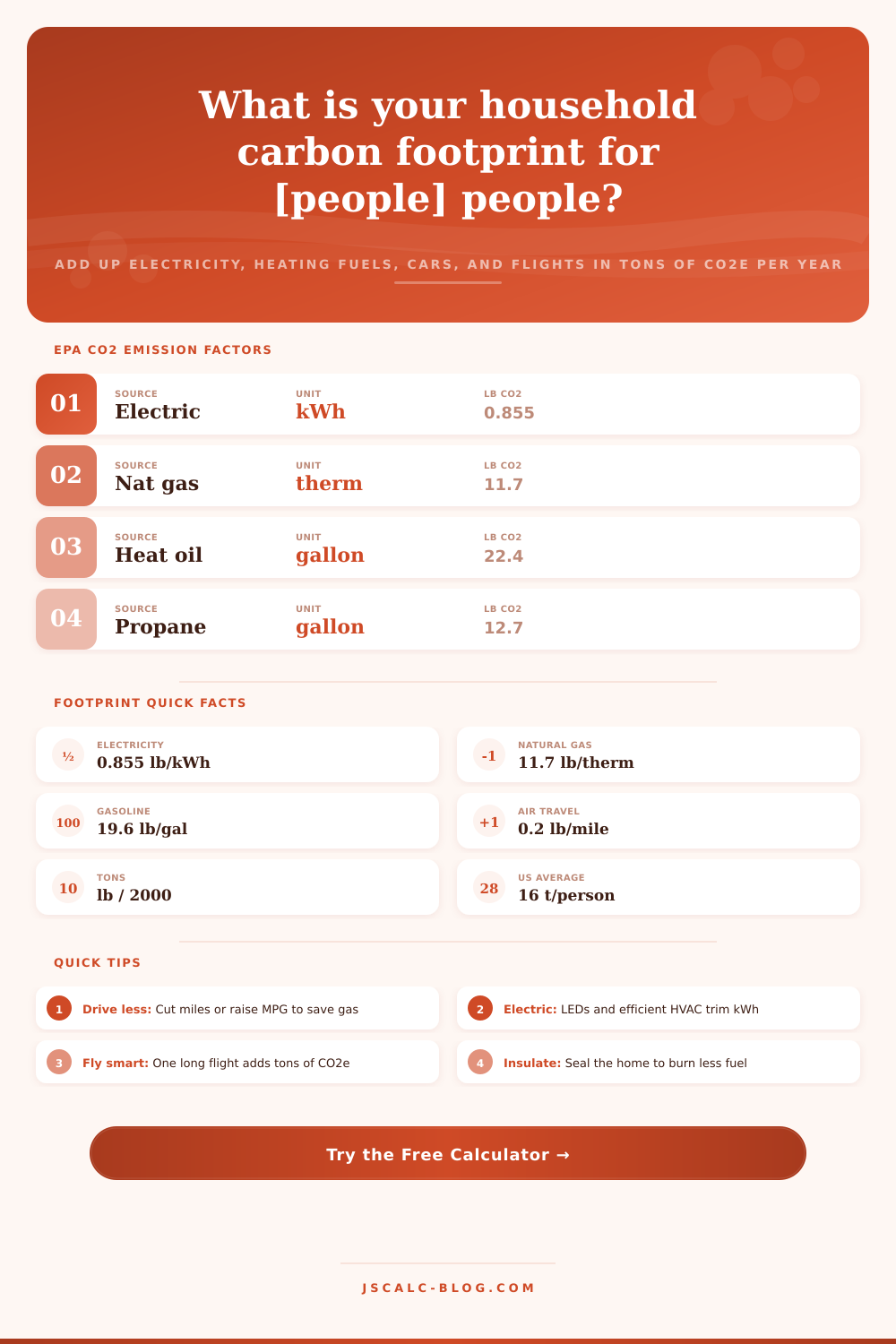
From your power bill; national grid factor 0.855 lb CO2 per kWh.
Gas bill therms; 11.7 lb CO2 per therm burned.
Fuel oil for the year; 22.4 lb CO2 per gallon.
LPG for heat, cooking, or hot water; 12.7 lb CO2 per gallon.
Miles driven per year by your primary vehicle.
Miles per gallon; gasoline is 19.6 lb CO2 per gallon.
Set to 0 if you only run one vehicle.
MPG for the second vehicle; ignored if miles are 0.
Total flight miles for everyone; 0.2 lb CO2 per passenger-mile.
Landfill methane offset from diverting household waste.
Controls how tons are displayed on the cards.
🔢Formula Snapshot
⚡EPA Emission Factors
| Emission Source | Activity Unit | lb CO2 per Unit | Notes |
|---|---|---|---|
| Grid electricity | kWh | 0.855 | US national average mix |
| Natural gas | therm | 11.7 | Residential heating and cooking |
| Heating oil | gallon | 22.4 | No. 2 distillate fuel oil |
| Propane (LPG) | gallon | 12.7 | Rural heat and cooking |
| Motor gasoline | gallon | 19.6 | Tailpipe CO2 per gallon |
| Air travel | passenger-mile | 0.20 | Average commercial flight |
| US short ton | pounds | 2000 | Divide total lb by 2000 |
👥US Average Footprint by Household Size
| Household Size | Typical Total (tons/yr) | Per Person (tons/yr) | Profile |
|---|---|---|---|
| 1 person | 6 to 10 | 6 to 10 | Apartment or small home |
| 2 people | 12 to 20 | 6 to 10 | Couple, two commutes |
| 3 people | 16 to 26 | 5 to 9 | Small family |
| 4 people | 18 to 32 | 4.5 to 8 | Suburban family |
| 5 people | 22 to 38 | 4 to 8 | Larger family home |
| 6 people | 26 to 44 | 4 to 7 | Multi-generation |
🌐Typical Footprint by Lifestyle
| Lifestyle | Main Drivers | Total (tons/yr) | Biggest Source |
|---|---|---|---|
| Car-free city dweller | Transit, small unit | 4 to 7 | Electricity |
| Eco minimalist | Low miles, efficient | 5 to 8 | Electricity |
| All-electric home | Heat pump, one EV-lite | 10 to 14 | Electricity |
| Frequent flyer | Many long flights | 14 to 20 | Air travel |
| Suburban family of four | Two cars, gas heat | 18 to 24 | Gasoline |
| Rural heating oil home | Oil heat, long drives | 22 to 28 | Gasoline |
| Large high-mileage house | Big home, two SUVs | 28 to 40 | Electricity |
🗃Source to CO2e Comparison Grid
| Source (Unit) | EPA Factor (lb/unit) | Example Usage | CO2 (lb) | CO2e (tons) |
|---|---|---|---|---|
| Electricity (kWh) | 0.855 | 900 kWh/mo x 12 | 9234 | 4.62 |
| Natural gas (therm) | 11.7 | 55 therm/mo x 12 | 7722 | 3.86 |
| Heating oil (gal) | 22.4 | 550 gal/yr | 12320 | 6.16 |
| Propane (gal) | 12.7 | 600 gal/yr | 7620 | 3.81 |
| Gasoline car (gal) | 19.6 | 12000 mi at 25 MPG | 9408 | 4.70 |
| Gasoline car 2 (gal) | 19.6 | 9000 mi at 22 MPG | 8018 | 4.01 |
| Air travel (mi) | 0.20 | 7000 passenger-mi | 1400 | 0.70 |
| Waste, no recycling | -- | Landfill methane | 600 | 0.30 |
⚙Formula Breakdown
💡Cut Your Footprint Tips
Your household carbon footprint is a number from your utility bills and travel activities that the EPA household carbon footprint calculator turns into something useful. It’s the amount of carbon dioxide equivalent in tons emitted by your home annually. Instead of guessing whether your household is a heavy or light emitter, this tool takes real figures for electricity, heating fuel, driving, and flying and plugs them in with EPA-style emission factors. The end result? It provides a clear total, a per-person breakdown, and an honest comparison with the approximately 16 tons of CO2e that average American emits annually.
Your carbon footprint is the sum of all greenhouse gases produced through your actions during the course of a year. If you’re talking about a house, this comes down to two almost-always-big items: the fuel you burn and the energy you buy. There’s an exact amount of carbon released for each unit of electricity used, that’s why it’s measured in kilowatt-hours. There’s an exact amount of carbon released for each gallon of gasoline burned or therm of natural gas consumed. Multiply those by the amount you consume and you’ve converted abstract units of utility into pounds of CO2.
How to Calculate Your Household Carbon Footprint
And that is where people make a mistake. They see dollars and cents, not tons of carbon. The figures remain rooted in science; it applies broadly available (EPA-type) factors to calculate things. For instance, the average mix of grid electricity produced nationally yields roughly 0.855 pounds of CO2 per kilowatt-hour generated. A therm of natural gas produces 11.7 pounds. Every gallon of motor gasoline combusted emits 19.6 pounds of carbon dioxide. Those are primary factors behind this tool. If you look at them they’re presented in a reference table just beneath the calculator. You know exactly what emission factors is being applied to each of your inputs. It makes the results something you can trust.
It wants numbers you should be able to pluck directly from your records and bills: the number of people in your household; the amount of electricity you use each month in kilowatt-hours; how much natural gas you consume monthly in therms. If you heat with fuel oil or propane, enter the number of gallons per year. Transportation-wise, the calculator handles two vehicles. Consider miles per gallon and annual mileage. The calculator also includes air travel; just add up total passenger-miles flown by everyone in your family. Choose a recycling habit. Filling in a blank space with zero drops out the contribution from that source. A car-free apartment or an all-electric house is easy modeled realisticly.
Monthly electricity in kilowatt-hours are multiplied by 12 and by 0.855 to get annual pounds of CO2. The same thing happens to natural gas therms (with a factor of 11.7). Propane and heating oil gallons are simply multiplied by their gallon factors. The number of annual miles driven is divided by miles-per-gallon for each vehicle, producing the number of gallons burned annually. That amount is then multiplied by 19.6. Total from all sources is calculated in pounds. That total is then divided by 2000 to convert it to tons. This final step is divided by the number of people to obtain the per-person figure. It is just math, but it is the kind of math we need.
We lead with four cards that make up the results panel: Your total footprint is your annual household emissions, in tons of CO2e. Per-Person: That same number divided among all people who live there. This is the fairest way to compare a family of five to a single renter. Biggest Source: The name of the category that’s doing the most damage. What percent of your total does it represent? Now you know exactly where to aim. Per-Percentile shows your per-person number as a percent of the 16-ton US average. This lets you turn this abstract figure into a quick benchmark you can act on.
On average, Americans produce approximately 16 tons of CO2e per year. That’s typically the point when people start to get personal. Seeing where they land above, near, or well below that average. A car-free city dweller may come in around five tons of carbon per person. A suburban family driving a lot and using oil heat might easily exceed national average. The tool doesn’t pass judgment. It merely tells you where you are and what levers to pull.
Measuring is one thing; but knowing what to change is worth a lot more. Prioritizing with the tool tells you where to make the biggest cuts (instead of guesswork!). Gasoline? Combine errands! Drive a high-mileage car! That’s the biggest bang for the buck because each gallon of gas is roughly 20 pounds of carbon. Electricity? Trim those kilowatt-hours with a heat pump and efficient lighting. Insulation and air sealing reduce the need to heating fuels. Tweak something, recompute, see that total shift. Use the EPA household carbon footprint calculator, and get a reliable annual figure plus guidance on how to shrink it.