Tile and Grout Calculator
Enter your area or room length and width, pick a real tile size, joint width, thickness and waste allowance, and get the tiles needed, boxes to buy, total area with waste, and the grout you need in pounds and 25 lb bags using the industry joint volume formula.
🎯Real Tile Job Presets
📏Tile and Grout Inputs
Choose to type total area, or the room dimensions.
Net area to be tiled before waste is added.
Longer wall to wall dimension of the room.
Shorter wall to wall dimension of the room.
Nominal tile face size in inches.
Sets the depth of the grout joint.
Space between tiles; wider joints use more grout.
Extra for cuts, breakage and future repairs.
Square feet printed on each carton; leave 0 to skip.
🔢Formula Snapshot
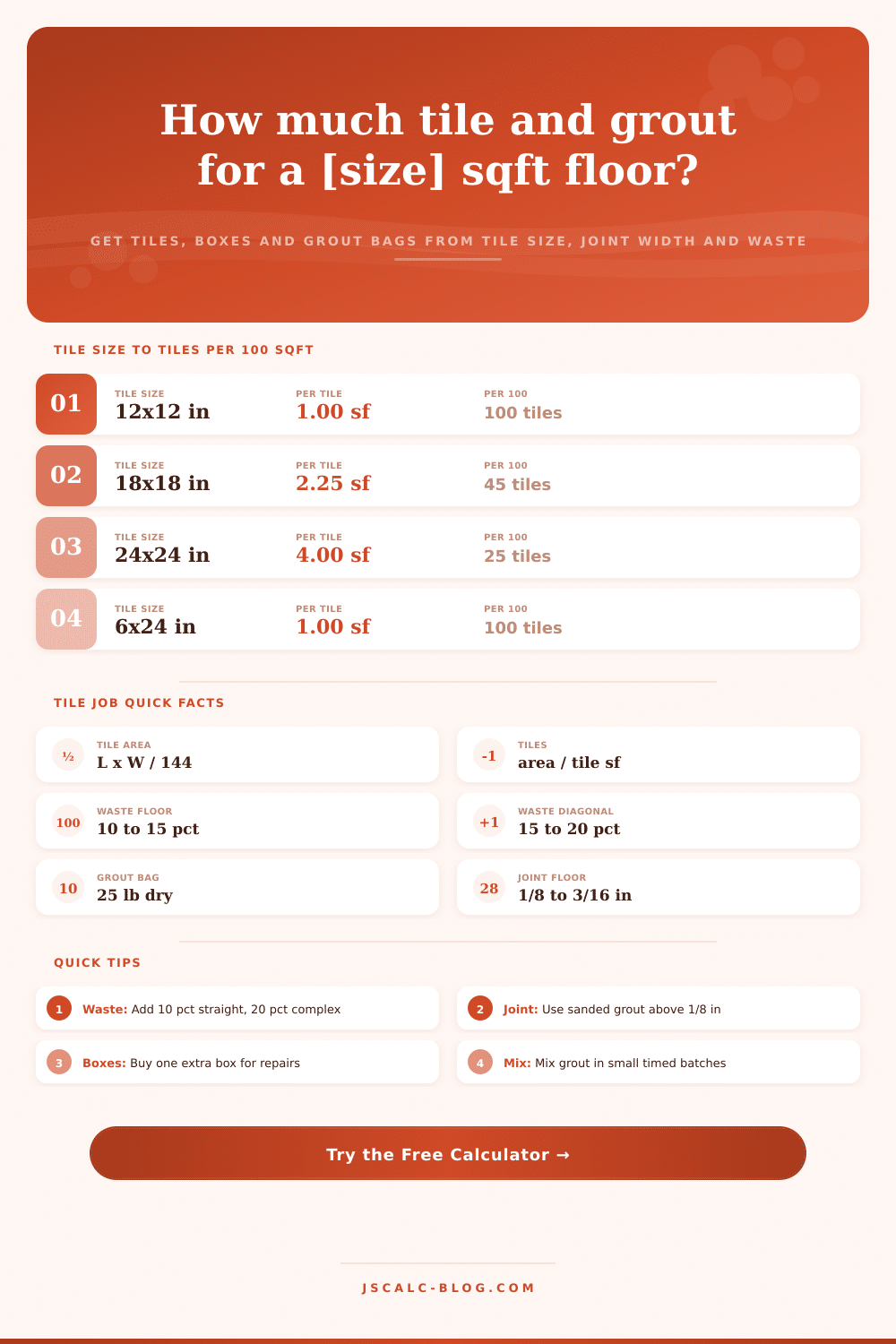
🟩Tile Size to Tiles Per 100 Square Feet
| Tile Size | Area Per Tile | Tiles Per 100 Sqft | Common Use |
|---|---|---|---|
| 3 x 6 in subway | 0.125 sf | 800 tiles | Backsplash and walls |
| 4 x 4 in | 0.111 sf | 900 tiles | Shower and accent walls |
| 6 x 6 in quarry | 0.25 sf | 400 tiles | Mudroom and utility floors |
| 6 x 24 in plank | 1.0 sf | 100 tiles | Wood look floors |
| 12 x 12 in | 1.0 sf | 100 tiles | Bath and laundry floors |
| 16 x 16 in | 1.778 sf | 57 tiles | Living area floors |
| 18 x 18 in | 2.25 sf | 45 tiles | Entry and hallway floors |
| 24 x 24 in | 4.0 sf | 25 tiles | Large open floors |
📋Grout Coverage: Sqft Per 25 lb Bag
| Tile Size | 1/16 in Joint | 1/8 in Joint | 3/16 in Joint | 1/4 in Joint |
|---|---|---|---|---|
| 3 x 6 in | 115 sf | 58 sf | 38 sf | 29 sf |
| 4 x 4 in | 111 sf | 56 sf | 37 sf | 28 sf |
| 6 x 6 in | 167 sf | 83 sf | 56 sf | 42 sf |
| 12 x 12 in | 333 sf | 167 sf | 111 sf | 83 sf |
| 6 x 24 in | 222 sf | 111 sf | 74 sf | 56 sf |
| 18 x 18 in | 500 sf | 250 sf | 167 sf | 125 sf |
| 24 x 24 in | 667 sf | 333 sf | 222 sf | 167 sf |
Values assume 1/4 in tile thickness and cementitious grout near 0.045 lb per cubic inch of set joint. Thicker tiles lower the coverage in proportion.
🔧Recommended Joint Width and Grout Type by Tile
| Tile Type | Recommended Joint | Grout Type | Notes |
|---|---|---|---|
| 3 x 6 subway | 1/16 to 1/8 in | Unsanded | Tight joints keep classic look |
| 4 x 4 wall | 1/16 to 1/8 in | Unsanded | Small format, narrow lines |
| 6 x 6 quarry | 1/8 to 3/16 in | Sanded | Rustic floors hide texture |
| 6 x 24 plank | 3/16 in | Sanded | Allows for plank lippage |
| 12 x 12 floor | 1/8 to 3/16 in | Sanded | Standard field floor joint |
| 18 x 18 floor | 3/16 in | Sanded | Larger tile needs wider line |
| 24 x 24 large | 3/16 to 1/4 in | Sanded | Wide joint eases flatness |
🪛Thinset Mortar Coverage by Trowel Size
| Trowel Notch | Coverage Per 50 lb Bag | Typical Tile | Use |
|---|---|---|---|
| 1/4 x 1/4 in square | 90 to 95 sf | Mosaic and 4 x 4 | Small wall tile |
| 1/4 x 3/8 in square | 70 to 75 sf | 6 x 6 and 6 x 24 | Standard floor tile |
| 1/2 x 1/2 in square | 40 to 50 sf | 12 x 12 and 18 x 18 | Medium floor tile |
| 1/2 x 3/4 in U notch | 30 to 40 sf | 24 x 24 large | Large format floors |
| 3/4 x 3/4 in square | 25 to 30 sf | Over 24 in | Heavy slabs and pavers |
🗃Tile Selection Comparison Grid
| Tile Size | Tiles Per 100 Sqft | Recommended Joint | Grout Type | Typical Use | Install Difficulty |
|---|---|---|---|---|---|
| 3 x 6 in | 800 tiles | 1/16 to 1/8 in | Unsanded | Backsplash | Moderate |
| 4 x 4 in | 900 tiles | 1/16 to 1/8 in | Unsanded | Shower walls | Moderate |
| 6 x 6 in | 400 tiles | 1/8 to 3/16 in | Sanded | Mudroom floor | Easy |
| 6 x 24 in | 100 tiles | 3/16 in | Sanded | Wood look floor | Hard |
| 12 x 12 in | 100 tiles | 1/8 to 3/16 in | Sanded | Bath floor | Easy |
| 18 x 18 in | 45 tiles | 3/16 in | Sanded | Entry floor | Moderate |
| 24 x 24 in | 25 tiles | 3/16 to 1/4 in | Sanded | Open floor | Hard |
⚙Formula Breakdown
💡Tile and Grout Buying Tips
This also will help calculate how much tile/grout you need for your own project. It figures out whole equation (no guessing at the store). So many people grab an excess of tile but skimp on their grout. However, thicker tiles or even just a wider joint can uses more grout than you think. The calculator will help keep you from running short in the middle of the process.
Starting at Step 1: How big is it? To start, get an accurate measurement. Either enter exact square feet (if you already know) or input both length and width of the space. This will multiply those numbers to give you total area before you add extra for waste.
How to Use the Tile Calculator
This difference are important; waste isn’t just some additional cushioning. Waste is a real factor for cutting around pipes, filling out corners, and compensating for inevitable broken tile(s) that occur while installing. For a simple grid pattern, expect about ten percent excess material. Diagonal layouts like this one or intricate herringbone styles requires much higher amounts. Once you pick a waste percentage based off your pattern, the calculator will adjust total downward to show how many tiles you actualy need.
The calculator then calculates the total number of tiles needed. A 12 x 12 inch tile equals one square foot, while a 3 x 6 inch subway tile equal one eighth of a square foot. It divides your space by one tile’s coverage amount and then it rounds UP to next integer. Since you can’t purchase part of a tile, you must round up. You enter either the actual coverage per box (which you can find on the packaging), which will calculate exact number of cartons required; or you can input “square footage” or dimensions to get a net area that determines both your tile and grout needs. As a rule of thumb, I always purchase one more box than calculated since dyelots change all the time. There’s no way to match a replacement tile to a broken one six months down the road once your supply has been depleted.
Most homeowners goes wrong with grout math. Grout isn’t just a matter of surface area. It’s a volume issue, which takes into account size of your tile, width of your joint and the overall square footage of the space. To calculate this, it applies the same formula used by pros in the industry and estimates number of cubic inches of void space between your tiles. Even if two spaces are the exact same size, smaller tiles has far more linear edge per square foot which means they need much more grout than larger format slabs do. Bags can dissapears fast when using a wide joint on thick tile. That amount will be converted into pounds as well as into number of standard twenty-five pound bags, so you’ll always know exactly how much to purchase.
For narrow joints measuring less than one eighth of an inch, you want to use unsanded grout to avoid cracking, whereas sanded grout offer the necessary strength for wider lines. Once you understand those inputs, your perspective on the project shifts. It is no longer about filling space. Instead, it is about working with materials that have specific qualities that change based on thickness and shape. The pre-set buttons in the tool provides some ready-to-go examples (kitchen backsplash or bathroom floor) where you can see a range of possible layouts, and immediately know how they alter material requirements. Watching that number tick up or down as you resize tiles or tweak the joint width explain why planning makes a difference.
Mismatched repairs are frustrating; having too many supplies is wasteful (and they take up space). The solution: Calculate amount of grout needed to match your actual tile quantity. Use the tool to do the math conversion; plug in your measurements plus the proper waste factor for your layout, then forget about it. You’ll know precisely how many tiles to buy before you cut, which is different than a pleasant workday and another unpleasant visit to the tile store.