Carpet Tile Calculator
Estimate modular peel-and-stick carpet squares fast. Enter your area or room length and width, choose a tile size and install pattern, and this tool returns the carpet tiles needed, cartons to order, adhesive tabs or glue, and the total area including pattern waste.
📏How Do You Know the Size?
🎯Real Room and Project Presets
📝Project Inputs
Total finished area in the chosen unit.
Longest wall of the room.
Wall at a right angle to the length.
Metric converts to sqft at 1 m = 3.28084 ft.
Nominal modular carpet square size.
Box count varies by brand and tile size.
Angled and offset layouts cut more tiles.
Controls the adhesive card below.
Multiplies the area by this room count.
🔢Formula Snapshot
📐Carpet Tile Sizes and Coverage
| Nominal Size | Metric | Area Each | Tiles per 100 sqft | Common Use |
|---|---|---|---|---|
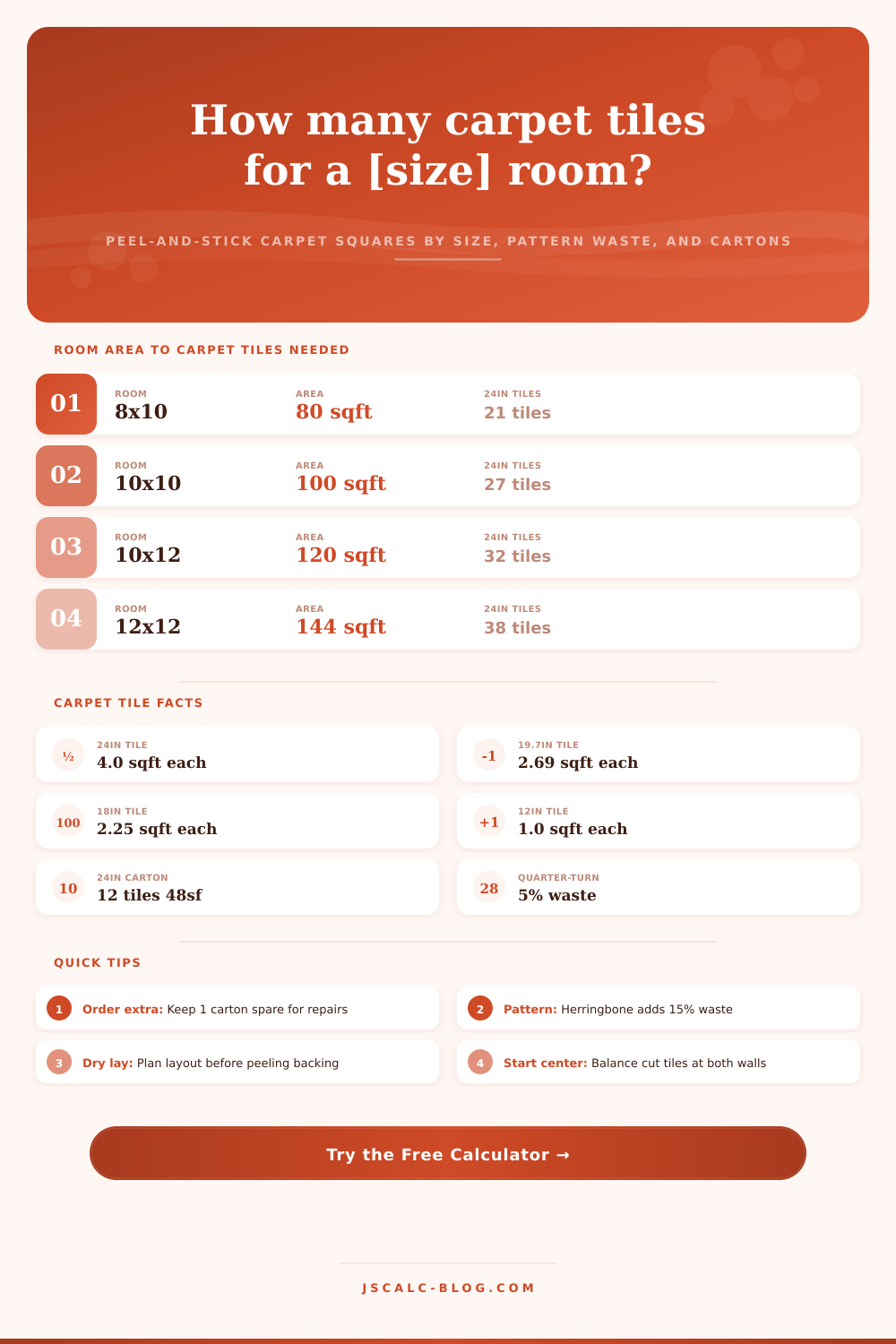
| 24 in x 24 in | 60 x 60 cm | 4.00 sqft | 25 tiles | Offices, large rooms |
| 19.7 in x 19.7 in | 50 x 50 cm | 2.69 sqft | 38 tiles | European / retail lines |
| 18 in x 18 in | 45 x 45 cm | 2.25 sqft | 45 tiles | Homes, DIY peel-stick |
| 12 in x 12 in | 30 x 30 cm | 1.00 sqft | 100 tiles | Borders, small accents |
📦Tiles and Coverage per Carton
| Tile Size | Tiles per Carton | Carton Coverage | Cartons per 100 sqft |
|---|---|---|---|
| 24 in x 24 in | 12 tiles | 48.0 sqft | 3 cartons |
| 24 in x 24 in (bulk) | 20 tiles | 80.0 sqft | 2 cartons |
| 19.7 in x 19.7 in | 20 tiles | 53.8 sqft | 2 cartons |
| 18 in x 18 in | 16 tiles | 36.0 sqft | 3 cartons |
| 12 in x 12 in | 20 tiles | 20.0 sqft | 5 cartons |
♻Install Pattern and Waste Allowance
| Install Pattern | Waste Factor | Cut Complexity | Notes |
|---|---|---|---|
| Quarter-turn / checkerboard | 5% | Low | Rotate each tile 90 degrees |
| Monolithic same-direction | 8% | Low | All arrows point one way |
| Ashlar / brick offset | 10% | Medium | Rows shift by half a tile |
| Herringbone / diagonal | 15% | High | Angled cuts waste more edge |
🧱Adhesion Methods Compared
| Method | How It Works | Pros | Cons |
|---|---|---|---|
| Peel-and-stick | Backing has pressure adhesive | Fast, no mess, DIY easy | Weaker on rough subfloor |
| Adhesive tabs | Sticky dots join four corners | Floating floor, replaceable | Tiles can shift under load |
| Full-spread glue | Trowel adhesive over subfloor | Strongest, best for traffic | Messy, harder to remove |
🗃Install Pattern Comparison Grid
| Pattern | Waste % | Look | Difficulty | Hides Dirt? | Best Use |
|---|---|---|---|---|---|
| Monolithic | 8% | Broadloom, seamless | Easy | Moderate | Executive offices |
| Quarter-turn | 5% | Subtle checkerboard | Easy | Good | Homes, low waste jobs |
| Ashlar | 10% | Plank, brick rows | Medium | Good | Hallways, corridors |
| Brick | 10% | Staggered offset | Medium | Very good | Retail, high traffic |
| Herringbone | 15% | Woven zig-zag | Hard | Very good | Feature rooms, lobbies |
| Random / non-directional | 7% | Textured, casual | Easy | Excellent | Playrooms, basements |
⚙Formula Breakdown
💡Carpet Tile Buying Tips
People tend to think of laying carpet as simple math: measure the walls, divide by the size of your tile… Wrong! The truth is, the cuts are where all the math occurs. Then there’s space between them… The gaps. Unless you have a perfectly square room which is rare, you’ll have uneven edges to consider.
Modular peel-and-stick carpet is increasingly popular in commercial hallways and basement rec rooms because it allow even a massive undertaking to be broken down into workable pieces. If you spill red wine on one tile in 2028, you don’t need to tear out the entire office floor. Just replace that one square.
How to Calculate Your Carpet Needs
The issue arises in knowing how many boxes to purchase such that you aren’t left with excess material or running out at the final wall. Plug in the numbers and the calculator does the math, provided you give it the correct ones, of course. Which brings us to the point: knowing what goes in saves both frustration and money.
Where do we begin? Well, of course, area. But that’s only the beginning; then there are decisions that will increase (or decrease) your grand total considerable.
The first major factor is tile size. Each standard 24-inch square tile cover four square feet, which means fewer boxes and a quicker install on large areas. On the other hand, smaller tiles may be the way to go for more intricate pattern, or if you’re working within a complicated set of furnitures arrangements.
Even though it’ll raise the overall number of boxes, toggling among popular sizes such as 18 inches, 50-centimeter metric squares, and small 12-inch accents shows how quickly the box count can change when you use tool (and it does so instantaneous).
And then there’s the pattern which is where majority of DIY estimates fail. The idea that waste is a buffer is easy to forget: it’s also a requirement with geometry. With a quarter-turn layout, each other tile are turned 90 degrees to form a slight checkerboard effect. This results in wasting roughly five percent of your material. It’s efficient and masks your seams nicely.
But if you want that high-end woven look with a herringbone or diagonal run, you’re looking at fifteen percent waste or more due to unusable scraps from angled cuts. This percentage is included in the total area before you count the tiles so your results are based off real-world needs rather than just theory.
Another variable that will change your shopping list is how you want the carpet attached. Do you prefer peel-and-stick squares, which come with backing? If so then you purchase no additional adhesives to stick them. Or do you plan to use adhesive tabs to secure corner seams of your floating floor, or spread glue over the whole surface (for the ultimate security in high-traffic areas)?
The tool adjusts amount of material needed based off your preference. No more one-size-fits-all with carpet; how you secure it is part of the equation.
The difference between a frustrating install and a smooth one? It is a little habit of buying more than you calculated. An extra carton stored in your garage is insurance against wear and tear and staining in the future, because dye lots changes between manufacturing runs. Add that to a careful dry-lay (laying from the center of the room out balancing cut edges) and that spare box becomes the least expensive insurance policy you’ll ever purchase.
The calculator provides the base line. Adding an extra carton guarantees you’ll never see a mismatched patchwork of flooring because it will all look brand new for years to come. You should of bought one more just in case.