12x12 Tile Calculator
Built only for 12 inch by 12 inch tiles, where every tile covers exactly one square foot. Enter your area or room length and width, choose a waste factor for your layout, and get the exact tile count, the number of boxes to buy, and the thinset bags you need in seconds.
🏠Real Room Presets
📐Tile Job Inputs
Enter room dimensions, or type a known area directly.
Meters convert to sqft automatically at 10.7639.
Longest wall of the room, in the unit chosen above.
Adjacent wall length; area equals length times width.
Used in area mode; enter square feet unless unit is meters.
Covers cuts, breakage, and pattern loss.
Real 12x12 box sizes; each tile inside is 1 sqft.
Bigger notch spreads more mortar, so fewer sqft per 50 lb bag.
Spare full tiles to keep for future repairs.
🔢Key Numbers at a Glance
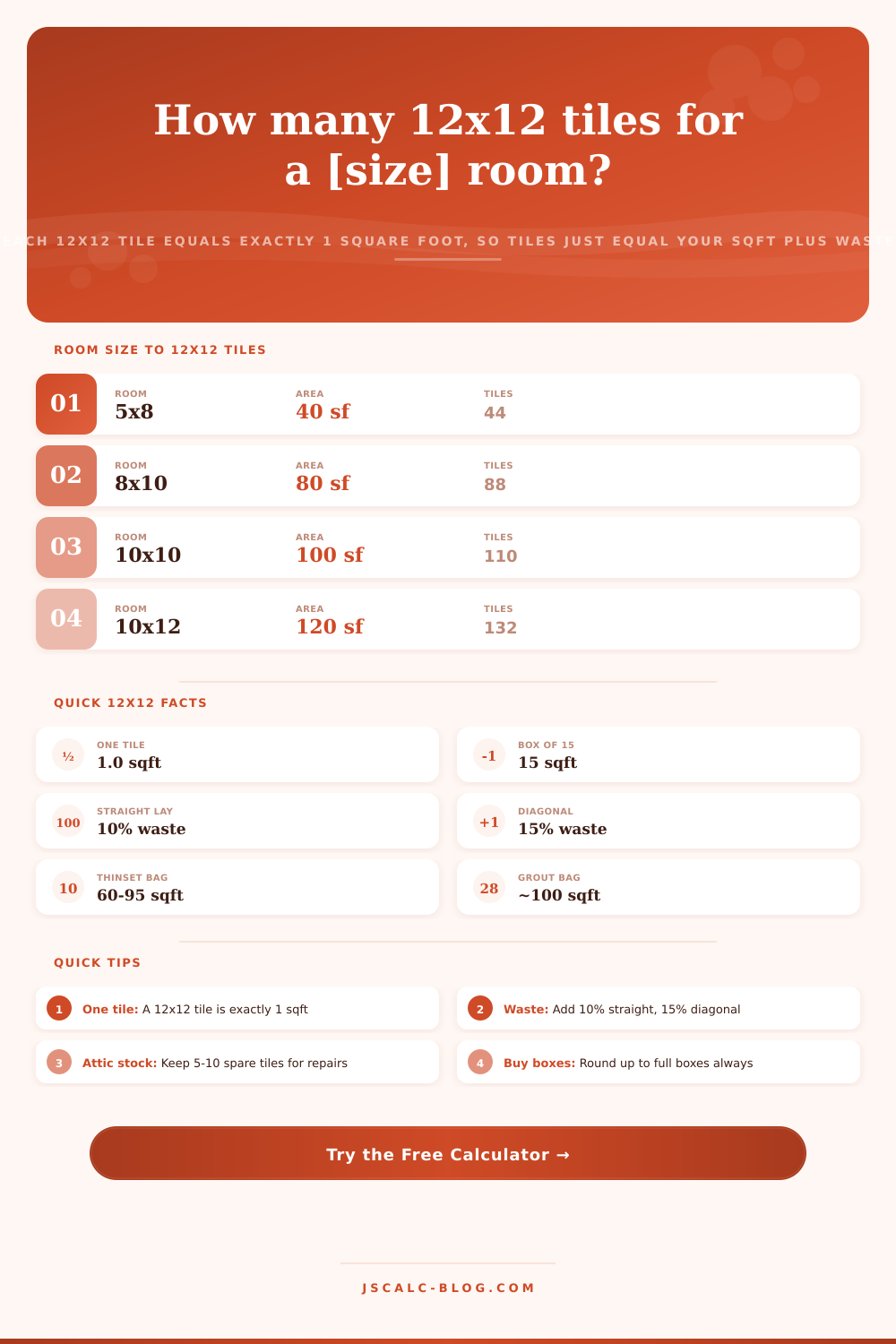
📋Room Size to 12x12 Tiles (with 10% Waste)
| Room Size | Area (sqft) | Tiles + 10% | Boxes of 15 |
|---|---|---|---|
| 5 x 8 ft | 40 | 44 | 3 |
| 8 x 10 ft | 80 | 88 | 6 |
| 10 x 10 ft | 100 | 110 | 8 |
| 10 x 12 ft | 120 | 132 | 9 |
| 12 x 12 ft | 144 | 159 | 11 |
| 12 x 15 ft | 180 | 198 | 14 |
| 14 x 16 ft | 224 | 247 | 17 |
| 16 x 20 ft | 320 | 352 | 24 |
📊Waste Factor by Layout
| Layout Pattern | Add Waste | Multiplier | Best For |
|---|---|---|---|
| Straight, square grid | 10% | x 1.10 | Simple rectangular rooms |
| Diagonal, 45 degrees | 15% | x 1.15 | Entryways and feature floors |
| Complex, many cuts | 20% | x 1.20 | Angled walls, alcoves, niches |
| Large single space | 10% | x 1.10 | Open rooms with few cuts |
| Small tight room | 15% | x 1.15 | Bathrooms with many edges |
| Herringbone or brick | 20% | x 1.20 | Offset and woven patterns |
📦Box Coverage and Thinset Options
| Item | Coverage | Notes | Tiles or Bags |
|---|---|---|---|
| Box of 15 | 15 sqft | Most common 12x12 case | 15 tiles |
| Box of 12.5 | 12.5 sqft | Porcelain and stone lines | 12 to 13 tiles |
| Box of 17 | 17 sqft | Value ceramic packs | 17 tiles |
| Box of 10 | 10 sqft | Premium or heavy stone | 10 tiles |
| 1/4 in square trowel | 95 sqft/bag | Thin, flat setting bed | 50 lb bag |
| 3/8 in notch trowel | 60 sqft/bag | Standard floor tile | 50 lb bag |
| 1/2 in notch trowel | 45 sqft/bag | Uneven slab, thick beds | 50 lb bag |
🗃Full Job Comparison Grid
| Room Size | Area (sqft) | Tiles +10% | Boxes @15 | Thinset Bags | Grout Bags |
|---|---|---|---|---|---|
| 5 x 8 ft | 40 | 44 | 3 | 1 | 1 |
| 8 x 10 ft | 80 | 88 | 6 | 1 | 1 |
| 10 x 10 ft | 100 | 110 | 8 | 2 | 1 |
| 10 x 12 ft | 120 | 132 | 9 | 2 | 2 |
| 12 x 12 ft | 144 | 159 | 11 | 2 | 2 |
| 12 x 16 ft | 192 | 212 | 15 | 3 | 2 |
| 14 x 16 ft | 224 | 247 | 17 | 3 | 3 |
| 15 x 20 ft | 300 | 330 | 22 | 4 | 3 |
| 16 x 20 ft | 320 | 352 | 24 | 4 | 4 |
| 20 x 25 ft | 500 | 550 | 37 | 6 | 5 |
⚙Formula Breakdown
💡Tile Buying Tips
Keep in mind that regular twelve by twelve inch tiles account for a square foot per piece, which simplifies tiling math: if you’re tiling a hundred square foot space then you will need about a hundred tiles. That’s the easy part; normaly what causes problems is figuring out the waste and layout cuts. Let the calculator do the math work, and let your brain concentrate on the logic of how to lay it out.
How does it work? It include extra waste, depending off your installation method. For example, you need roughly ten percent additional if you’re installing a straight lay in a simple rectangular room (for cutting around edges). If you’re installing diagonally, where you have to cut into the corners, you’d needed about fifteen percent additional because the corner cuts will waste more material. If you are doing something complex like an angled wall/niche combo, perhaps add twenty percent to account for all those odd bits you’ll just throw away rather than put down.
How to Calculate Tiles for Your Project
Since stores sell tiles in boxes rather than individually, the calculator round to the nearest box (a typical box contains 15 sq ft) to ensure that we are rounding up when budgeting. For example, if your project requires a hundred and ten tiles, then you need to purchase eight boxes, not seven point three. You can’t go to the store and just buy part of a box, so it’s important to round up for an accurate budget.
Also remember: calculate how much mortar you’ll use by size of notch in the trowel. Bigger notches yield thicker layers of adhesive (good if you have an uneven floor or are installing heavy stones) but require more product. Ninety five sq. You get ninety-five square feet per fifty pound bag with a quarter inch square notch, and forty-five with a half inch notch. If you don’t pick the right trowel, you will either be wasting money or your tiles may pop loose later because they weren’t glued down well enough. This calculates the number of bags you should of order depending on which one you choose.
Stockpile a few extra tiles: The color of certain tiles will vary between manufacturing runs. Even if you buy an identical brand of tile again in 2 years, it may not exactly match your existing floor. Stockpiling 5 or 10 extra tiles ensure that any future repairs match perfectly. It’s like insurance for when things get scratched and scuffed by moving furniture and dropped objects.
The page has some reference tables of typical room sizes so you can check how your estimates compare. For example, a ten by ten kitchen require approximately one hundred tiles plus waste, while a sixteen by twenty living area will require around three hundred and fifty. These aren’t prescriptions, they’re just guides to get an idea of what the scale would be. You should still measure your specific space, accounting for closets, alcoves, and built-ins that might reduce the actual floor area.
Ordering Tile: Being prepared is more important than being perfectly accurate. Running out and having to mix in a different lot will cost you big-time. You’ll end up with a noticeable color difference, which is worse then having some excess boxes stored in your garage. With the calculator, you won’t need to guess when ordering supplies. You can use the time for cutting placement, pattern flow, and other design elements.
Know your space… Enter your room dimensions, select your layout type and let it do the work. Include an additional percentage of waste, round up to the next whole box and factor in mortar requirements. Once you take away the worry, it’s that easy.
You know how many square tiles you have. You also need to cover a floor. Trust your measurements, buy a few extra boxes and hide them away. That will get you ready for when something needs repair down the road.