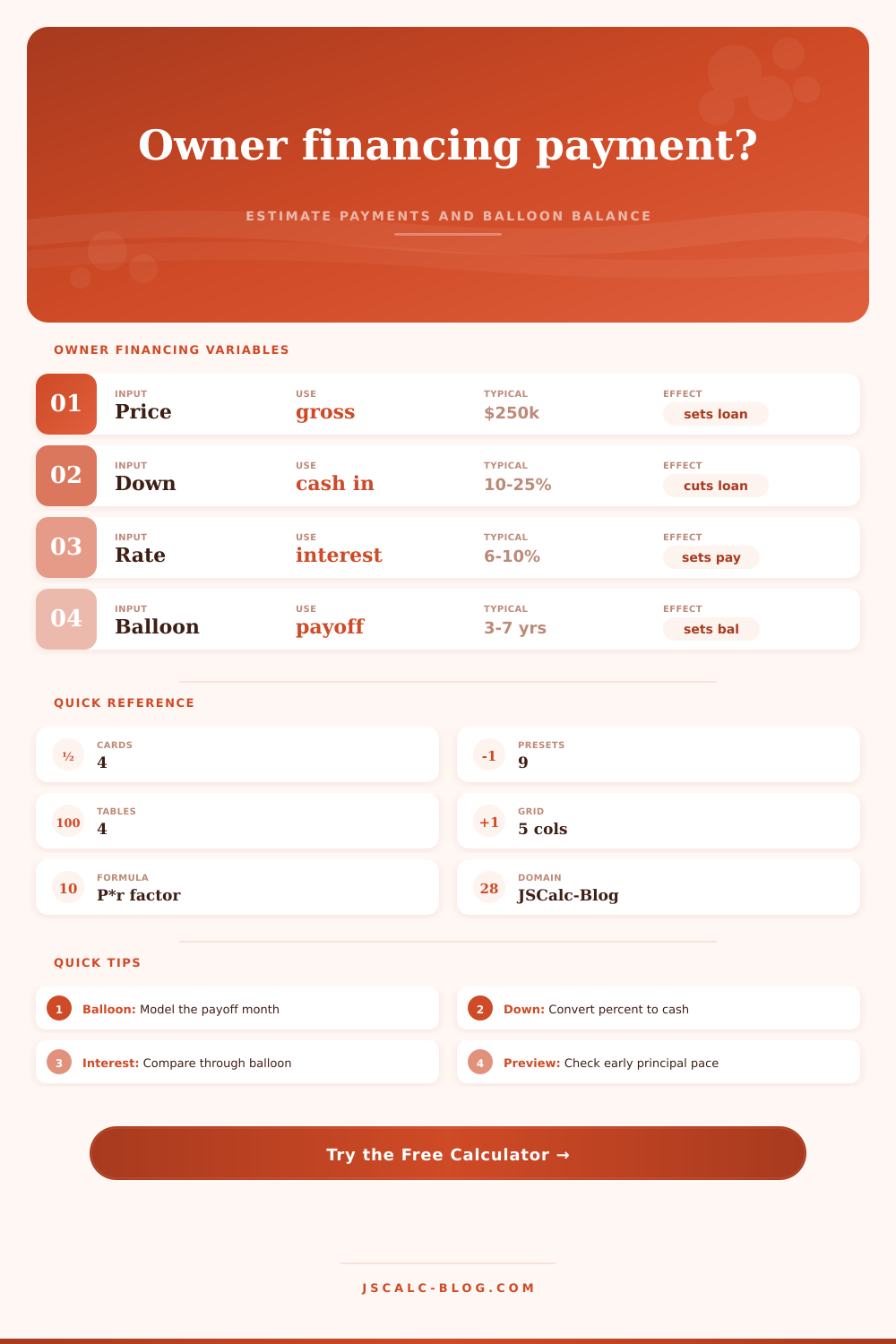
Owner Financing Payment Calculator
Estimate a seller-financed note with down payment, amortized or interest-only payments, balloon balance, total interest, payoff timing, and a month-by-month preview for JSCalc-Blog.com.
Start with a common seller-financing structure, then tune the rate, amortization, balloon term, and extra principal.
The preview shows beginning balance, scheduled payment, interest, principal, extra principal, and ending balance for the first selected payments.
| Payment | Beginning Balance | Scheduled Payment | Interest | Principal | Extra Principal | Ending Balance |
|---|---|---|---|---|---|---|
| Run the calculator to build the amortization preview. | ||||||
| Structure | Scheduled Payment | Balloon Balance | Interest Through Balloon | Principal Paid | Best Used When |
|---|---|---|---|---|---|
| Run the calculator to compare amortized, interest-only, and shorter payoff options. | |||||
| Term Element | Common Range | Payment Effect | Balloon Effect | Seller Risk Note |
|---|---|---|---|---|
| Down payment | 10% to 30% | Higher down lowers payment | Higher down lowers payoff | More buyer cash at closing |
| Interest rate | 6% to 10% | Higher rate raises payment | Small direct effect if amortized | Compensates seller for time |
| Amortization | 15 to 30 years | Longer term lowers payment | Longer term raises balloon | Slower principal recovery |
| Balloon date | 3 to 10 years | No direct scheduled change | Earlier date raises payoff | Refinance timing matters |
| Interest-only | 6 to 60 months | Lowest scheduled payment | Principal mostly remains | Needs clear exit plan |
| Extra principal | Optional | Raises cash outflow | Lowers balloon balance | Improves principal recovery |
| Step | Formula | Calculator Use | Output | Check |
|---|---|---|---|---|
| Down payment | Price x down % | Computes cash down | Down dollars | Cannot exceed price |
| Note principal | Price - down | Sets financed amount | Seller note | Must be positive |
| Periodic rate | Annual rate / periods | Converts annual rate | Rate per pay | Zero rate allowed |
| Amortized payment | P*r(1+r)^n / ((1+r)^n - 1) | Schedules P and I | Payment | Uses full amortization |
| Interest-only | P x r | Schedules interest only | Payment | Principal remains |
| Balloon balance | Balance after k pays | Stops at balloon date | Payoff due | Includes extra principal |
The seller sits across from you. You shake hands on a deal that seems right. But you can barely make out the numbers on the back of a napkin.
The house is three hundred twenty-five thousand dollars, and you’re putting down fifteen percent, a solid chunk of cash that instantly reduce the principal the seller finances. Once you plug in terms (balloon term, interest rate, down payment) into the calculator above, it do the math for you, saving you the guesswork on conversions and coefficients.
How to Use the Seller Financing Calculator
Yes, this is about whether or not you can afford the monthly check. But it’s also about knowing exactly how much money you need sitting in a rainy-day fund for that day when the balloon drops. If you don’t pay enough principal along the way, then that day will come sooner then you think. Here’s where amortization really kicks in, and the key is understanding what it actualy accomplishes here.
If you’re using an amortized payment with a thirty-year schedule, the amortization stretches the principal repayment across three hundred sixty monthly installment. Those payments appear affordable. But remember: your seller note isn’t going to run for thirty years. With a five-year balloon, you’ll make those tiny payments for just sixty months before coming up with the rest. That’s when the balloon balance is due, the difference between what you’ve paid and what you still owe at that point.
Borrowers new to seller financing often don’t realize that the long amortization doesn’t mean the loan will vanish by that time. It won’t. A longer amortization reduce your monthly payment but increases total payoff sum. Table of references on the page shows this clearly.
Since the seller is taking on more risk with an owner finance deal, the interest rate tend to be higher… Floating above what you’d get at the bank. Rates can range anywhere from eight to nine percent, which is steep (the total cost of borrowing). That said, if the bank wants a large downpayment or has exorbitant origination fees, the monthly payment could still be cheaper than a bank mortgage.
To show you that difference, you can toggle between interest only and amortized payments. If your income is variable, interest only will keep the monthly cash outflow low, but you won’t really be building equity via the payments themselves. In other words, you’re renting the money from the seller. That’s great if that’s what you’re trying to do, but dangerous if you don’t remember to sell/refi before the balloon date.
The strongest tool in this scenario, and by far the most powerful of any additional principal feature, is the one to reduce that scary balloon. Adding a few hundred bucks (or whatever) to each monthly payment directly decreases the principal, which decrease the amount of the balloon and saves you interest payments in the process. A little bit here or there may not seem like much, but it matters more than negotiating a slightly lower interest rate.
You see exactly where every dollar from each payment go. Toward principal or interest. You’ll watch your equity increase before your eyes in the amortization preview table. For the first several months, nearly all of your payment will go toward interest. It is slow going, but then the amount of principal increase as time goes on.
All these deal structures are modeled based off real-world deals. These range from raw land to investor rentals to your own starter home. This isn’t made up stuff. It’s a reflection of what buyers can afford and what sellers are willing to accept based on their risk level. If a seller accepts a lower down payment, they needs a higher interest rate. If something goes wrong, the house could be foreclosed upon. The seller is also exposed to market changes and default risk.
You are trading flexibility for access. Model the deal, don’t focus solely on the monthly payment. Focus on how much total interest will be paid by the balloon date. That’s the true price you’ll pay for the bridge. This is the exit strategy.
Don’t be blinded by a nice monthly payment! The deadline is the balloon date. By that time, would of you refinanced into a conventional mortgage? Will the property have gone up enough in value so you can sell at a gain?
The calculator won’t predict what happens next. But it provides clarity to plan ahead. You know the cost of the bridge. Which means you’ve entered this deal with your eyes open. That’s where people go wrong. They fixate on the entry, and forget about the exit. Be prepared for both.