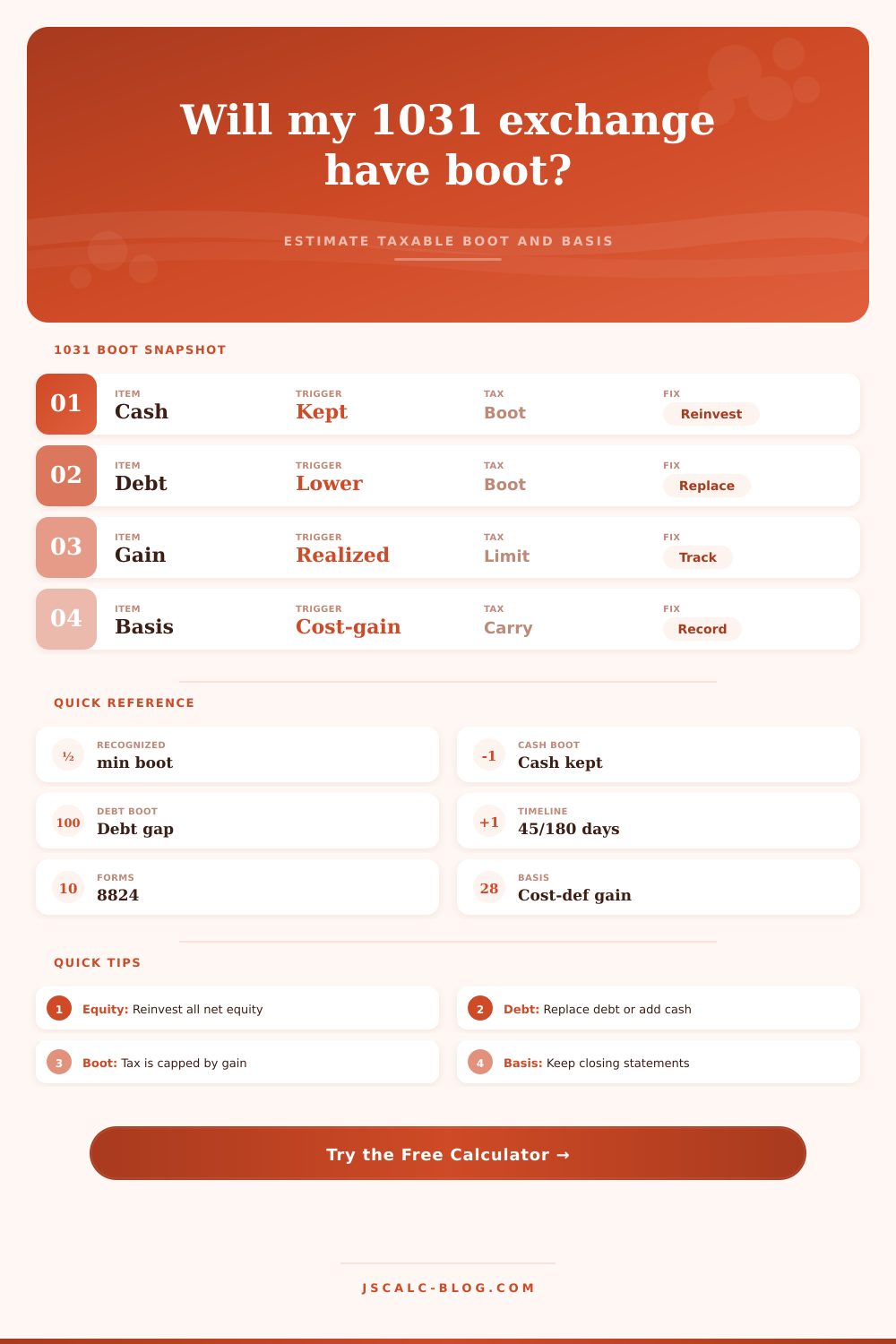
1031 Exchange Boot Calculator
Estimate cash boot, mortgage or debt-relief boot, realized gain, recognized gain, deferred gain, estimated tax, and the carryover basis of the replacement property on JSCalc-Blog.com.
Load a realistic exchange pattern, then adjust the sale, debt, reinvestment, basis, and tax-rate inputs.
The grid recalculates alternate structures from your current inputs so you can see how adding cash, replacing debt, or buying up changes the result.
| Structure | Cash Boot | Debt Boot | Total Boot | Recognized Gain | Deferred Gain | Basis |
|---|---|---|---|---|---|---|
| Current inputs | $0 | $0 | $0 | $0 | $0 | $0 |
| Boot Type | How It Appears | Calculator Treatment | Planning Lever |
|---|---|---|---|
| Cash boot | Cash received, unspent exchange proceeds, notes, or non-like-kind property. | Added to total boot before applying the realized-gain cap. | Reinvest all net exchange equity into like-kind replacement property. |
| Mortgage boot | Debt paid off on the old property exceeds replacement debt. | Debt relief is reduced by outside cash invested, then added to boot. | Replace debt, assume liabilities, or contribute enough new cash. |
| Expense boot | Nonqualified expenses are paid from exchange proceeds. | Included with cash boot through the nonqualified cost input. | Pay financing charges and personal items with separate cash. |
| Taxable limit | Boot exceeds the economic gain in the relinquished property. | Recognized gain equals the lesser of total boot or realized gain. | Confirm adjusted basis and depreciation before filing Form 8824. |
| Checkpoint | Full Deferral Target | Partial Deferral Signal | Calculator Input |
|---|---|---|---|
| Value replacement | Buy replacement property equal to or above net sale value. | Replacement value is lower than relinquished net value. | Sale price, selling expenses, replacement price. |
| Equity reinvestment | Use all exchange equity for like-kind property. | Cash is kept or exchange proceeds remain unspent. | Cash received, replacement debt, outside cash. |
| Debt replacement | Replacement debt plus added cash equals old debt. | Debt relief remains after cash contribution. | Old debt, replacement debt, new outside cash. |
| Expense character | Qualified exchange costs reduce amount realized. | Loan fees or personal items paid from proceeds. | Exchange expenses and nonqualified costs. |
| Tax reporting | Recognized gain is zero when boot is zero. | Boot exists but tax is capped by realized gain. | Realized gain, boot, and tax-rate inputs. |
| Reference Item | Common Rule | Why It Matters For Boot | Documentation To Keep |
|---|---|---|---|
| Identification period | Replacement property is usually identified within 45 days. | A rushed replacement can create value or debt shortfalls. | Written identification sent to the qualified intermediary. |
| Exchange period | Replacement property is usually received within 180 days. | Late or failed closings can leave taxable cash proceeds. | Closing statement and QI disbursement records. |
| Form 8824 | Like-kind exchanges are reported with the tax return. | The form reconciles boot, realized gain, and basis. | Sale HUD/CD, purchase HUD/CD, basis schedule. |
| Depreciation records | Prior depreciation affects adjusted basis and recapture. | Lower basis can make more boot immediately taxable. | Depreciation schedule and improvement ledger. |
| Step | Formula | Meaning | Result Use |
|---|---|---|---|
| Amount realized | Sale price - qualified sale and exchange expenses | Net value disposed of for gain calculation. | Sets realized gain and value replacement target. |
| Realized gain | Amount realized - adjusted basis | Total economic gain before 1031 deferral. | Caps how much boot can be recognized as taxable gain. |
| Net boot | Cash boot + debt relief boot + nonqualified expense boot | Total non-like-kind value received or debt not replaced. | Compared with realized gain to find recognized gain. |
| Recognized gain | Minimum of total boot and realized gain | Estimated gain currently taxable from the exchange. | Allocated to recapture, capital gain, and state tax. |
| Replacement basis | Replacement cost - deferred gain | Carryover basis after the deferred gain is preserved. | Used for future depreciation and future sale gain. |
When you sign the closing docs on your rental property sale, that money begins to feel real. The mortgage are paid off. The agent fees are gone. And the wire lands in your qualified intermediary‘s bank account.
But it isn’t all yours yet. Until you’re able to park that money into another similar investment, the IRS owns it. Take one single dollar toward a new car or a vacation, and the tax code consider this a distribution of value. At this point, boot comes into play. Boot (technical term) refers to any amount of cash or debt relief that you retain rather than reinvest, which immediately triggers taxes.
Understanding Boot and Debt in 1031 Exchanges
The 45-day window is where most investors get hung up, but that’s not the issue. The issue with depreciation recapture is in your math: it’s a specific component of your gain that is taxed at a higher rate. How much are you getting back? You might be able to nail a property’s identity on paper, and still end up with a huge tax bill.
How do we model these cash vs. How do debt relief flows behave? By splitting them into two separate boots (the calculator above helps with that).
Why does it matter? It matters because of how each behaves at closing. Cash boot is straightforward: It’s the dough that you opt to keep for yourself. Debt relief boot is trickier: When your existing mortgage vanishes, the IRS views that relief like you’ve been given a wad of cash. If the new place doesn’t need such an enormous loan (or if you elect not to borrow against the new purchase), the difference becomes taxable income. Yes, that stuff doesn’t appear in your fist; however, tax bill is very real.
Our calculator compares these total boot amounts with your realized gain, calculating the amount you’re on the hook to report. The adjustment to basis is the amount you sell the property for minus the amount you paid (the “adjusted basis”). You will pay tax on whichever is lower. So if you’re not going to get that money anyway, this cap ensures that you don’t pay tax on money you’ll never see. However, each dollar of boot reduce the size of your tax protection.
Most people misunderstand what they need to do to defer all the tax; they only consider replacement’s purchase price. They believe that by purchasing an asset worth the same or more than their selling price, they’ll automatically be able to fully defer. Nope! In fact, you have to replace both the debt and equity, too. (And value isn’t the only measure.)
Suppose you sold a building with a large mortgage and bought a new one with no mortgage. The difference between your old mortgage and your new one counts as debt relief boot. To avoid it, you’d need to add outside cash to cover that gap. Your calculator will let you enter both existing debt and the proposed debt, so you can see exactly how much extra money you’d need to invest in order to maintain a zero boot.
It will also account for qualified exchange costs, which will reduce the amount realized, hence lowering your gain. This reduces the boot. Nonqualified costs, like financing fees, don’t give you this benefit, and if you pay them out of proceeds of the exchange, they’ll contribute to a positive boot.
The timing matters. Under a 1031, you have 180 days from the day of sale to close on the replacement. If it’s a hot market, you might need to settle on something that isn’t exactly your ideal situation; either because your search is taking too long, or because there simply aren’t any better deals out there. That might force you into a lower-value property or one with less financing, creating a value gap. The values does not match.
To see this play out, the tool has a series of check points (outlined in the tables) which show when partial deferment indicators deviate from complete deferral targets. Run through a couple different scenarios. Load up a pre-set in which you retain some cash, or reduce amount of debt on the replacement. Notice how the acknowledged gain increases. Now restore the cash. Observe the figures adjust.
That’s the power of using debt within a 1031 exchange. It turns the strategy from “just trading keys” into “managing a balance sheet.” You’re swapping liabilities, too. The trick is to save as much basis as you can. For every dollar you defer of gain, your basis goes down. When you finally sell (without doing a 1031), you’ll have less basis for the new place, which means you’ll pay more in taxes. That’s why minimizing your boot today reduces your tax bill down the road.
That’s what the calculator presents. An illustration of that trade-off. Based off both current capital gains rates and any depreciation recapture, it estimates how big a dent this might leave in your tax bill. Since depreciation recapture gets treated like ordinary income; not capital gains, boot containing any portion of that gain costs you more. Have your depreciation schedule(s) and your closing documents nearby. The numbers are estimates, but they’re based on the same formulas used by the IRS. Run ’em through the machine and use ’em to stress test your plan before you sign.
Modeling for a few minutes could save you thousands when tax time comes. The money is real right now. But it remains real if-and-only-if you reinvest it all.