Home Sale Tax Exclusion Calculator
Estimate Section 121 eligibility, gain, exclusion limit, and taxable home-sale gain with JSCalc-Blog.com.
📌Real Sale Presets
🧾Sale, Basis, and Eligibility Inputs
Calculation Breakdown
📊Section 121 Quick Facts
🔍Eligibility Comparison Grid
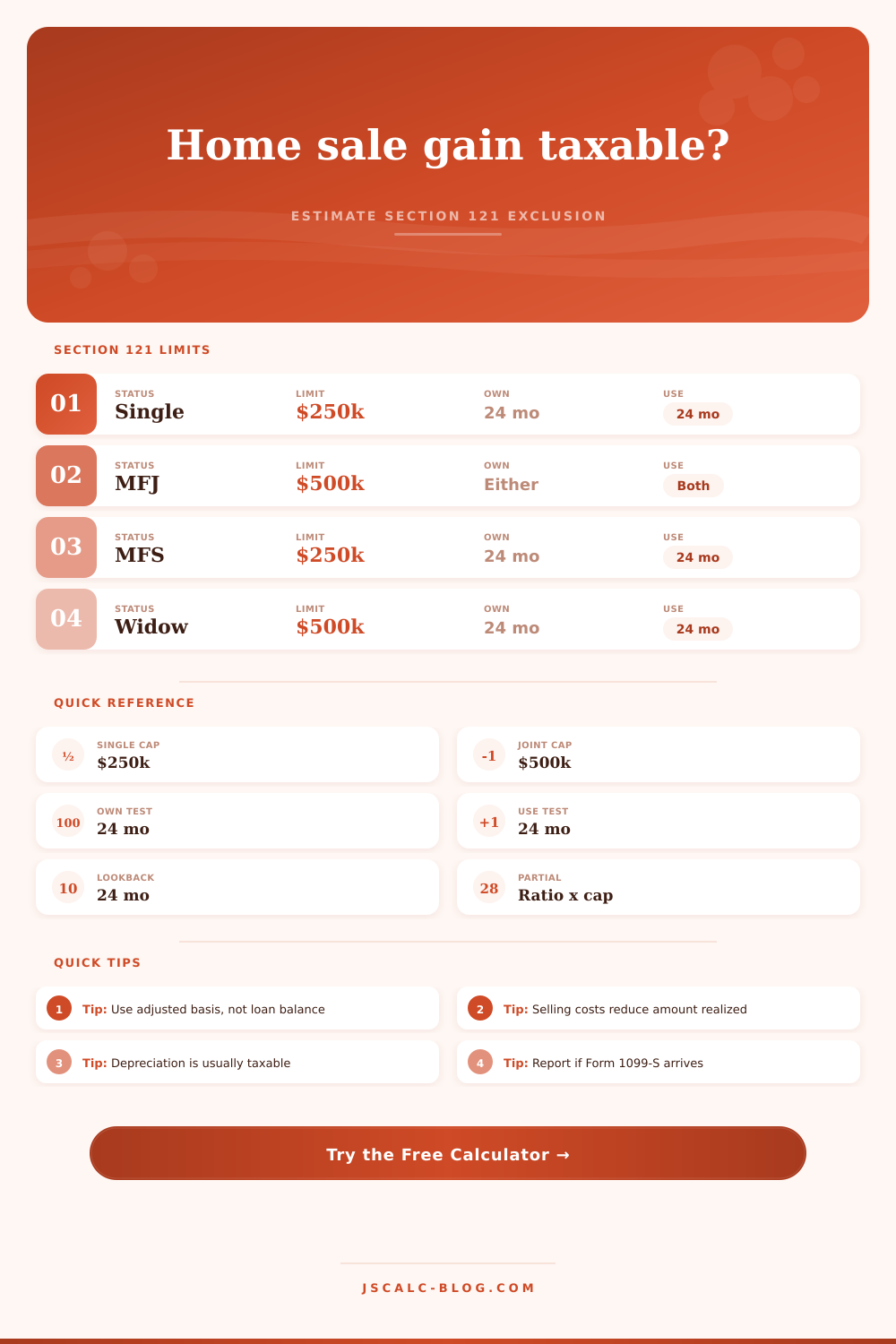
| Filing path | Maximum exclusion | Ownership test | Use test | Lookback test | Calculator treatment |
|---|---|---|---|---|---|
| Single | $250,000 | You owned 24 months in the 5-year period | You used it as main home 24 months | No prior exclusion within 24 months | Full, partial, or none |
| Married filing jointly | $500,000 | Either spouse meets 24 months | Both spouses meet 24 months | Both spouses clear the two-year lookback | Full joint limit or spouse-by-spouse partial |
| Married filing separately | $250,000 | You meet the 24-month ownership test | You meet the 24-month use test | You clear the lookback | Same limit as single |
| Qualifying surviving spouse | $500,000 | Ownership/use can include late spouse time | Must meet the 24-month residence rule | No recent exclusion by either spouse | $500k only if sale is within 2 years |
| Second home or investment property | $0 | Not enough by itself | Must be main home use | Still relevant | No Section 121 exclusion shown |
| Recent 1031 acquisition | $0 in simplified model | Special holding rules apply | Special rules apply | Still relevant | Flags disqualification for review |
🧮Gain and Basis Reference Table
| Line item | Typical effect | Where it enters | Example |
|---|---|---|---|
| Sale price | Increases amount realized | Top-line sale amount | Contract price before selling costs |
| Selling expenses | Reduce amount realized | Subtracted before gain | Commissions, transfer taxes, escrow fees |
| Adjusted basis | Reduces gain | Subtracted from amount realized | Purchase basis plus capital improvements |
| Depreciation after May 6, 1997 | Usually taxable | Non-excludable gain input | Home office or rental depreciation allowed |
| Nonqualified-use gain | May be taxable | Other non-excludable gain input | Certain post-2008 non-main-home periods |
| Personal residence loss | Not deductible | Shown as zero taxable gain | Sale below adjusted basis |
📋Partial Exclusion Reference
| Reason category | IRS-style trigger | Ratio used here | Notes |
|---|---|---|---|
| Work-related move | New work location generally 50+ miles farther from home | Shortest qualifying months / 24 | Can apply to spouse, co-owner, or resident in some cases |
| Health-related move | Move for diagnosis, treatment, care, or doctor-recommended change | Shortest qualifying months / 24 | Family-care moves can qualify under Publication 523 |
| Unforeseeable event | Death, divorce, multiple births, unemployment, or similar event | Shortest qualifying months / 24 | Facts matter; keep documentation |
| Other facts and circumstances | Primary reason is work, health, or unforeseeable even if not a safe harbor | Shortest qualifying months / 24 | This calculator estimates; tax advice may be needed |
📘Reporting and Caveat Table
| Situation | Taxable gain result | Reporting signal | Calculator note |
|---|---|---|---|
| Gain fully excluded and no 1099-S | $0 taxable gain | Often no sale reporting required federally | Confirm with current return instructions |
| Form 1099-S received | Could still be $0 | Sale generally must be reported | Use Form 8949/Schedule D guidance |
| Gain exceeds exclusion limit | Excess remains taxable | Report non-excluded gain | Calculator shows gain before applying tax rates |
| Depreciation or rental allocation | May be taxable even with exclusion | Often requires extra forms | Enter known non-excludable gain separately |
| Loss on personal home | No taxable gain | Loss is generally not deductible | Calculator floors taxable gain at $0 |
💡Two Practical Tips
I can tell you from experience that everyone believes that selling a house simply involves finding a replacement residence and paying closing costs. What they fail to realize is that the IRS has a rather narrow definition for determining which homes qualifies as your primary residence, and this may not be clear until you’re knee-deep in changing residences.
The Section 121 exclusion provides that you can exclude up to $250,000 of capital gains on the sale of your home (or $500,000 if married and filing jointly). This is one of most valuable tax breaks available, so long as you follow some pretty strict requirements regarding use and ownership, even if you are a savvy seller. To help you do this without having to guess if you qualify for 100% or something less, plug your basis and sale price into the calculator above and it’ll crunch the numbers for you.
How to Calculate Your House Sale Tax Exclusion
Here’s what’s important to know about how it works: Not all gain are created equal. First, you typically pass the use test if you lived in the home as your primary residence for at least two out of the past five years. Second, you must have owned it for at least two years during that period, too.
Note: These periods do not have to be consecutive. You could rent out your home while living abroad for a year or two, then return and still meet the qualifications if the total time add up to what is required. People frequently underestimate this flexibility when they think they were disqualified after moving out for a period due to health issues or a job transfer.
The adjusted basis, one of the more tricky inputs, isn’t just what you paid for the house, but rather, your purchase price plus major improvements made to the property over time. An addition? A new roof? Those count. But routine maintenance (such as gutter fixes or repainting) don’t. Why does this matter? A higher basis mean a lower gain, which lowers your tax bill.
Additionally, if you’ve rented out all or part of your home and taken a depreciation deduction for it, that depreciation recapture will typically be taxable, even if you’re eligible for the main home exclusion. So the calculator breaks out this non-excludable gain so you know precisely how much of your profit is actualy shielded vs. What may come under scrutiny on your return.
That’s where it gets interesting: partial exclusions. In certain circumstances (i.e., if you move because of a health issue, new job, etc.) you can sell under the two-year mark and still get some sort of exclusion. Not necessarily the whole thing, but something. As long as you lived in the property during those two years, the IRS will consider the main reason you sold it and decide whether you’re eligible. For lots of people who don’t fall into the neat “five-year box,” this is a valid way out.
The calculator assumes that you were a homeowner for X number of months and occupied it for Y number of months. Then it compares that against the total 24-month period you need to meet for a complete exclusion. That produces an estimate of what you’d owe, which you should think of as a ballpark figure rather then an exact amount.
One more layer for the confusion: There’s also a reporting element. Depending on who sells it to you (i.e., the settlement agent), they may send you a Form 1099-S that reports the gross proceeds of the sale. If you’re expecting to owe tax on all your gain, seeing this form will raise eyebrows. Even though you may exclude your entire gain! You won’t owe anything by receiving this form, it simply indicates that the transaction has been recorded.
You’ll report the sale so the IRS knows that you have claimed an exclusion under Section 121. Don’t ignore it, thinking “I don’t owe taxes,” or you risk getting questioned about it down the line. The reference table in the tool breaks these scenarios out well, differentiating those that must be reported vs. Others that may not need to be reported.
Many sellers mistakenly believe that their mortgage balance is equal to their basis. That’s not true. Your basis includes your investment in the property… I.e., what you’ve paid for it over time (plus closing costs when you purchased the place). For example, if you purchased your home for $300,000 twenty years ago, your basis might be much higher today due to renovations and original fees… which means your basis has gone up significantly. Using the incorrect number here will mess up your gain calculation. This is why you should of gotten those records in order before listing the property.
Bottom line: Selling a house isn’t just about the transaction; it’s also a tax event, so we’re going backwards in time to review your last five years of homeownership. The exclusion is generous, but it’s not infinite. If you took depreciation on business use or rented out any part of the property, that’s still taxable. And gains beyond the exclusion amount are fair game for capital gains taxes.
Knowing which part of the gain is excludable, and which parts aren’t, allows you to separate the wheat from the chaff without unpleasant surprises in April. Instead of anxious planning for the future, you’ll know exactly what’s what. The math will be straight-forward once you have the correct numbers. And if you understand the rules, you get to keep what’s rightfully yours.