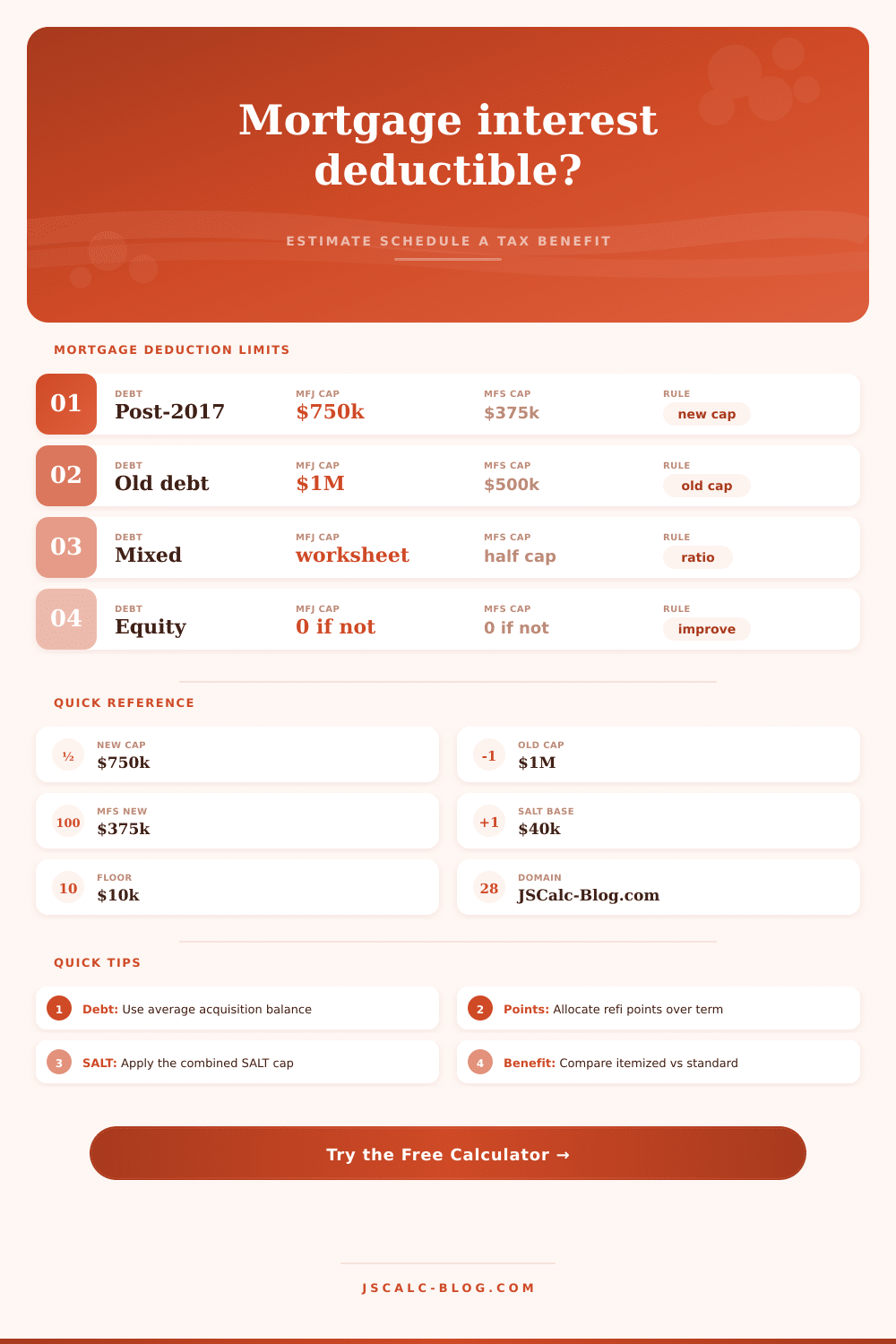
Mortgage Interest Deduction Calculator
Estimate deductible home mortgage interest, points, loan-limit allocation, SALT context, itemized deduction comparison, and marginal federal tax benefit on JSCalc-Blog.com.
Load a realistic filing pattern, then edit the balances, Form 1098 interest, points, SALT, and standard deduction inputs.
Full Calculation Breakdown
| Debt category | Acquisition date or use | MFJ, Single, HOH, QSS limit | MFS limit | Interest allocation | Calculator treatment |
|---|---|---|---|---|---|
| Post-2017 acquisition debt | After Dec. 15, 2017 | $750,000 | $375,000 | Deductible up to cap ratio | New balance input |
| Older acquisition debt | Before Dec. 16, 2017 | $1,000,000 | $500,000 | Deductible up to older cap | Older balance input |
| Mixed old and new debt | Both timing buckets | Publication 936-style blended limit | Half limits apply | Qualified limit / total acquisition balance | Ratio applied to interest and points |
| Home equity used for improvements | Buy, build, or substantially improve | Included with acquisition debt cap | Included with half cap | Can qualify if secured by the home | Enter in the proper balance bucket |
| Home equity used for personal spending | Debt, school, travel, investing, cash-out use | No deduction for that interest | No deduction for that interest | Excluded from home mortgage interest | Use nonqualified interest input |
| Second home debt | Main home plus one qualified second home | Shared combined cap | Shared combined half cap | Same limit ratio across both homes | Select main plus second home |
| Scenario | Interest | Points | SALT allowed | Other items | Total itemized | Benefit vs standard |
|---|---|---|---|---|---|---|
| Run calculator | $0 | $0 | $0 | $0 | $0 | $0 |
| Point situation | Common federal treatment | Calculator method | Useful input | Watch item |
|---|---|---|---|---|
| Purchase points | May be deductible in the year paid if IRS conditions are met | Full points this year, then debt-limit ratio | Point deduction method: purchase | Must be true points, not disguised fees |
| Refinance points | Usually deducted over the life of the new loan | Points / years x months / 12 | Amortization years and months held | Remaining points can accelerate when loan ends |
| Home improvement refinance points | Improvement portion may have special timing | Use custom entries if splitting points | Separate qualified and nonqualified interest | Documentation matters |
| Seller-paid points | May be treated as paid by buyer in some purchase cases | Enter deductible amount only | Points paid this year | Coordinate with basis and settlement statement |
| No points deduction | No current Schedule A points line | Points treated as $0 | Do not deduct points | Use if points fail IRS conditions |
| Filing status | 2025 standard deduction | 2026 standard deduction | 2025 SALT cap base | SALT phaseout threshold | Minimum SALT floor |
|---|---|---|---|---|---|
| Single | $15,750 | $16,100 | $40,000 | $500,000 MAGI | $10,000 |
| Married filing jointly | $31,500 | $32,200 | $40,000 | $500,000 MAGI | $10,000 |
| Married filing separately | $15,750 | $16,100 | $20,000 | $250,000 MAGI | $5,000 |
| Head of household | $23,625 | $24,150 | $40,000 | $500,000 MAGI | $10,000 |
| Qualifying surviving spouse | $31,500 | $32,200 | $40,000 | $500,000 MAGI | $10,000 |
Maybe it was a shiny new bathroom after some renovations. It was a nice place to hang out, and maybe it gave you a feeling of “I did something.” It’s not just pretty; you took out new debt. But you got a tax benefit for it for years. The interest paid on the loan you took out to spruce up the bathroom? It is deductible. That reduced your federal tax bill for years.
And then the ground moved under you. The rules changed. What you could deduct is capped. A simple formula became a maze filled with debt limits and details based off your filing status.
How to Calculate Your Real Tax Savings from Home Loans
Homeowners think they can deduct every dime of mortgage interest they pay. Most people get that wrong. They’re getting that one wrong. The IRS draws a pretty tight distinction between “qualified acquisition debt” and anything else. It qualifies if the loan was taken out to purchase (or build) or substantially improve your home. Anything else, i.e., taking cash out for a boat, sending kids to college or paying off credit card balances, is effectively invisible to Uncle Sam.
So enter your own balances into the calculator above and it will crunch the numbers for you, no need to guess if your renovation loan is included or not. Then it splits out your pre-2017 debt from more recent borrowing. That’s important, because they has separate limits. Joint filers can claim up to a million dollars on older debts. You can get seven hundred fifty thousand on newer ones. If you’ve got both, then you’re subject to some kind of blended ratio that few people accurately compute by hand. So the tool does it for you and shows you what percentage of your interest realy survives the limit test.
There is one more point to consider. On the purchase side, you’re typically allowed to deduct these right away. On the refi side, no way: These has to be amortized across the life of the new loan. You’ll see an option for this on the calculator to spread the cost of points over your loan term. You will also see an option for how many months you lived with mortgage. This means that if you refinanced in November, you won’t recieve the full year’s worth of deductions; just a fraction of it. It is a small detail, but it matters when every dollar counts.
The catch is the state and local tax trap. Perhaps you have a hefty property tax bill. Great. A nice deduction for you, right? Yes … until it hits the cap. And the cap is no joke; it’s a hard cap on how much in state and local taxes you can deduct. Beyond the ceiling, the extra goes away for federal purposes. Enter your property tax bill (and any other state taxes) into the tool, and it will tell you what’s inside the cap and what isn’t. It helps provide a realistic picture of how much you’ll be able to claim in itemized deductions.
The catch: Just because it’s a big deduction doesn’t mean much. Unless you top the standard deduction. Which is pretty high these days, then you don’t get any benefit from paying mortgage interest on your federal tax bill. For example, for many homeowners, their mortgage interest won’t be enough to top the standard deduction. If this applies to you, then you don’t save any federal tax at all when you itemize, even though you’re making a huge deduction.
That’s where the “incremental” part comes in. Our calculator calculates your total listed deductions compared with the standard deduction based on your filing status. So if you see a zero, well, you know you’re not saving any federal tax money from itemization. After that, it calculates how much more in interest you’ve paid and then projects what your federal tax benefit would of been (given your marginal rate). This is the true savings amount. It is not the grand total interest you paid. That’s the extra deduction times your tax bracket. The actual economic value of your mortgage interest distinguishes between accounting and cash flow impact.
Making these calculations is about seeing the big picture. You need to consider more than just the size of the loan. You also need to consider what kind of debt it is. When did you take this loan? How much did the points cost you? What’s your state tax liability? And where does the standard deduction kick in? This calculator pulls all that information into one spot. A jumble of tax rules becomes a simple estimate of what you might save.
Tweak your inputs. See how various scenarios pan out. If you refinance, will it affect the points deduction? Do you pay off enough principal so that the total debt falls below the limit? Knowing the answer makes your decisions smarter (and it’ll save you from surprises on tax day).
To be clear: this isn’t about filling in the lines on a form. This is about understanding where your housing expenses and the tax code meet. This is about knowing the difference between non-qualified and qualified debt (so that you don’t mess up). This is about understanding the threshold of the standard deduction (so that you’re not falsely hopeful). And this is about getting a sense of the real tax benefit so that you can plan accordingly.
While the fresh-paint smell will fade, the tax consequences stick around for years. Get the math correct and those years will be as good to you as they possibly can be.