Construction Loan Interest Calculator
Estimate monthly interest-only charges from a draw schedule, average outstanding balance, loan fees, contingency, inspection charges, and total carrying cost on JSCalc-Blog.com.
📌Construction Loan Presets
📝Loan Inputs
📊Editable Draw Schedule
| Draw | Milestone | Month funded | Percent of loan | Retainage holdback % | Amount note |
|---|---|---|---|---|---|
| 1 | Land / permits | - | |||
| 2 | Foundation | - | |||
| 3 | Framing | - | |||
| 4 | Dry-in | - | |||
| 5 | MEP rough-in | - | |||
| 6 | Insulation / drywall | - | |||
| 7 | Interior finish | - | |||
| 8 | Final / retainage | - |
📅Monthly Interest Breakdown
| Month | New draws | Outstanding balance | Monthly interest | Unused fee | Total monthly carry |
|---|---|---|---|---|---|
| Run the calculator to see month-by-month interest. | |||||
🧾Fee and Funding Breakdown
| Line item | Formula | Amount | Included in loan? | Timing |
|---|---|---|---|---|
| Run the calculator to see origination, inspection, contingency, and loan-cap math. | ||||
🏘5-Column Construction Loan Grid
📐Method and Draw Timing
| Calculation step | Formula | Why it matters | Example input | Output |
|---|---|---|---|---|
| Contingency | Contract x contingency % | Sets reserve dollars | $525,000 x 10% | $52,500 |
| Loan need | Total cost - cash equity | Shows requested borrowing | $667,500 - $120,000 | $547,500 |
| LTC cap | Total cost x LTC % | Limits maximum advance | $667,500 x 80% | $534,000 |
| Monthly interest | Balance x APR / 12 | Matches interest-only billing | $300,000 x 8.25% / 12 | $2,062.50 |
| Average balance | Sum monthly balances / term | Explains interest load | $3.1M / 12 | $258,333 |
| Carrying cost | Interest + loan fees | Total build-period cost | $21,300 + $6,400 | $27,700 |
💡Construction Loan Tips
When most people think of construction financing, they imagine a large lump sum deposited into their bank account. Instead, it starts at zero and climbs as money is released, different than a standard mortgage. Here’s the truth: If you don’t plan for this, it gets a lot more costly, and much more complicated.
A construction loan isn’t like a normal mortgage where interest begins with the entire amount immediately. Instead, it begin at zero and rises with every dollar that leaves lender’s bank and enters yours. That’s called a “draw” based system. Your carrying cost is all about timing.
How Construction Loans Actually Work
I’ll run the math through my calculator for you, but knowing how these numbers works is what saves you money.
The first stumbling block for borrowers are the loan cap. Lenders don’t lend one hundred percent of anything. They consider the total cost (including land and a contingency reserve) and lend based off a percentage of this total cost (called Loan to Cost). Let’s say your house is half a million dollars, and the lender will lend you eighty percent. That means you borrow four hundred thousand. Not five. Twenty percent less then you thought! That cuts down principal balance by twenty percent from day one. That lowers the interest charge every month from day one.
Builders often overlook fact that they pay interest on possible risk, not just on what the labor end up being. That’s what’s happening behind the scenes on the draws schedule. You’re paying no money for money sitting in the bank. Every month you release that money to the contractor, you pay interest on it.
The most common error people make here is releasing too soon: you don’t want to pay for an idle investment. A common mistake is releasing funds too early, like paying for foundation before the site is properly graded or framing before the footings are cured. Your foundation was poured before your site was fully graded, your frame went up while your footings were still curing.
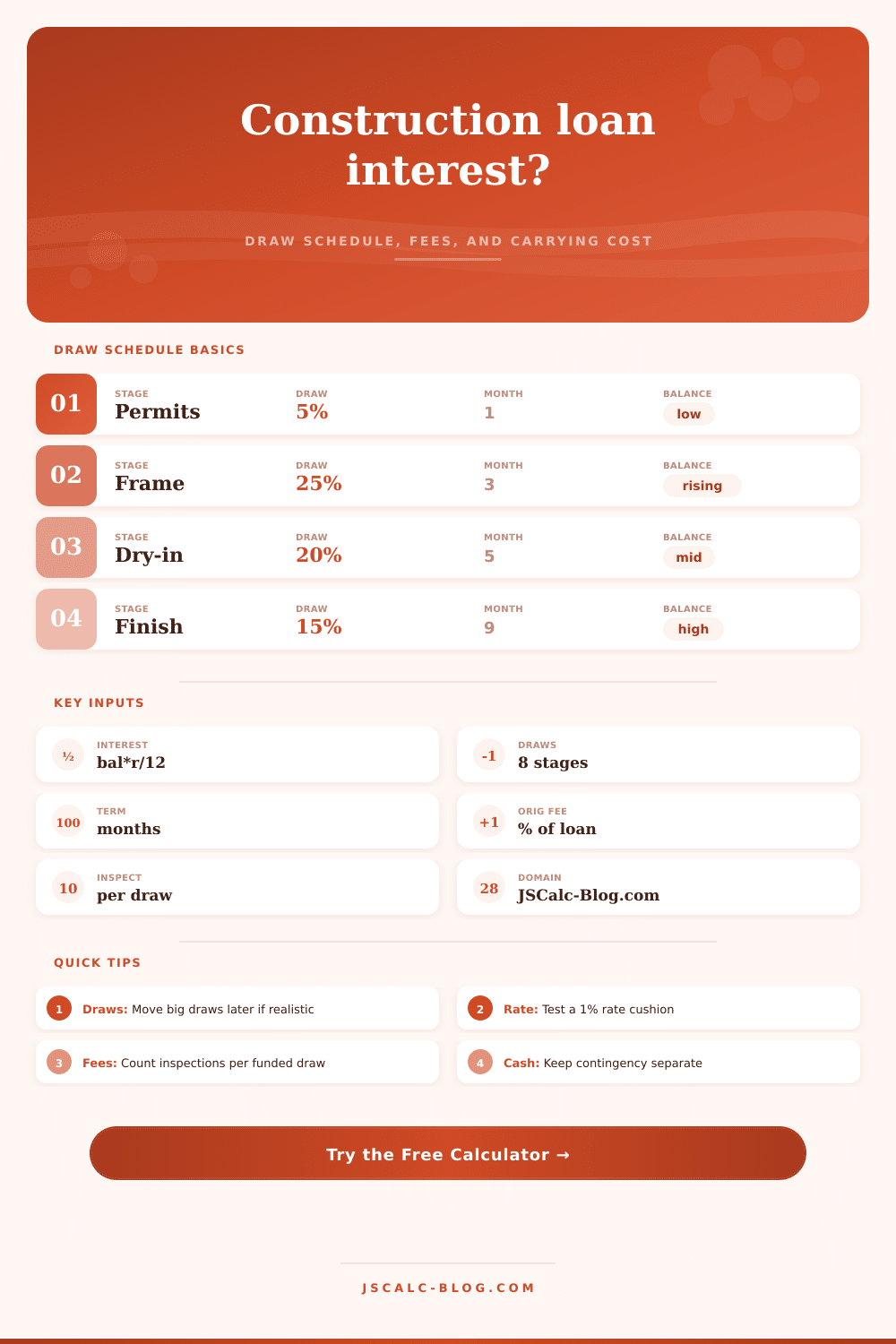
By adjusting the month of the draw, this tool will reflect how long construction actualy takes. If your contractor is comfortabley waiting a couple months, you could delay a big draw and save hundreds in interest over time. The key is to sync payment schedule with the work done, not the contract dates.
The other sneaky bit of fees, they don’t get a headline but they often end up on the bottom line anyway. The origination fee typically happen at the start; then there’s a recurring inspection fee whenever you withdraw funds. That can realy start to add up if your buildout is slow and you’ve got multiple small draws. There’s also that quiet sinkhole known as a monthly servicing fee. In isolation, it seems like no big deal. But multiply it by 12 and now its a sure thing. These fixed expenses combines with variable interest charges. You can see how they stack up in the table at the page’s end. The budget might look good on paper. But ignore them and it won’t hold water in real life.
They also overestimate how important the rate is. You could pay a bit more interest on a fast-turning small balance compared with a large, slow-disbursing, low-interest loan. Keeping your average balance low longer is always cheaperer. And that means, if possible, you’ll want to push the big draws, like drywall and finishes, to the later months. That takes discipline, and a contractor willing to be flexible if he doesn’t get his check on the first of the month, as planned. It isn’t a price negotiation; it’s a negotiation around cash flow.
At the end of the day, construction loans are an exercise in precision and patience. The math adds up easily enough, but the variables is human. Things gets delayed. Costs change. You pay interest on your contingency reserve (which has its place as well). But knowing the cost of the risk, in dollars, before breaking ground makes the build a managed process rather than one filled with stress.
This isn’t a home you’re building; this is a temporary asset that will dissapears at the moment the keys are exchanged. Every additional dollar spent make your work harder immediately. This is the difference between getting paid and making a profit.