Bridge Loan Cost Calculator
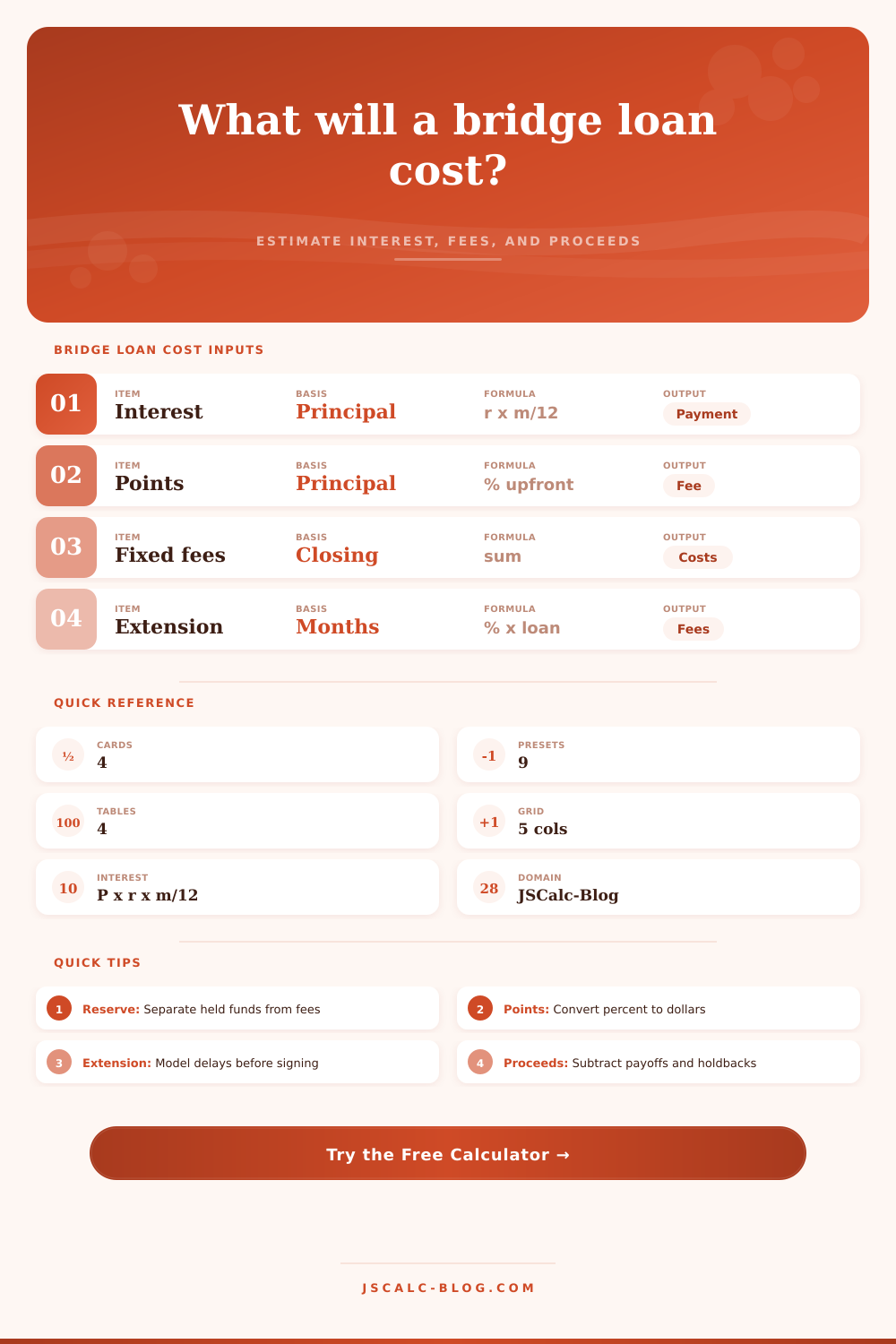
Estimate bridge loan interest, points, origination, fixed closing fees, extension fees, monthly interest-only payment, cash held in reserve, and net proceeds.
Load a realistic starting point, then adjust the loan amount, rate, term, points, fixed fees, reserves, and payoffs to match a term sheet.
| Use case | Typical term | Cost driver | Exit source | Watch item |
|---|---|---|---|---|
| Move-up purchase | 3-12 months | Carry period | Old home sale | Sale delay |
| Fix and flip | 6-18 months | Rate and points | Resale | Repair holdback |
| Rental bridge | 6-24 months | DSCR/refi path | Permanent loan | Seasoning rules |
| Construction exit | 3-12 months | Extension risk | Sale or refi | CO timing |
| Commercial bridge | 12-36 months | Origination | Stabilized refi | Lease-up |
| Land carry | 6-24 months | Lower leverage | Sale or takeout | Entitlements |
| Component | Input | Formula | Timing | Included in cost? |
|---|---|---|---|---|
| Base interest | Rate, months | Principal x rate x months / 12 | Monthly or reserve | Yes |
| Monthly payment | Rate only | Principal x rate / 12 | Monthly | Yes over time |
| Discount points | Point percent | Principal x points | Closing | Yes |
| Origination | Origination percent | Principal x fee percent | Closing | Yes |
| Fixed closing fees | Dollar fees | Appraisal + title + legal + other | Closing | Yes |
| Interest reserve | Reserve months | Monthly payment x reserve months | Held back | No duplicate cost |
| Extension fee | Months, percent | Principal x fee x months | Extension | Yes |
| Annual rate | Monthly payment | 3 months | 6 months | 9 months | 12 months | 18 months |
|---|---|---|---|---|---|---|
| 8.00% | $667 | $2,000 | $4,000 | $6,000 | $8,000 | $12,000 |
| 9.50% | $792 | $2,375 | $4,750 | $7,125 | $9,500 | $14,250 |
| 11.00% | $917 | $2,750 | $5,500 | $8,250 | $11,000 | $16,500 |
| 12.50% | $1,042 | $3,125 | $6,250 | $9,375 | $12,500 | $18,750 |
| 14.00% | $1,167 | $3,500 | $7,000 | $10,500 | $14,000 | $21,000 |
| Loan profile | Rate range | Points range | LTV range | Reserve style | Extension risk |
|---|---|---|---|---|---|
| Prime residential bridge | 8%-11% | 0.5-2.0 | 50%-75% | Often monthly | Low to medium |
| Private residential bridge | 10%-14% | 1.0-3.0 | 55%-70% | Often reserved | Medium |
| Fix and flip bridge | 10%-15% | 1.5-4.0 | 60%-75% ARV | Reserve common | Medium to high |
| Commercial bridge | 9%-14% | 1.0-3.0 | 55%-70% | Negotiated | Lease-up driven |
| Land bridge | 11%-16% | 2.0-5.0 | 35%-60% | Reserve common | Entitlement driven |
| Distressed or urgent close | 12%-18% | 2.0-6.0 | 40%-65% | Reserve common | High |
This JSCalc-Blog.com bridge loan calculator is an educational planning tool, not legal, tax, mortgage, or investment advice. Confirm actual charges with your lender, escrow officer, attorney, and closing disclosure.
The fast-moving market got you, didn’t it? You couldn’t wait until your existing house was out of escrow, you loved the new place, and you bought it anyway. Now you’re left with a financial gap between those two transactions. That’s where bridge loans comes in, but there are sneaky fees that will ding your wallet. The interest rate isn’t the entire picture. Let me explain how it works so that you don’t get surprised by the number crunchers; here’s the same thing using the calculator on this page:
A bridge loan is typically a short-term solution (three months to one year). It can be longer in duration if there’s an issue with closing. Since it’s a short loan, the lender will focus on two things. First is your exit plan, which will either make the bridge loan work for you or break your bank account. Second is the collateral value, which is less of a concern because the loan isn’t long enough for your long-term income to matter.
Hidden Costs of Bridge Loans
People overlook up-front costs: “Oh look! My mortgage is only 10% APR. That doesn’t sound too bad.” But then there’s those origination fees and those points. “Huh? Origination fee, what’s that?” Oh yeah, it’s another one percent of your loan total. What about discount points? What is that?” It is another two percent. At ten percent with an origination fee and points, that doesn’t seem like such a good deal anymore… And those up-front costs get subtracted from your loan proceeds, meaning you begin owing more money than you actualy got in cash. The tool takes care of all this by computing how much money you’ll walk away with after paying those fees, not just how big the gross loan will be. That can make a huge difference if you’re closing on a house whose purchase price leaves no wiggle room whatsoever.
Reserves can also be a tricky element. Sometimes lenders will ask you to establish an interest reserve, three to six months worth of payments sitting in a reserve account. No, it’s not a fee. It’s YOUR money, being held in trust until it’s needed for upcoming payments. For someone who’s tight on cash at closing, having that reserve amount removed from their pile of available funds can appear as though it’s a hidden cost. But it’s not a cost to the lender. It is a cost to your available cash, and it is a cost to the other places where you would rather have that money. Somewhere else). The reserve means less of that cash will go toward the new property or toward any repairs you may want to do.
It’s laid out in a way that makes sense on the page (see below; it’s a reference table), so you can look at the numbers in context. For example: Maybe your loan will require more points because it’s a fix-and-flip loan, where the quality of the reno plays a role in the risk (vs. The market value). Or maybe your fee is lower because your bridge is for a move-up purchase, the collateral is already in place and proven. Know what category your deal falls under, then use that to negotiate. Shop around with multiple lenders if possible, and compare apples-to-apples by considering the overall cost of holding the debt (not simply the headline rate).
Bad timing, Extension fees: As I mentioned before, real estate is a messy business. The inspection fails, the appraisal is low, the house stays on the market longer than expected. Each month that you extend the loan, you pay an extension fee. This is usually a small percentage of the principal per month, but it adds up fast. That adds up fast! The delay model lets you show the impact of these delays. This is extremely important when stress-testing your plan. Will you be able to afford the interest + extension fee for every month you have to extend, while also not touching your emergency savings?
Monthly payments consist of interest only and provide predictable cash flow. No principal reduction; your loan balance remains large. Fine for a short hold, but hazardous over a long time. Points + Fees add to the cost. Include these points & fees when calculating the effective annual cost. Our tool computes this effective rate. Helping you see what borrowing actualy costs.
All in all, the bridge loan is a quick-money tool. It’ll get you over the chasm (fast). But it also consumes money quickly. Have your escape strategy lined up and know exactly what each cost will be. Double-check the math, leave yourself a cushion if things don’t go as planned, and ensure that everything pencils out before signing on the dotted line. The distance from sell to buy is a slim one, and the price tag adds up quicker then you’d think.