Real Estate Investment Payback Period Calculator
Estimate initial cash invested, NOI, debt service, annual cash flow, simple payback, discounted payback, cash-on-cash return, and ROI.
ROI includes projected cash flow plus equity gain from appreciation, less remaining loan balance at sale.
| Year | Gross Income | NOI After Reserve | Debt Service | Cash Flow | Cumulative | Discounted Cum. |
|---|---|---|---|---|---|---|
| 1 | $0 | $0 | $0 | $0 | $0 | $0 |
| Metric | Formula | Your Result | Common Use |
|---|---|---|---|
| NOI | EGI - expenses - reserve | $0 | Operating yield |
| Strategy | Typical CoC | Payback Range | Growth Assumption | Primary Risk |
|---|---|---|---|---|
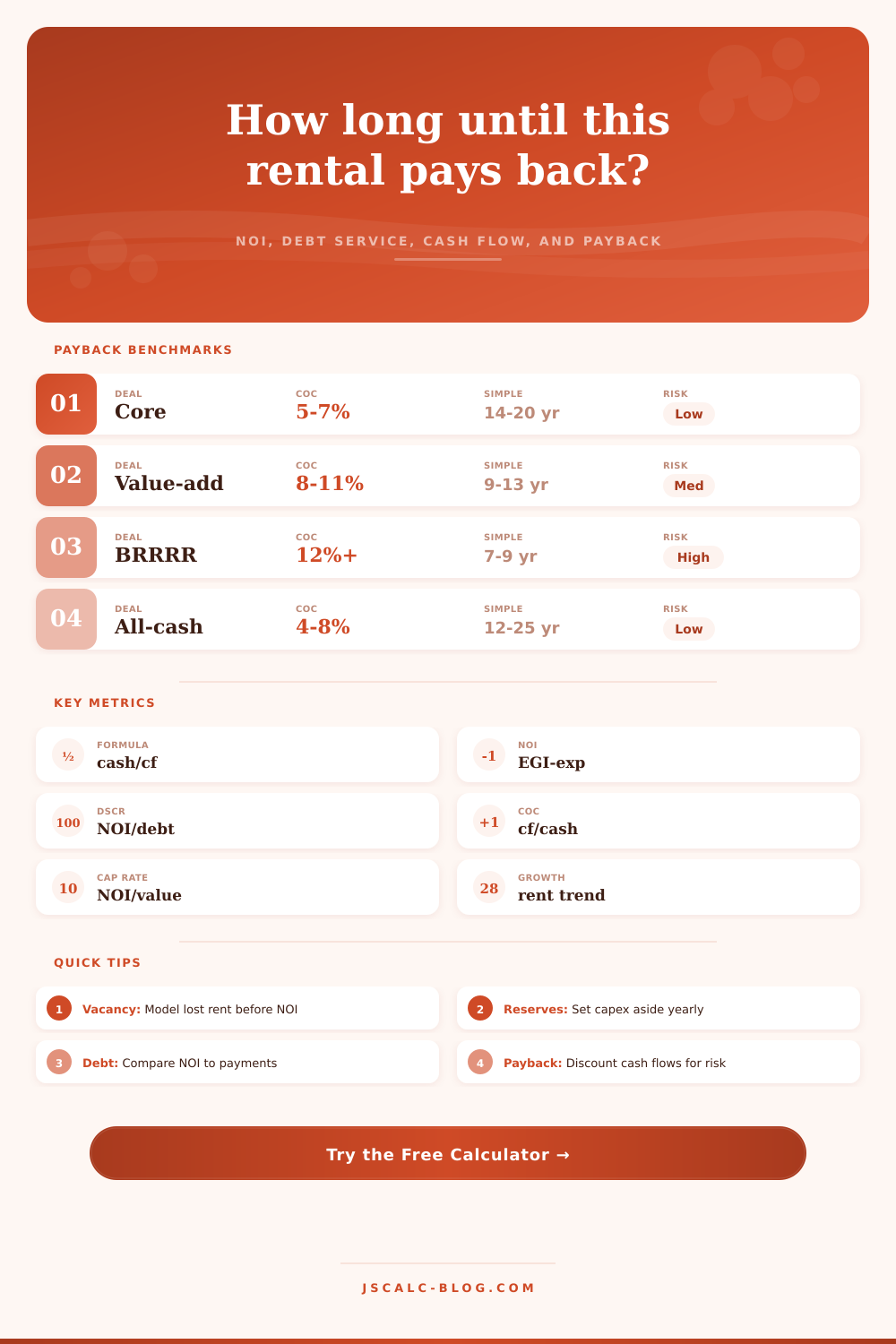
| Stabilized single-family | 4% to 8% | 13 to 25 years | 2% to 4% | Repair concentration |
| Small multifamily | 6% to 10% | 10 to 17 years | 2% to 4% | Tenant turnover |
| Value-add rental | 8% to 14% | 7 to 13 years | 3% to 6% | Renovation execution |
| Short-term rental | 8% to 18% | 6 to 13 years | 0% to 5% | Seasonality and rules |
| All-cash rental | 4% to 7% | 14 to 25 years | 2% to 4% | Lower leverage return |
| Refinance pullout | 10%+ | Varies | 2% to 5% | Rate and refinance risk |
| Input | Conservative | Moderate | Aggressive |
|---|---|---|---|
| Vacancy allowance | 8% to 10% | 5% to 7% | 2% to 4% |
| Operating expenses | 45% to 55% | 35% to 45% | 25% to 35% |
| Capex reserve | 7% to 10% | 4% to 6% | 2% to 4% |
| Discount rate | 9% to 12% | 7% to 9% | 5% to 7% |
| Rent growth | 0% to 2% | 2% to 4% | 4% to 6% |
Initial cash invested = down payment + closing costs + renovation / initial capex.
Effective gross income = (rent + other income) x 12 x (1 - vacancy rate).
NOI after reserve = effective gross income - operating expenses - capex reserve.
Annual cash flow = NOI after reserve - annual debt service.
Simple payback = initial cash invested / year 1 annual cash flow. Discounted payback accumulates each year's cash flow after discounting it by the selected discount rate.
Calculator built for JSCalc-Blog.com
Then you close on the house, you purchase the home. Then comes the wait, and this is where majority of investors gets jitters. Every time you make a mortgage payment you’re staring into bank account watching value diminish. You cross your fingers hoping that the rent covers the cost. It’s a combination of math and psychology.
The calculator will do the math for you (above). But you have to know what that means. More than just the spreadsheet, there has to be a decision of when to walk away… And when to hold. Otherwise you risk running out of cash before youve recieved the payoff on your investment.
How to Plan Your Real Estate Money
The time to recoup is most basic measure of all. How many years will it take for you to get your original cash investment back? Let’s say you purchase a property with $50K and you earn five grand per year in net cash flow. That equals a 10-year payback.
Easy enough…until you consider that a dollar a decade from now isn’t the same thing than a dollar today. Opportunity cost compounds against it, and inflation gnaws away at your return. For example, what if you could invest that cash somewhere else? Discounted payback addresses this problem by applying a discount rate to future cash flows, so it removes the illusion that a far-off payment carries equal value as a chunk of your cash today. The table below breaks it down visualy. It illustrates that the riskier the strategy, the quicker it must produces its reward before you agree to play.
Vacancy is the silent killer. A lot of investors assume their property will be rented 365 days per year… That never happens. Leases end, people move out, tenants need to wait for repairs, etc. And when they do? You lose money. Your property will have gaps in occupancy. Use this to model those gaps. You can enter a vacancy rate into the tool, which decreases your effective gross income prior to any other expenses entering the picture.
This creates a slight, compounding change over time. Ignore it at your own peril, your cash flow projections will look rosy on paper, but your bank statement tells another story. Set realistic expectations from the very start.
The other side of this equation involves operating expenses. Roofs aren’t immortal; insurance rates change; property taxes goes up. Even if nothing big breaks down, a good investor still sets aside funds each year for capital improvements. This reserve fund protects you from being caught off guard when that furnace conks out three years later. If you factor in those reserves into your math, you’ll realize that your cash flow per year decreases, making your payback period longer.
To some people, this sounds crazy (why would I plan on making less?) but you have to think long-term. This isn’t about flipping houses, it’s about building a business.
There’s also debt service coverage, which is a key sanity check. Lenders want to see at least a one-point-two coverage ratio, meaning the property should produces sufficient income to pay the mortgage with a healthy buffer. Anything less than that, and you’re running on thin margins. One unexpected repair bill (or one month of vacancy) could throw you into negative cash flow.
This is where the calculator comes in handy: it breaks down how much money goes to the bank versus how much ends up in your pocket, helping you visualize your risk. Think of it as separating the property’s operational performance from the debt used to purchase it.
At the end of the day, real estate investing is a numbers game, one played with human behavior. Judgment is what you bring; the calculator is the framework. Treat your cash-on-cash return as more than a percent, think of it in terms of how liquid that number makes you. How does your result compare with the benchmark? Is this an above-average deal, or an exceptional one? It’s not enough to have property; it has to be property that pays for itself well.
Be conservative with your assumptions. Fund your reserves. Have a clear exit strategy. When you know precisely when the money stops working against you and starts working for you, the wait wouldn’t of seemed so long.