Blended Interest Rate Calculator
Combine several loans or credit lines into one balance-weighted rate, payment-weighted rate, total annual interest estimate, and refinance comparison using the exact weighted average formula.
| Account | Balance | Rate % | Monthly Payment | Type | Include |
|---|---|---|---|---|---|
The core blended rate is balance-weighted: sum(balance x annual rate) divided by sum(balance). Payment values are used for payment-weighted rate and payoff projections.
Use the same basis for every row when possible.
Used for first-window interest and payoff comparison notes.
| Account | Balance | Normalized APR | Balance Weight | Scenario Payment | Annual Interest | Monthly Interest | Payment Check |
|---|---|---|---|---|---|---|---|
| Enter balances and calculate to see the per-account breakdown. | |||||||
| Scenario | APR | Payment | Balance / Principal | Total Interest | Fees Included | Total Paid | Payoff Time |
|---|---|---|---|---|---|---|---|
| Calculate to compare the current payment plan with refinance alternatives. | |||||||
| Rate basis | Calculator treatment | Monthly rate used | Best use | APR / nominal note |
|---|---|---|---|---|
| Nominal APR | APR divided by 12 for monthly interest | APR / 12 | Loans quoted with standard APR | Most amortized loan quotes use this convention. |
| Effective annual rate | Converted to equivalent nominal APR | ((1 + EAR)^(1/12)) - 1 | Comparing products quoted as APY or effective rate | The shown blended APR is normalized before weighting. |
| Simple annual rate | Annual interest equals balance x rate | Rate / 12 estimate | Quick simple-interest approximations | Good for annual interest, less exact for amortization. |
| Payment-weighted rate | Weights APR by monthly payment dollars | Payment share x APR | Checking where cash flow is aimed | It is not the official blended APR; it is a scenario lens. |
| Balance-weighted rate | Weights APR by outstanding balance dollars | Balance share x APR | Finding the true blended interest rate | This is the primary formula result. |
| Debt mix | Included balance | Weighted annual interest | Blended rate | Payment-weighted rate | Interpretation |
|---|---|---|---|---|---|
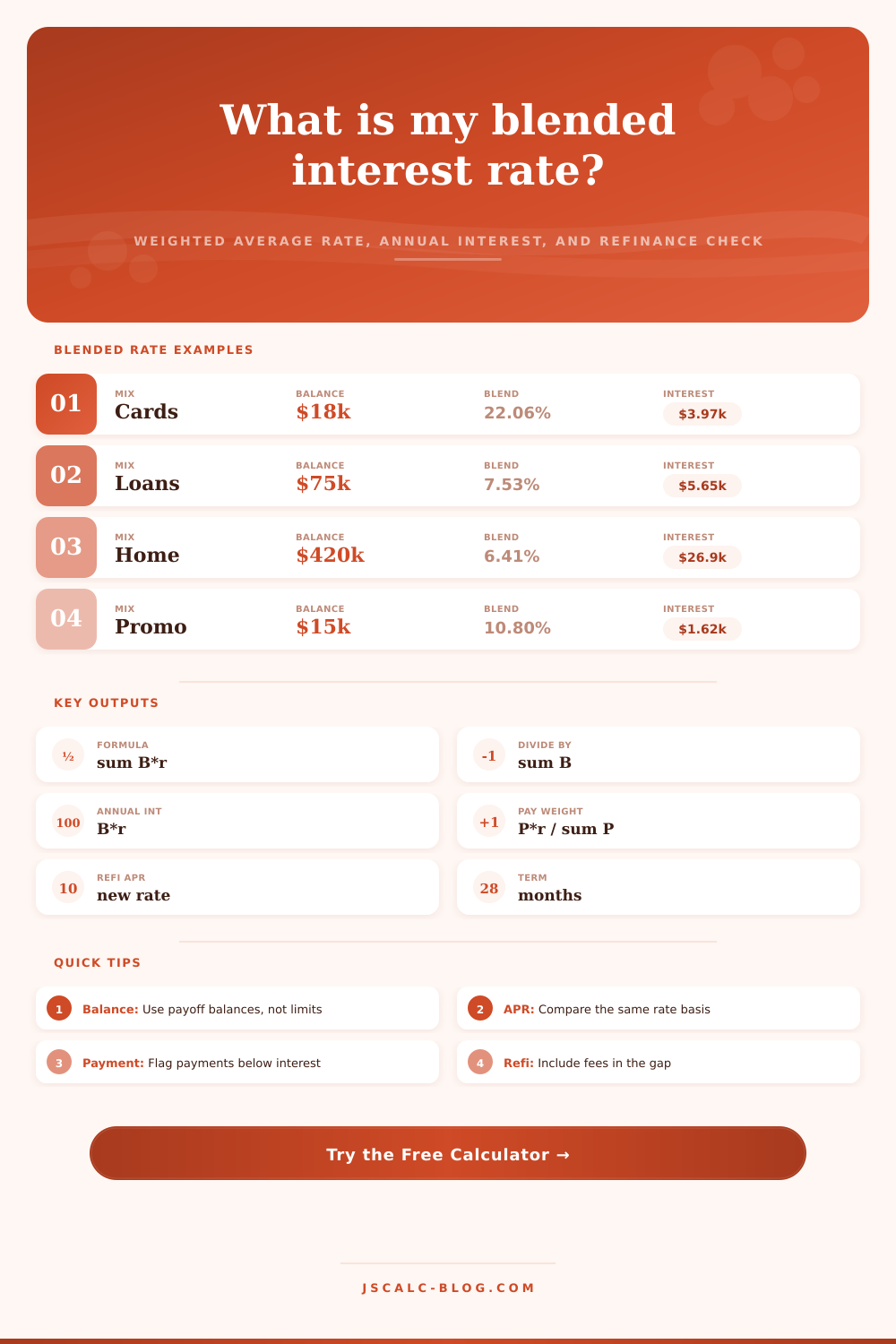
| Three credit cards | $18,000 | $3,970 | 22.06% | 23.10% | Cash flow is aimed slightly more at high-rate balances. |
| Mortgage plus HELOC | $420,000 | $26,910 | 6.41% | 7.02% | The smaller HELOC can move the payment-weighted view. |
| Federal student loans | $75,000 | $5,648 | 7.53% | 7.46% | Similar balances and payments keep both rates close. |
| Auto plus personal loan | $44,500 | $4,171 | 9.37% | 10.28% | Payments are concentrated on the faster personal loan. |
| Promo balance mixed in | $15,000 | $1,620 | 10.80% | 16.35% | A 0% balance lowers the true blend but may expire later. |
| Business debt stack | $92,000 | $11,555 | 12.56% | 14.11% | Payment-weighted rate flags pressure from expensive credit. |
If you have several debts. An auto loan, student loans, credit card(s), a mortgage, you’re juggling various terms, payment amounts, interest rates, etc. Keeping all that information in your head is a massive mental load. And most people focus on the details (the interest rate on each debt) rather than zooming out and looking at the big picture. They’ll pay down one small balance with a low interest rate … but ignore larger balance with a higher interest rate. Most people look at individual rates without seeing the forest for the trees.
A blended interest rate calculator can help. It combines all your debts into a single weighted-average interest rate. It reveals actual cost of carrying debt. In theory, it’s just a matter of math. Simply multiply every balance by its corresponding rate, add ’em all up, then divide by the grand total. That’s the underlying formula.
Why Use a Blended Interest Rate Calculator
But in real life, things don’t align neatly into columns. Small balances with minimum payments throw off how cash is spread out. Promotional 0% periods mess with average. Once you plug in your information, the tool figures that out for you. It adjusts rates from different bases, allowing for an apples-to-apples comparison. If one loan has a nominal APR while another has an effective annual rate, the calculator converts them both to same base. Why? Because mixing-and-matching without converting rates will lead you astray.
Most people fixate on the balance-weighted rate. That’s the headlinese number. That’s real cost of owning it all at once. If your large debt is at 6% and your small debt is at 20%, your blended rate is going to be somewhere near 6%. Your large debt weigh heavily because it has a big principal. That can lull you into a false sense of security. You think debt is cheap because that little high-rate balance sucks up cash each month.
One number is not enough. In that sense, the payment-weighted is helpful. It shows you the direction of your real cash flow. Are you spending more on that pricier credit card and less on the mortgage? Your balance-weighted rate won’t reflect that; but your payment-weighted one will. What does it tell us? It tells us what you’re doing. Is the debt getting knocked out in order of interest-rate, from largest to smallest? Or are you making minimum across the board? You can use this tool to play “what-if” with different dollar shifts, testing whether adding an extra hundred bucks to the biggest loan makes you better off.
When rates dip, it’s tempting to refinance. But beware: Fees can derail the transaction. The calculator features a comparison grid where you plug in your new rate, term, upfront costs and more. It will spit out how much more (or less) interest you’d pay with your new plan compared to existing one. The existing plan includes the cost of fees in its calculations. If closing costs exceed amount you’ll save over the length of the mortgage, a lower rate won’t matter. That’s where the gap calculation comes into play. Enter all the data and it’ll tell you whether you’re saving or losing money by refinancing. If the number is positive, hooray! You save dough. If the number is negative, boo! You’re paying someone else for the privilege of switching loans.
Clear as mud?
Math vs. Humans: Humans don’t always like to go with the math. We want to pay down low bills so we can feel good about it. (This is known as the snowball method.) It’s great for your motivation. It is not so great from a purely economic standpoint. The calculator doesn’t care what you prefer. It only cares how much it will cost. So if you want to pay off the lowest one instead, the tool will tell you how much more interest you’re paying to make yourself feel good. Know thyself. Knowing exactly how much that emotional price tag costs allows you to decide whether or not it’s worth it.
The interest compounds every month or day. If you have a balance, you’re paying a fraction of a cent each day. Those fractions accumulates. The blended rate shows you a snapshot in time. It also assumes your balances remain static, but they never will. When you pay them off, the weights changes. Your high-rate balance decreases, bringing down your overall blend over time. Good! That’s faster progress. You’re accelerating payment on the most expensive debt.
Choose simplicity over complexity. Money isn’t rocket science, despite what anyone says. It doesn’t require you to be a math wiz; it requires the proper view. That’s where this calculator comes into play. It removes all the extra rates and statements so that you’re left with one thing to focus on: a number. The best way to start is by focusing on the highest-rate debt. Model your situation using the calculator. Observe how the blended rate decreases. Control your debt, but don’t screw up your finances while doing it.