Seller Net Sheet Calculator
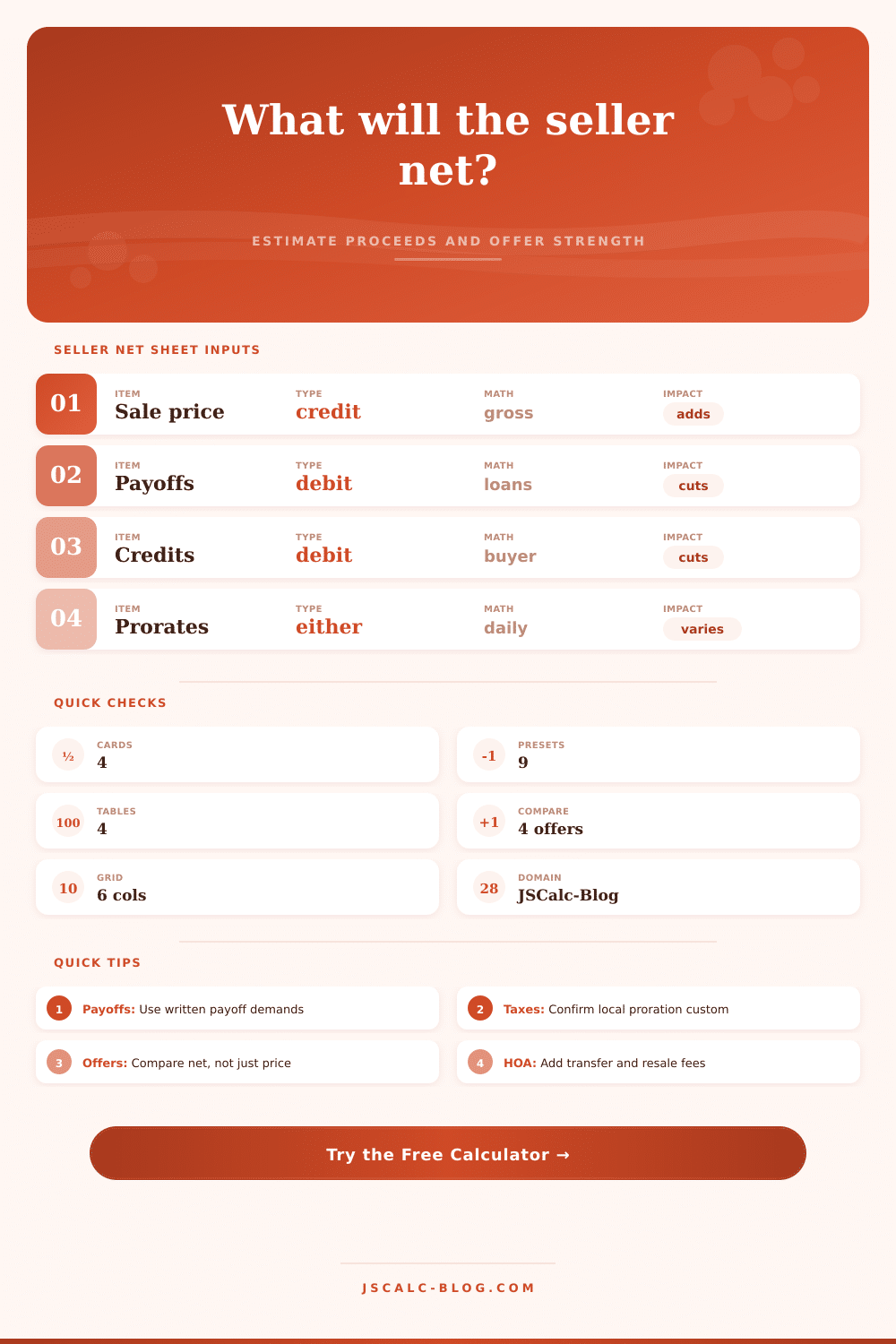
Estimate seller proceeds after loans, liens, commissions, concessions, title and escrow charges, prorated taxes, HOA items, repairs, credits, and competing offer terms on JSCalc-Blog.com.
Pick a realistic sale pattern, then adjust the numbers to match the closing statement or offer terms.
Estimated seller settlement
Enter up to four competing offers. The grid applies each offer price, commission, concessions, closing timeline prorations, repair credit, and risk adjustment to the same payoff baseline.
| Offer | Price | Concession | Commission | Prorations | Risk | Estimated net |
|---|---|---|---|---|---|---|
| Calculate to compare offers. | ||||||
| Line item | How this calculator treats it | Formula or source | Seller impact |
|---|---|---|---|
| Loan payoff | Subtracts from gross proceeds | First payoff + second payoff | Debit |
| Liens and assessments | Subtracts other required releases | User-entered liens | Debit |
| Commission | Percent of price or flat fee | Sale price x rate | Debit |
| Seller concessions | Buyer closing help or repair credits | User-entered credits | Debit |
| Transfer tax | Seller-paid transfer tax estimate | Sale price x tax rate | Debit |
| Prorations | Daily taxes and HOA dues | Annual amount / 365 x days | Debit or credit |
| Settlement line | Common range | Who confirms it | When to update |
|---|---|---|---|
| Mortgage payoff | Exact demand amount | Lender or servicer | Inside payoff-good-through date |
| Commission | Contract percentage or flat fee | Listing agreement | When offer price changes |
| Title and escrow | Local fee schedule | Title, escrow, attorney | After title order opens |
| Transfer tax | State and local rates | County, closing agent | Before final statement |
| Property tax proration | Annual tax / 365 x days | Tax collector and escrow | When closing date moves |
| HOA charges | Dues, resale, transfer, estoppel | Association or management | Before document package is ordered |
| Repairs and credits | Contract or amendment amount | Buyer and seller agreement | After inspection resolution |
| Seller reserve | Optional cushion | Seller preference | When payoff interest changes |
| Proration item | Calculator formula | Positive days mean | Negative days mean |
|---|---|---|---|
| Property taxes | Annual tax / 365 x tax days | Seller credits buyer | Buyer reimburses seller |
| HOA dues | Annual HOA / 365 x HOA days | Seller credits buyer | Buyer reimburses seller |
| Transfer tax | Sale price x transfer rate | Seller-paid debit | Not applicable here |
| Reserve cushion | Sale price x reserve rate | Seller holds back estimate | Use zero if not needed |
Your heart races as you sign the purchase agreement with a buyer. Then reality hits: you have no idea how much money is in your pocket. That sign says “listing price.” But until you subtract all the credits, fees, and costs that occur between signing the contract and recieveing the check, that’s just make believe. The amount after those deductions are the net proceeds from the sale. It is by far the most critical number in any real estate transaction. Yet most sellers is fixated on the gross sale price, that’s the one that looks good and makes them feel like winners. In truth, the winner is whoever has the higher net proceeds. That’s the money going directly to your retirement fund (or to your bank account). Knowing the distinction is key to negotiating well in real estate.
All those fees are deducted, the mortgage payoff (not merely what’s due on your most recent monthly bill), plus any second mortgages or home-equity lines that need paying off, and everything else tied to the property that’s been assessed against its title, like solar leases and tax liens., whatever money remains is yours. Except it isn’t. You don’t know how much is yours, because the calculator figure that out for you by plugging in your own debt amounts and local schedule of fees. First the gross contract price goes into the calculator. Then come the deductions. Next are the deductions.
What Is Net Proceeds?
It begins with the mortgage payoff. But it’s not simply the remaining balance from your final monthly payment. Because it wants every penny back, including all the interest you’ve already accumulated, it asks for repayment as of the date of closing. This means the total amount owed will typicaly be slightly more than what was on your latest statement. Commissions are usually the next largest chunk gone from your proceeds. This varies by offer, since not all do the same thing for both the buyer’s and seller’s agents. This happens if you’re getting a better price with one buyer, but the agent wants a bigger cut or more seller concessions are needed to close. If you have to give money back to the buyer at closing, you may end up making less profit then with an offer that is $X cheaper. Concessions are sneaky (they appear like help for the buyer), but they subtract right from your wallet. This can be closing cost assistance, repair credits, etc. Every dollar you provide as a concession is a dollar less in your bank account.
Taxes: Depending on where you live, they’re either paid in advance or after the fact (i.e., taxes are prorated based off how many days of the year you lived there). Similarly, HOA fees is paid in arrears or advance. Which means you only keep money for the days you actually owned the home. So how much are you keeping? The calculator finds the daily amount by dividing annual bills by 365 days. Sell at the beginning of the month, and you owe less. Sell toward the end of the year, and you may owe a bit more. It’s just a few bucks here or there. But when every dollar is important … it adds up. You should also consider estoppel and transfer fees from the HOA, as they differ widely from building to building. While some charge five hundred bucks, others will charge you fifty. Know your HOA’s rules before settling on a price below which you won’t budge.
If you’re comparing offers, look beyond just headline numbers. Use the tool’s multiple offer comparison grid to stack up different options side-by-side. Sometimes “the best deal” is a high price paired with lots of repairs and concession demands, but it nets you less money than a low price accompanied by clean terms and no concessions. Also factor in risk: what looks like a great offer on paper could fall apart due to a low appraisal, a weak buyer’s financing, etc. There’s a field for risk adjustment in the tool, which allows you to mentally knock down shaky offers by subtracting some kind of cushion from their estimated net. That forces you to balance the risk of uncertainty vs. It is potential gain.
But I think maybe the most under-rated aspect of this is the reserve line item. This lets you put aside some amount (or percent) of your proceeds in case something comes up unexpectedly. Maybe the payoff interest rose higher than expected; maybe there was some small thing that the title company uncovered and needs cleared up. If you have a cushion calculated ahead of time, then you won’t be shocked by the final bill. Even if the math checks out, you may still feel like you’ve been robbed, but at least you’ll feel good about it with a cushion. You should of had one.
There are never any guarantees in real estate. No matter how many factors go into buying or selling a house, things change at the last minute, there are unexpected costs, and it’s never quite as simple as black-and-white. The point isn’t merely to receive top dollar, but to ensure the deal makes sense and that you understand the price needed to walk away comfortabley. You run the numbers prior to listing, knowing exactly how much money you’d have to net to be cool with moving on. This eliminates chasing ghosts and allows you to negotiate with precision. It transforms your anxiety into a game plan, one that has math working for you, instead of against you, come closing day.