Net Proceeds From Home Sale Calculator
Estimate seller net cash after mortgage payoff, accrued payoff interest, commissions, concessions, closing charges, repair credits, transfer taxes, prorated property tax, and escrow refund.
1 Choose a seller scenario
Each preset fills a realistic seller net sheet. Adjust every field to match your contract, payoff quote, and local settlement statement.
2 Sale, payoff, and settlement inputs
Estimated seller proceeds
3 At-a-glance proceeds metrics
4 Seller cost breakdown
| Line item | How it is calculated | Debit | Credit | Net effect |
|---|
5 Payoff date interest and prorations
| Timing item | Date basis | Days | Daily amount | Seller result |
|---|
6 Preset comparison grid
This 6-column grid recalculates the nine preset cases with the same payoff and proration engine used by the form.
| Scenario | Sale price | Payoff | Seller costs | Tax or escrow | Net proceeds |
|---|
7 Common seller net-sheet references
| Item | Common range | Usually a debit or credit? | Where to confirm | Calculator field |
|---|---|---|---|---|
| Brokerage commission | 0% to 6%+ | Debit | Listing agreement and purchase contract | Commission |
| Mortgage payoff interest | Daily per diem | Debit | Lender payoff statement | Rate, dates, payoff fee |
| Seller concessions | 0% to 6% | Debit | Contract addendum or closing disclosure | Concession percent and flat credit |
| Transfer tax | 0% to 2%+ | Debit | State, county, or city schedule | Transfer tax rate |
| Property tax proration | Daily tax share | Either | Settlement statement and local custom | Annual tax and paid-through date |
| Escrow refund | Current cushion | Credit, often later | Loan servicer escrow analysis | Expected escrow refund |
| Repairs and holdbacks | Contract specific | Debit | Inspection response and escrow instructions | Repairs and holdback |
8 Formula and practical tips
Core formula: net proceeds = sale price - mortgage payoff - commissions - seller concessions - seller closing costs - repairs - transfer taxes - other liens - holdbacks - tax proration cost + tax proration credit.
Payoff formula: mortgage payoff = principal balance + payoff fees + accrued interest. Accrued interest = principal x annual rate / 365 x days from last payment date to payoff date.
Escrow note: the calculator reports settlement net before escrow refund and a second net including the expected refund, because many loan servicers send escrow refunds after the loan is paid off.
Many of you obsess about headline number. It is as though the list price is how much money you’ll get in your bank account when all is said and done. Wrong! That’s the starting price. There are deductions that lowers that figure. Before you see a single dollar, there will be less money in your bank account than the headline value. And by how much? That depend on how much equity you have (i.e., the mortgage), and what fees you incur for transferring ownership. That’s the “net” versus “gross.” You need to know that spread between cash in hand vs. Gross purchase price. Otherwise you might accept an offer because you think it’s fantastic. But then you discover that you don’t have enough money for your next downpayment.
The above calculator does this for you. You enter the inputs, and it displays where each dollar go. But before entering inputs, first you must know how they relate to reality. Your “mortgage payoff” isn’t simply the outstanding principal balance printed on your most recent statement. Daily interest accumulates until lien is released by your lender. If you close three days later than anticipated, you’ll owe hundreds of additional interest dollars. Contact your lender and request a formal payoff quote that’s valid on your exact closing date. Otherwise you’ll get a bogus estimate based off an outdated statement, which results in writing a check that is too small at the closing table and creates false hope.
Why You Will Get Less Money Than The Listing Price
Your top line is reduced at once by commissions and concessions. Normally, an agent takes his fee (the commission) from the total amount the property sells for. This means that the agent has an incentive to cut the deal’s price: it lowers the commission, while helping the buyer. There are other fixed costs like transfer taxes and closing costs. Closing costs don’t vary with the state of the market. An attorney will cost you roughly the same no matter if you sell house for $500,000 or $200,000, and the premium for title insurance will be about the same. Fixed costs makes up a larger portion of your profits in lower-priced markets. Thin equity deals can therefore seem disproportionately expensive.
There’s yet another wrinkle: property tax proration. Many areas charge their tax bills on an in-arrears basis (that is), they charge you for the portion of current year that you spent livig there. And while you don’t want to be charged for days when you’re no longer the owner, the calculator splits this up by day. If you overpaid your tax reserves (or other mortgage-related escrow), then you should of get that money back; typically within a few weeks after close. That’s also not part of the primary payment. So it needs to show up as a separate line item in the output. Otherwise you might mistakenly believe that you’ve got that cash in hand to spend right away when you sign the paperwork.
You also need to consider repair credits and holdbacks, which reflect what was decided during negotiations rather than actualy costs. For example: If the buyer requests $3,000 worth of credits for a defective HVAC unit … that’s not going into your pocket. That’s money that will be subtracted from your proceeds, same as all other debts. Think of those negotiated credits as real money slipping through your fingers. Some sellers attempt to reduce this effect by doing the repairs themselves prior to listing. Only do so if the repair expense is less than the credit request.
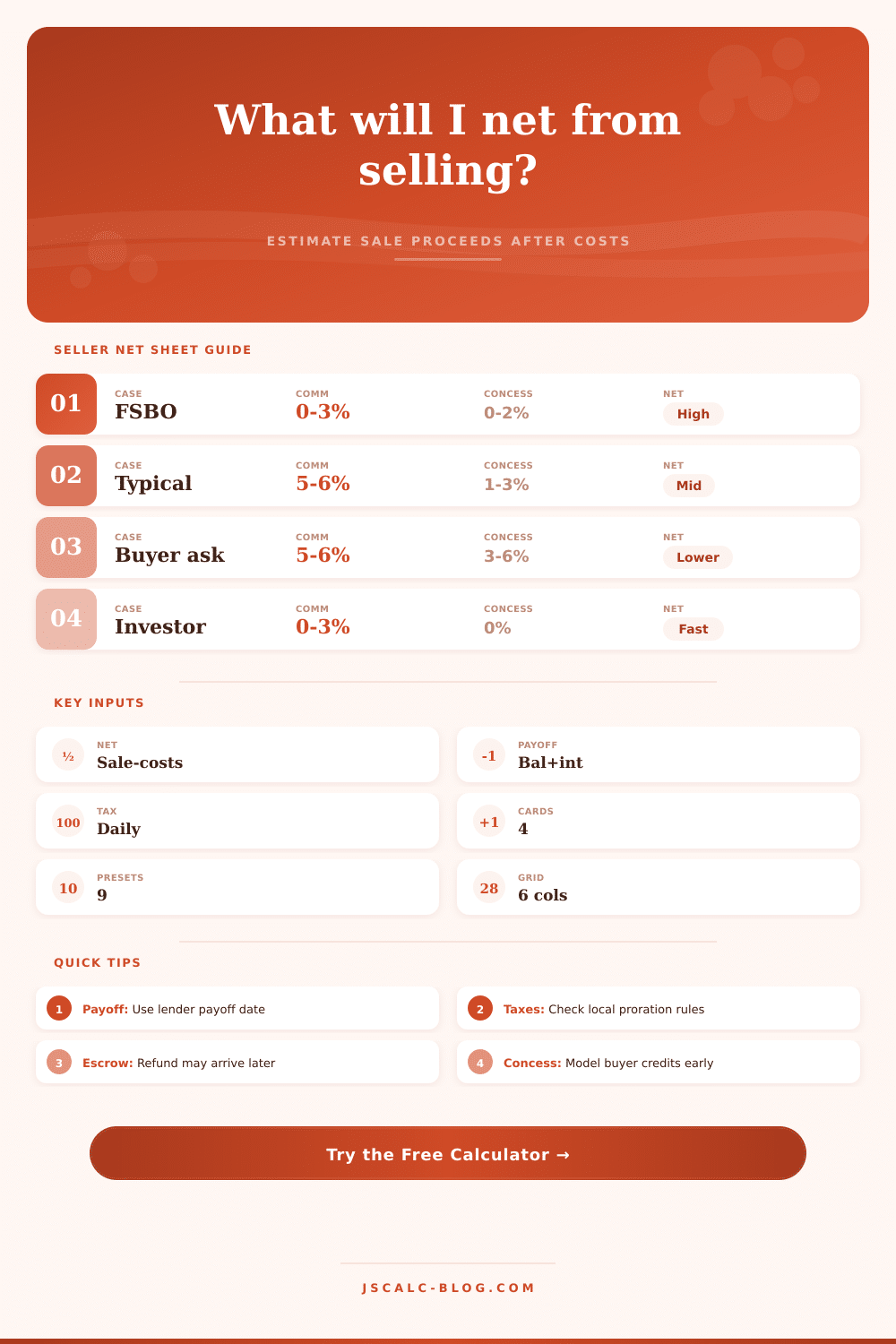
The tool provides some handy presets. You can use them as a point of comparison. For example, compare a normal real estate sale to a For Sale By Owner deal. This helps you see the benefit of using a professional or how much you could save by doing it yourself. If you’re talking about a normal suburban home, commissions will typically range between five and six percent. That’s what you could save if you sell FSBO. But there are also risks: You could price yourself wrong. There is legal risk. These ranges are presented clearly in the reference tables in the interface. So you’ll be able to know where you sit on the spectrum.
Home sales are all about expectation management. Only one number matters when you’re making your next move: your net proceeds. What does that mean? That determines whether you’ll be able to bridge to your next purchase … or whether you might have to reconsider your timeline. So run the numbers early on, and adjust for reasonable fees. Prepare yourself for the fact that closing costs will feel higher then expected. Don’t blindly try to max out the listing price; instead, try to improve the real cash in hand. Look at the final check, and let it reflect reality, not hope.