Real Estate Commission Calculator
Model sale price times commission rate, listing and buyer agent splits, referral fees, franchise deductions, flat fees, tiered structures, and the seller net effect.
1.Load a real deal preset
2.Commission structure and sale inputs
3.Referral, broker, and seller net inputs
4.Current scenario mini cards
5.Commission method reference
| Method | Core formula | Best use | Split handling | Watch item |
|---|---|---|---|---|
| Standard percentage | Sale price * total rate | Conventional full-service listing | Listing share divides total | Effective rate rises with price |
| Side rates | Price * listing rate + price * buyer rate | MLS or contract shows sides separately | Each side is calculated directly | Rates may not add to old market norms |
| Flat fee | Fixed dollar commission | Limited service or fixed-fee listing | Flat allocation decides side | Buyer-agent offer may be separate |
| Hybrid | Price * rate + fixed fee | Minimum fee, premium marketing, admin add-on | Percent plus allocated flat fee | Compare the true effective rate |
| Tiered | Tier 1 amount * rate + excess * rate | Higher-priced homes and land | Total commission is split afterward | Threshold placement matters |
| Buyer-side only | Price * buyer rate | FSBO or seller keeps listing work separate | Listing side can be zero | Seller credits still lower net |
6.Preset comparison grid
| Scenario | Method | Sale price | Gross commission | Listing gross | Buyer gross | Seller net |
|---|
7.Fee and split reference table
| Item | Typical range | Applied to | Who receives it | Calculator field |
|---|---|---|---|---|
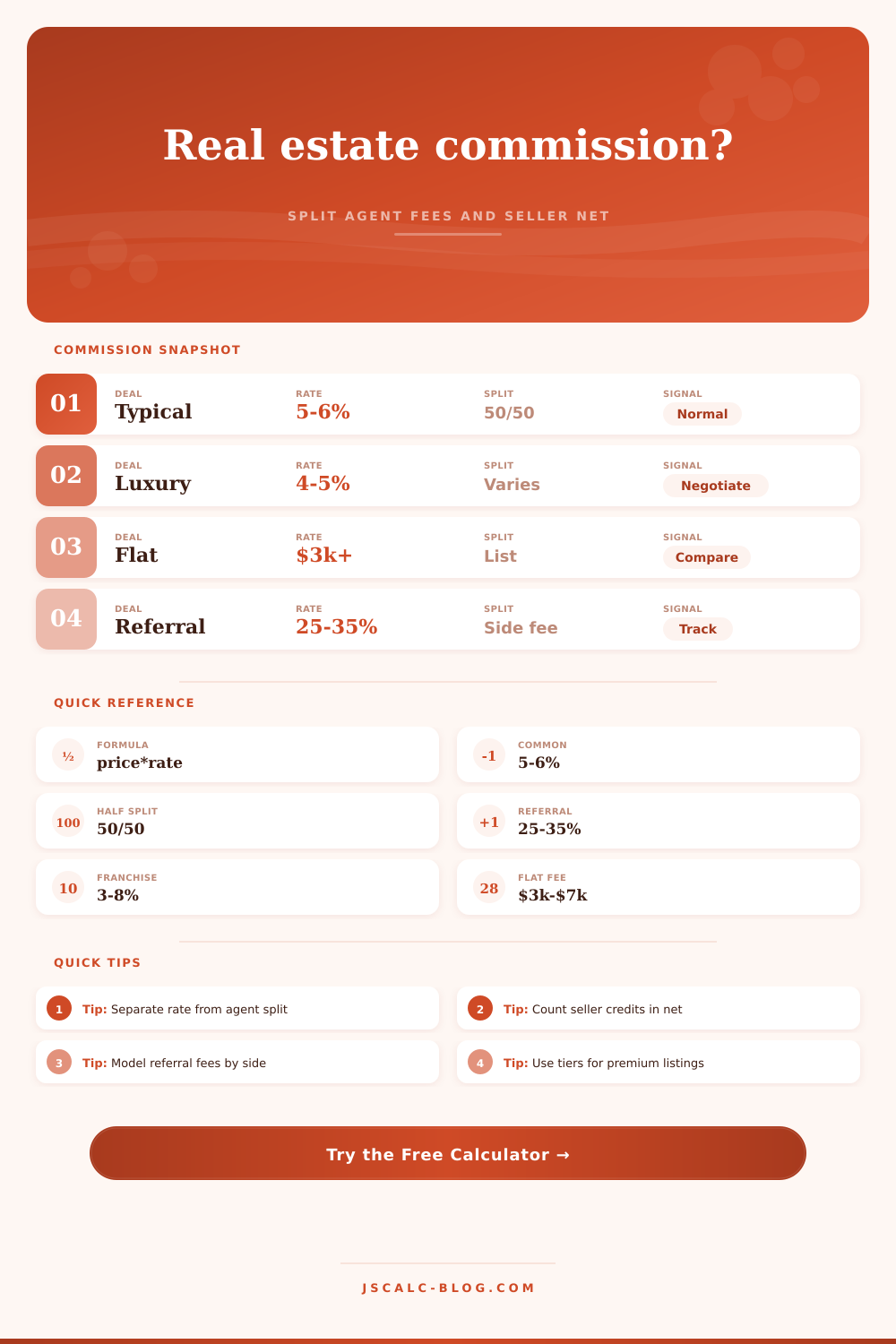
| Total commission | 4% to 6% | Sale price | Brokerages and agents | Total commission rate |
| Listing side | 2% to 3% | Sale price or split total | Listing brokerage | Listing side share or rate |
| Buyer side | 2% to 3% | Sale price or split total | Buyer brokerage | Buyer side rate |
| Referral fee | 25% to 35% | One side gross commission | Referring brokerage or agent | Referral fee percentages |
| Franchise fee | 3% to 8% | Side commission after referral | Brand or broker platform | Franchise or broker fee |
| Seller closing costs | 0.5% to 2.5% | Sale price | Tax, title, escrow, recording | Other seller closing costs |
8.Seller net sensitivity
| Sale price test | Commission | Other closing costs | Credits | Payoff | Seller net |
|---|
9.Practical notes
It’s your living room. You can smell the new paint on the walls. The buyers is pre-approved and sale price is set. There must be some catch in the fine print, right? Chances are, it does have something to do with the fine print.
Your gut tells you there’s something about commissions in the fine print. Everyone knows that agents gets paid, but very few sellers realize they don’t get all of it. But how does that chunk come back to them? What happens between when it shows up in your closing statement and when it lands in their pocket? The answer lies in understanding this process, or series of deductions from headline percentage down to your take-home amount. How you see the deal depend on knowing where the money flows.
How Much Money You Actually Get From Selling Your House
Once you have the details of your deal plugged in to this calculator, it will do the number crunching for you, no more guesswork on the coefficient/split!
Commission is not one thing. It’s actualy two things (two separate payments) packaged into one contract. We refer to it as “listing” and “buyer” side commission. The former go to the agent who marketed your house. The buyer side compensates the person which brought you the check. Most folks believe they’re talking about commission when they use the term. But realy, they’re tossing out a generic 5% or 6% that represents their percentage breakdown. Those aren’t numbers, though. Those are containers and here’s where the hard work comes: deciding what fills up those containers.
The headline sale price isn’t as important than your seller net proceeds. I’ll use the typical “split evenly” example: a standard 50/50 split assumes both agents does equal work for equal pay, but the market rarely works that cleanly. But in reality, there aren’t two equally productive people splitting a check; it doesn’t always break down into clean 50/50s. For example, if you work with an agent who refers you to someone else in another city, the referral fee come out of the listing side first before any splits happen. So now the local agent has to earn less than half (since the referral fee comes off the top first). Franchise dues and referral fees eats up a portion of your gross earnings, see table on the page for a clear breakdown. Little things like this erode your net proceeds, but you never notice until signing day.
The other piece is the structure. With all those methods, it’s not a flat percentage across the entire dollar figure. For example, tiered commission structures can drops your effective rate on expensive properties because they apply a lower percentage to everything past some given level. And then there’s flat fees, which provide the predictability, but may not get as much marketing power behind the sale as more traditional model. Every approach moves the rewards and risks in various ways. Does the certainty matter more than the performance to you at this particular price?
Another aspect that is overlooked far too often are closing costs. Sure, sellers have tunnel vision about getting a commission check, but don’t forget: There are no free lunches. The escrow fees, title insurance, and transfer taxes gets paid out of the same pot. And if you’re trying to sweeten the deal with a rate buydown or a credit towards closing costs for your buyer. Well, that cash will come right off the top of your net. It may seem like a minor negotiating point, but it could of make all the difference in swinging the final number by thousands of dollars.
Just remember: Look beyond the headline sale price to seller net proceeds. Commission negotiation is tricky ground, as it’s both about market power and about personal value at once. On one hand, you need an agent who’ll get you top dollar; on the other, every percentage point count. Modeling some scenarios beforehand (try a high rate + a premium-marketing guarantee, for instance, vs. A low rate + fewer services) is helpful. How much does the total amount change in each scenario? The numbers will clue you in to where your actual leverage is.
Buying and selling real estate is an emotional process, but the money aspect need to be cold and calculating. Don’t let the thrill of closing a deal cloud your head about how much money you actually walk away with. Record each and every deduction from the original commission split to the final administrative fee. Once you see how all the pieces interlock, the closing table won’t feel like a mystery anymore; it will look like a map.
The result? You end up with exactly what you expected, which is a total surprise when you are trying to move on with your life.