Drywall Taping Calculator
Estimate the finishing materials that actually eat your budget: joint compound in pounds and boxes, paper or mesh joint tape in feet and rolls, the drywall sheets themselves, and the fasteners by count and by pound. Enter a wall and ceiling area directly, or type room length, width, and height and var the tool size the job by finish level, sheet size, and compound type.
🏠Quick Room Presets
📏Project Inputs
Choose direct area or var the tool build it from room dimensions.
Combined wall and ceiling square footage to be finished.
Longer of the two floor dimensions.
Shorter floor dimension, used with length for the ceiling.
Wall height, floor to ceiling. Standard is 8 to 9 ft.
Adds length x width of ceiling to the wall area.
Bigger sheets mean fewer butt joints and less tape.
Higher levels add coats and compound for smoother walls.
Affects box weight and pound-per-box coverage shown below.
Total linear feet of outside corners and window returns.
Padding added to compound, tape, and screw totals.
🔢Estimate Snapshot
📋Drywall Finish Levels 0 to 5
| Level | What Is Done | Coats After Tape | Typical Use |
|---|---|---|---|
| Level 0 | No taping or finishing | 0 | Temporary or unfinished space |
| Level 1 | Tape set in compound only | 0 | Attics, above ceilings, plenums |
| Level 2 | Tape plus one thin coat | 1 skim | Garages, behind tile or cabinets |
| Level 3 | Tape plus one full coat | 1 | Heavy or knockdown texture |
| Level 4 | Tape plus two coats, sanded | 2 | Flat and light paint, most homes |
| Level 5 | Level 4 plus full skim coat | 2 plus skim | Gloss paint and raking light |
🧪Joint Compound Types Compared
| Compound | Best Job | Set or Dry | Working Time | Sanding |
|---|---|---|---|---|
| All-purpose (green) | Tape and fill coats | Air dry | Long, stays open | Moderate effort |
| Lightweight (blue) | Finish and top coats | Air dry | Long, stays open | Very easy |
| Topping (clear) | Final skim only | Air dry | Long, stays open | Easy, weak bond |
| Setting 20 (hot) | Fast patch and bed | Chemical set | 20 minutes | Hard, dense |
| Setting 45 (hot) | Fill and same-day coat | Chemical set | 45 minutes | Hard, dense |
| Setting 90 (hot) | Deep gaps and beads | Chemical set | 90 minutes | Hard, dense |
📦Compound Coverage And Screw Specs
| Package | Net Weight | Covers Approx | Notes |
|---|---|---|---|
| All-purpose box (4.5 gal) | 61.7 lb | 1150 sqft tape coat | Heaviest, strong bond |
| Lightweight box (4.5 gal) | 48 lb | 1150 sqft tape coat | Same volume, less weight |
| Setting bag (mix your own) | 18 lb powder | Varies with water | Add water to hot mud |
| Paper tape roll | 250 or 500 ft | Best for flat and inside | Strong, no stretch |
| 1-1/4 in screw (1/2 in board) | 320 per lb | Field at 12 in on center | For half inch drywall |
| 1-5/8 in screw (5/8 in board) | 235 per lb | Field at 12 in on center | For 5/8 in fire rock |
📊Finish Level Comparison Grid
| Finish Level | Coats After Tape | Typical Use | Compound Need | Sanding Effort | Cost Tier |
|---|---|---|---|---|---|
| Level 1 | 0 | Concealed areas | 0.020 lb/sqft | Minimal | Lowest |
| Level 2 | 1 skim | Garage, tile base | 0.033 lb/sqft | Light | Low |
| Level 3 | 1 | Heavy texture | 0.045 lb/sqft | Moderate | Medium |
| Level 4 | 2 | Flat paint homes | 0.053 lb/sqft | Higher | Medium high |
| Level 5 | 2 plus skim | Gloss, raking light | 0.072 lb/sqft | Highest | Highest |
| Level 5 spray | 2 plus spray skim | Large open ceilings | 0.078 lb/sqft | Highest | Highest |
⚙How The Estimate Is Built
💡Taping And Mud Tips
You can also get too little mud and too many sheets of dry wall. Most folks do. And when you do it makes what was a weekend job into a mid-week crisis as you await the reopening of the home center so you can patch your tape without tearing off all of the drywall. Or worse yet you’re broke because you spent all your money on finish materials, and now at nine o’clock on a Tuesday night you realize you don’t have any joint compound.
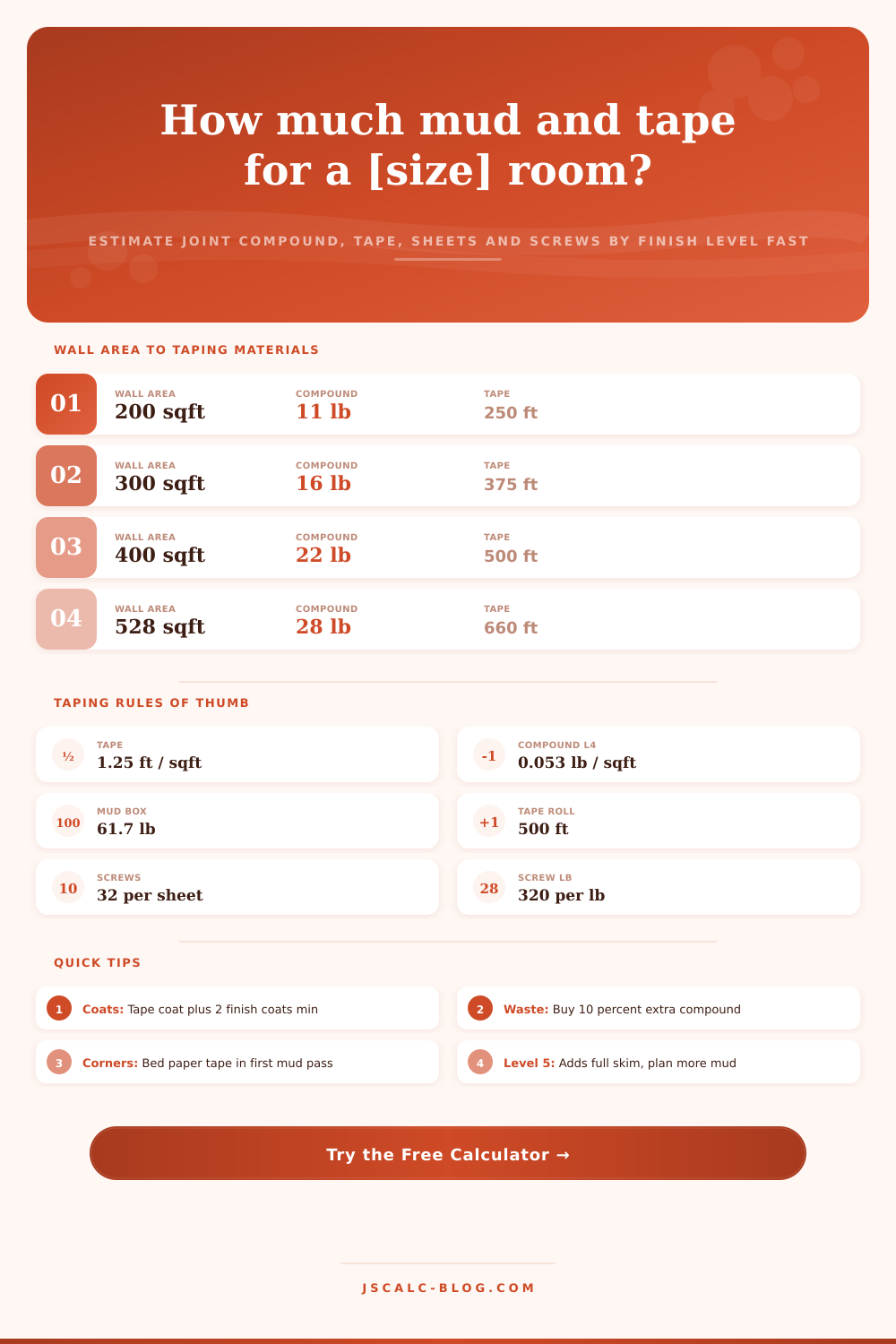
Before you grab a knife use this calculator to help you figure out how much stuff you’ll need in pounds rather than in square footage so you don’t deal with that same kind of frustration. Everything scales based off surface area; start there. If your walls were measured, you can plug their numbers in raw; if not, you can type in the rooms dimensions, and the tool will figure out the geometry. The program figure wall area as perimeter times height, and tacks on the ceiling if you need to include that work too. A typical twelve-foot-by-twelve-foot bedroom with an eight-foot ceiling has three hundred eighty-four square feet of walls alone. Tack on another one hundred forty-four for the ceiling and you’ve got five hundred twenty-eight total. And that’s just one number that affects every estimate later on, hence the importance of careful measuring over any shortcut.
How to Plan Your Drywall Supplies
Most of us undervalue joint compound. If we pick a finish level (level four is typical for painted houses; level three is what’s applied under a heavy texture), the tool apply a coefficient based on that level to come up with the number of pounds of mud required per square foot. A four requires approximately 0.053 pounds of mud per square foot, a five (which gives you a full skim coat applied to everything) jumps up to about 0.072 pounds per square foot. This means you’re not just filling the seams anymore. The next thing it do is divide this by the net weight of a box (typically about sixty one and a half pounds for an all purpose mud), and there you have it. That’s exactly how many boxes to put into your cart.
Area: How much tape do I need for my seams? Tape length corresponds directly (and unsurprisingly) to Area. One 4×8 sheet has about 40′ of tape when you take shared edges into account. This is about 1.25 ft of tape per sqft of wall. So multiply that by your total area and you’re at a decent starting number. By default this assumes paper since it’s strong and doesn’t stretch much… but if you want mesh on the flat parts, same deal with the length figure; itll work just as well. Once you’ve got those feet in the tool, it rolls them back up so you can tell if you need one 50′ roll or maybe two.
It’s easy to understand sheet count, but the bigger they are, the better. If possible, go with big sheets, four-by-twelves. Why? Because there will be fewer butt joints. You’ll have fewer joints overall, which means fewer seams to cover up. Butts are the most difficult joint to hide because they don’t taper on one end like a flat does. Less to cover = less mud = less tape = much less sanding later. And when the hallway permits, that’s what the pros grab: long boards.
Each sheet requires about thirty-two screws at twelve-inch intervals. The calculator factor in the correct number of screws. And the list is complete with fasteners. Screws come in packs by weight, so this tool will automatically convert the number of screws into pounds using a standard ratio, like 320 screws per pound for 1/4 inch coarse thread.
You can enter in your waste factor, typically ten percent which covers all those cut-offs plus the inevitable bits of mud that stick to your pan when you’re done. And if you’re not sure how smooth to make it, the page’s reference tables rank finishes from zero to five. Just match the room to the desired smoothness. Glossy paint isn’t necessary for a garage, but it might be for the living room.
These numbers read differently. They translate to shopping lists. You no longer guess; you go down the line itemizing what will get loaded into the basket at the cash register. It’s a breakdown explaining precisely why Level five costs more in materials than Level four. Why setting-type mud isn’t as heavy or fast drying as lightweight compound. How it becomes a clear map instead of a vague need for “some supplies.”
You step foot into the store armed with a list that matches the walls before you. Mostly it’s knowing what we are measuring when we say that number. It isn’t the drywall, but that slim coating of tape and compound holding everything together and hiding the seams so they appear seamless on the wall. Once you have those numbers figured correctly then the rest will fall into place.
You shouldn’t of run out of mud at 10pm the night before and need to go to the store in your jammies. That little win is worth planning for.