Hot Tub pH Calculator
Find the exact dry acid or pH increaser dose for your spa in teaspoons, tablespoons, and ounces. Balances small hot tub volumes using sodium bisulfate to lower pH and soda ash to raise it.
🛁Real Spa Presets
📝Spa & Water Inputs
Typical hot tubs hold 250 to 500 gallons; swim spas hold much more.
Higher alkalinity resists pH change, so dosing scales up.
🔢Dosing Formula Snapshot
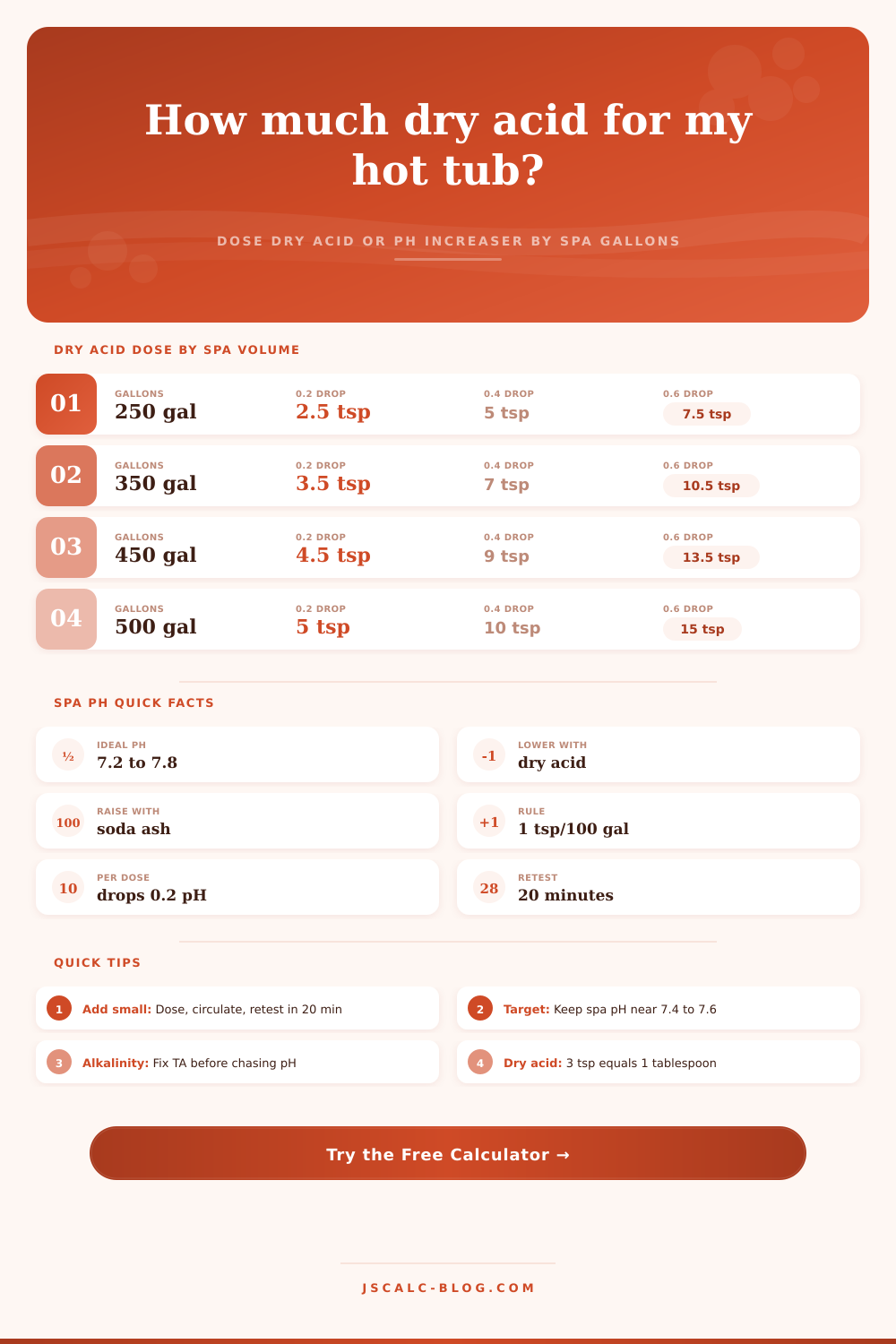
📊Dry Acid Dose by Volume & pH Drop
| Spa Volume | 0.2 Drop | 0.4 Drop | 0.6 Drop | 0.8 Drop | 1.0 Drop |
|---|---|---|---|---|---|
| 250 gal | 2.5 tsp | 5 tsp | 7.5 tsp | 10 tsp | 12.5 tsp |
| 300 gal | 3 tsp | 6 tsp | 9 tsp | 12 tsp | 15 tsp |
| 350 gal | 3.5 tsp | 7 tsp | 10.5 tsp | 14 tsp | 17.5 tsp |
| 400 gal | 4 tsp | 8 tsp | 12 tsp | 16 tsp | 20 tsp |
| 450 gal | 4.5 tsp | 9 tsp | 13.5 tsp | 18 tsp | 22.5 tsp |
| 500 gal | 5 tsp | 10 tsp | 15 tsp | 20 tsp | 25 tsp |
| 1000 gal | 10 tsp | 20 tsp | 30 tsp | 40 tsp | 50 tsp |
| 1500 gal | 15 tsp | 30 tsp | 45 tsp | 60 tsp | 75 tsp |
Base rule at total alkalinity near 100 ppm. Higher alkalinity increases the dose; the calculator applies a buffer factor automatically.
⚖Ideal Spa Chemistry Targets
| Parameter | Ideal Range | Acceptable | Low Fix | High Fix |
|---|---|---|---|---|
| pH | 7.4 to 7.6 | 7.2 to 7.8 | Add pH increaser | Add dry acid |
| Total alkalinity | 80 to 120 ppm | 60 to 180 ppm | Add alkalinity up | Add dry acid |
| Free chlorine | 2 to 4 ppm | 1 to 5 ppm | Add sanitizer | Wait or dilute |
| Free bromine | 4 to 6 ppm | 3 to 8 ppm | Add bromine | Wait or dilute |
| Calcium hardness | 150 to 250 ppm | 100 to 400 ppm | Add hardness up | Partial drain |
| Water temp | 100 to 102 F | 95 to 104 F | Raise setpoint | Lower setpoint |
🧪Dry Acid vs pH Increaser
| Trait | Dry Acid | pH Increaser |
|---|---|---|
| Chemical | Sodium bisulfate | Soda ash (sodium carbonate) |
| Effect on pH | Lowers pH | Raises pH |
| Use when | pH above 7.8 | pH below 7.2 |
| Form | Dry granules | Dry granules |
| Base dose | 1 tsp / 100 gal per 0.2 | 1 tsp / 100 gal per 0.2 |
| Also affects | Lowers alkalinity too | Raises alkalinity slightly |
| Add method | Pre-dissolve or broadcast | Pre-dissolve or broadcast |
🥄Teaspoon & Ounce Conversions
| Teaspoons | Tablespoons | Dry Ounces | Rough Grams |
|---|---|---|---|
| 1 tsp | 0.33 tbsp | 0.17 oz | ~5 g |
| 3 tsp | 1 tbsp | 0.5 oz | ~14 g |
| 6 tsp | 2 tbsp | 1 oz | ~28 g |
| 10.5 tsp | 3.5 tbsp | 1.75 oz | ~50 g |
| 12 tsp | 4 tbsp | 2 oz | ~57 g |
| 24 tsp | 8 tbsp | 4 oz | ~113 g |
Dry chemical density varies by brand; ounce and gram values are approximate for sodium bisulfate.
🗂Volume vs Dose Comparison Grid
| Spa Size | Gallons | 0.2 Change | 0.4 Change | 0.6 Change | 0.6 in Ounces |
|---|---|---|---|---|---|
| Compact 2-seat | 200 gal | 2 tsp | 4 tsp | 6 tsp | 1 oz |
| Small hot tub | 250 gal | 2.5 tsp | 5 tsp | 7.5 tsp | 1.25 oz |
| Standard 4-seat | 350 gal | 3.5 tsp | 7 tsp | 10.5 tsp | 1.75 oz |
| Large 6-seat | 450 gal | 4.5 tsp | 9 tsp | 13.5 tsp | 2.25 oz |
| XL lounger | 500 gal | 5 tsp | 10 tsp | 15 tsp | 2.5 oz |
| Swim spa small | 1000 gal | 10 tsp | 20 tsp | 30 tsp | 5 oz |
| Swim spa large | 1500 gal | 15 tsp | 30 tsp | 45 tsp | 7.5 oz |
| Endless pool | 2500 gal | 25 tsp | 50 tsp | 75 tsp | 12.5 oz |
⚙Full Dosing Math Breakdown
💡Practical Spa pH Tips
Now you notice your water feels slippery before you go check. You pull out your test strips, compare the colors to chart, and … yup! The pH are up again. Man, you want that water to feel smooth, not slippery, so you work hard to make sure you get it right. Sounds familiar? If you own a spa, then you know what we’re talking about.
The water chemistry change frequently. Over time, heat depletes the carbon dioxide (CO2) from the water, raising the pH. Next, you add some sanitizer, knocking the pH off-kilter even more. To fight that, you adds some acid to lower the pH. This lowers alkalinity, which causes another set of issues.
How to Fix Spa Water pH Easily
So when you input your current and volume into the calculator, it do the math. It spares you from guesstimating which amount of chemical to dump in there. It displays measurement in teaspoons, tablespoons, and ounces for the soda ash/dry acid to dump into the jets, adjusted based off your specific product strength.
Why? Because most folks don’t realize you need to take total alkalinity into account, as well. That’s the number that controls how difficult it is to manipulate water. Alkalinity are a buffer. It prevents water changes in one direction more than another. So if you have a low alkalinity, then a small dose of acid may throw your pH way out of whack. Then you’ll be chasing the right number and constantly over correcting.
Why is the input important? Because it’s not simply about pH balance; it’s about maintaining a system. That means considering your total alkalinity reading and applying a buffer factor. The dose go up or down according to that factor. Also, it takes into account the strength of the product. All dry acid granules aren’t created equal. Some blends is more concentrated than others. Less volume equals a stronger blend. Without this knowledge, overdosing/underdosing can occurs. For example, using a generic brand when the label doesn’t jive with what you’re actualy using can cause an underdose.
It outputs in ounces, tablespoons, and teaspoons, familiar units for anyone who owns a set of spoons in their kitchen or garage. No need to buy a lab scale. Just use a regular measuring spoon. If you are careful, and level it off correctly, it will work just fine. The conversion table explains that three teaspoons equals one tablespoon. That comes in handy when you want to add more.
If you are trying to drop the pH down a half unit in a five hundred gallon tub, you may have to use as many as fifteen teaspoons of acid. Sounds like a lot, but it’s really just two and a half tablespoons. Those powders may look big, but they dissolves in the water.
You must know what you are measuring. Test strips is handy but not accurate at the extremes. Depending on light source, a test strip can be 7.6 or it could be 7.8 if it’s an orange color. A digital probe will be more accurate, but it also has to shares checked regularly. Whatever you choose to use, the idea remains the same; maintain the pH in the 7.2 to 7.8 range for maximum sanitizer performance. If you go below this range, the chlorine turns corrosive to metal component. If above this range, not only does the sanitizer become less effective but it cause scale to deposit on heater elements.
Slowly add the chemical. Don’t dump all of your calculated dose into the tub at one time. Allow the water to circulate for twenty minutes, then test again. It takes time for the chemical to settle the chemistry, rushing it can result in overshooting the mark. Adding acid may require immediate use of the pH increaser as well. That’s money down the drain. Time too. Spa maintenance is about patience over precision. The water will settles. You’ll get there.
Keep in mind: Strips aren’t a rule but a guide. Keeping a steady hand will keep the tub safe for visitors.