Dog Age by Breed Calculator
Convert your dog's age into human-equivalent years adjusted for breed size. Small, medium, large, and giant dogs age at different speeds, so this tool uses size-specific AKC and AVMA style tables, plus the modern epigenetic formula and the classic times seven rule, to show life stage, remaining lifespan, and the share of life lived.
🎯Real Dog Presets
📝Dog Details
Whole years the dog has lived. Range 0 to 30 years.
Extra months on top of the years, 0 to 11. Helps young puppies.
Adult body weight decides how fast the dog ages.
Picking a breed auto-sets the size category for you.
Size table is most realistic. Epigenetic is DNA research based.
How precisely to show the human-equivalent age.
🐕Typical Lifespan Snapshot
📊Dog Age to Human Age by Size
| Dog Age | Small – under 20 lb | Medium – 20 to 50 lb | Large – 50 to 90 lb | Giant – over 90 lb |
|---|---|---|---|---|
| 1 year | 15 | 15 | 15 | 14 |
| 2 years | 24 | 24 | 24 | 22 |
| 3 years | 28 | 29 | 29 | 29 |
| 4 years | 32 | 34 | 34 | 35 |
| 5 years | 36 | 39 | 40 | 42 |
| 6 years | 40 | 44 | 45 | 49 |
| 7 years | 44 | 49 | 50 | 55 |
| 8 years | 48 | 54 | 56 | 62 |
| 10 years | 56 | 64 | 67 | 75 |
| 12 years | 64 | 74 | 78 | 88 |
| 15 years | 76 | 89 | 95 | 108 |
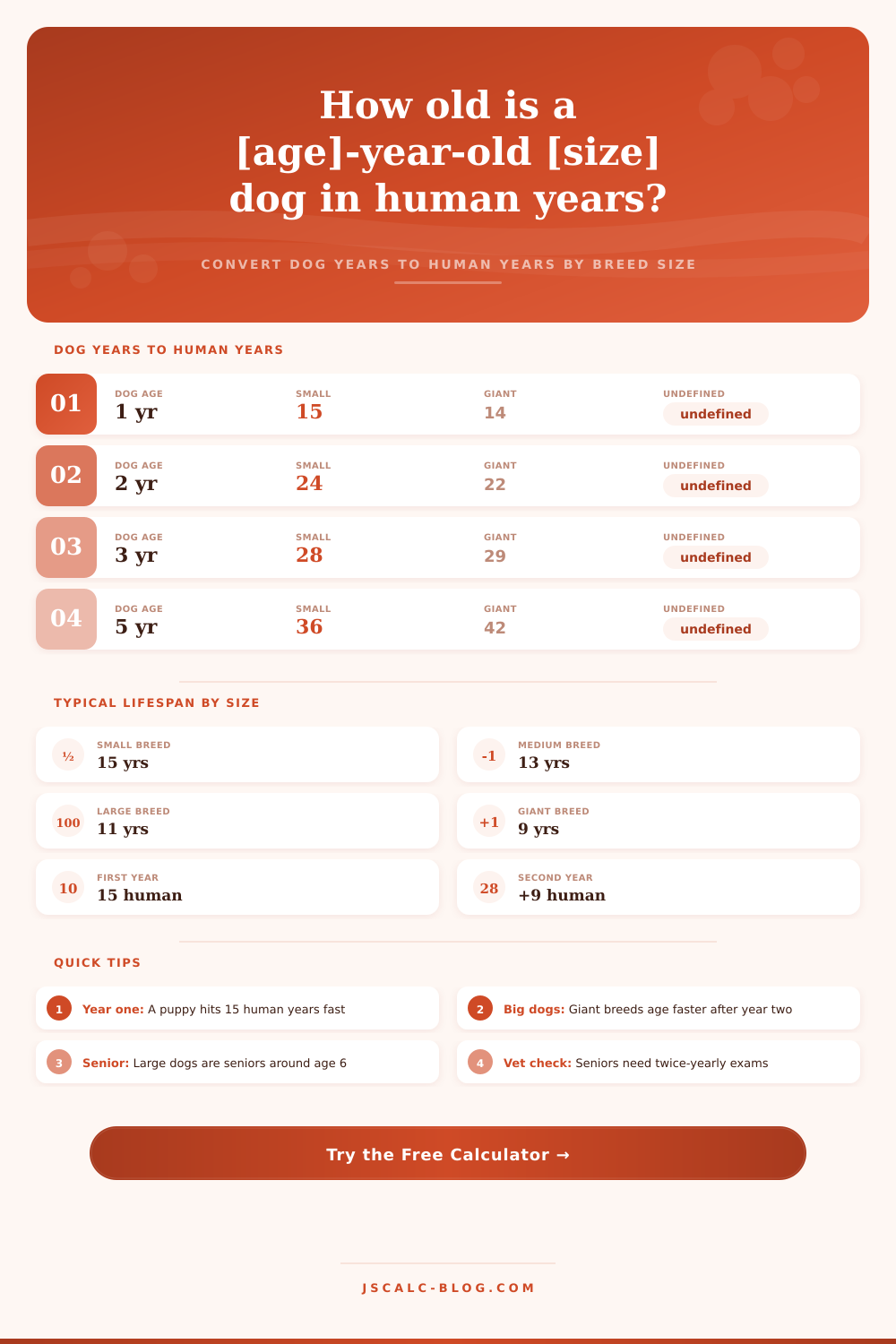
Values follow AKC and AVMA style size charts: year one about 15, year two adds 9, then each later year adds about 4 for small, 5 for medium, 5.5 for large, and 6.5 for giant.
👤Life Stages by Size
| Life Stage | Human Age Feel | Small & Medium Dog Age | Large & Giant Dog Age | Care Focus |
|---|---|---|---|---|
| Puppy | Under 18 | 0 to 1 year | 0 to 1 year | Vaccines, socializing, growth diet |
| Adult | 18 to 50 | 1 to 7 years | 1 to 5 years | Weight control, dental, activity |
| Senior | 50 to 75 | 7 to 11 years | 5 to 8 years | Twice yearly vet, joint support |
| Geriatric | 75 and up | 11 years and up | 8 years and up | Comfort, mobility, bloodwork |
Large and giant breeds reach senior and geriatric stages years earlier than small breeds at the same calendar age.
📏Popular Breed Lifespan Chart
| Breed | Size Class | Typical Weight | Average Lifespan | Senior Age |
|---|---|---|---|---|
| Chihuahua | Small | 4 to 6 lb | 14 to 16 yrs | ~10 yrs |
| Yorkshire Terrier | Small | 5 to 7 lb | 13 to 16 yrs | ~10 yrs |
| Beagle | Medium | 20 to 30 lb | 12 to 15 yrs | ~8 yrs |
| Standard Poodle | Medium | 45 to 70 lb | 12 to 15 yrs | ~8 yrs |
| Labrador Retriever | Large | 55 to 80 lb | 10 to 12 yrs | ~6 yrs |
| Golden Retriever | Large | 55 to 75 lb | 10 to 12 yrs | ~6 yrs |
| German Shepherd | Large | 50 to 90 lb | 9 to 13 yrs | ~6 yrs |
| Great Dane | Giant | 110 to 175 lb | 7 to 10 yrs | ~5 yrs |
| Mastiff | Giant | 120 to 230 lb | 7 to 10 yrs | ~5 yrs |
| Saint Bernard | Giant | 120 to 180 lb | 8 to 10 yrs | ~5 yrs |
🔄Method Comparison
| Dog Age | Classic times 7 | Size Table (Large) | Epigenetic 16 ln + 31 | Best Use |
|---|---|---|---|---|
| 1 year | 7 | 15 | 31 | Puppies age very fast, x7 too low |
| 2 years | 14 | 24 | 42 | Size table is realistic here |
| 4 years | 28 | 34 | 53 | Epigenetic runs high for adults |
| 7 years | 49 | 50 | 62 | Size and x7 nearly agree |
| 10 years | 70 | 67 | 68 | All three converge |
| 13 years | 91 | 84 | 72 | x7 overshoots older dogs |
The epigenetic curve comes from a 2019 study of DNA methylation in Labradors and applies best to dogs one year and older.
👥Human Age Comparison Grid
| Dog Age | Small Human Yrs | Medium Human Yrs | Large Human Yrs | Giant Human Yrs | Fastest Ager |
|---|---|---|---|---|---|
| 1 year | 15 | 15 | 15 | 14 | Even start |
| 2 years | 24 | 24 | 24 | 22 | Even start |
| 3 years | 28 | 29 | 29 | 29 | Giant pulls ahead |
| 5 years | 36 | 39 | 40 | 42 | Giant |
| 6 years | 40 | 44 | 45 | 49 | Giant |
| 8 years | 48 | 54 | 56 | 62 | Giant |
| 10 years | 56 | 64 | 67 | 75 | Giant |
| 12 years | 64 | 74 | 78 | 88 | Giant |
| 14 years | 72 | 84 | 89 | 101 | Giant |
At the same calendar age a giant breed is biologically much older than a small breed, which is why big dogs need senior care sooner.
⚙Formula Breakdown
💡Care Tips by Age and Size
This dog age by breed calculator from JSCalc-Blog.com gives friendly estimates for education only. Aging varies by individual dog, health, and care. It is not veterinary advice, so always consult your veterinarian for medical decisions.
For example, you may have heard that as a general rule you can take your dog’s age and multiply it by seven to get his equivalent in human years. That’s an easy formula, but it doesn’t work well. Dogs don’t mature steadily; they’re not all aging on the same clock. Big dogs age differently than little dogs so a decent calculator has to takes that into account. When we talk about “human” years, what we mean is actualy biological maturity (not simply calendar time).
One critical factor for a dog’s life expectancy is its adult size. Generally, small dogs (90 lbs), often only to 8-10 yrs. Note that the trend here is reversed compared with what we’d typically expect for all mammals, bigger should of meant longer, not shorter. In human years, a six year old Mastiff is far closer to retirement than a six year old Beagle (even though both would be the exact same age on calendar). That’s why it’s so easy for people to underestimate age of their big dog, he might still act spry while he is, biologically, realy old.
Why Dog Size Changes Their Age
Instead of using a flat multiplier like the AVMA or AKC have used in their aging tables over time, this tool uses a flat table. Puppies goes through a lot between birth and age one, roughly 15 human years. The second year increases by approximately another 9 years (two year olds is equivalent to around 24 years in humans). From there the pace tapers off and body size becomes the determining factor.
Small breed dogs will gain roughly 4 human years for every year after age two. Medium sized dogs gain 5 human years per year. Large dog gain 5.5 years per year while giant breeds gains up to 6.5 or more. For example, a five-year-old large dog would be 15 + 9 + 3 x 5.5 = nearly 40 human years. This is much higher than old system’s estimate of just under 35.
A more recent formula, developed by researchers who used Labrador Retriever DNA methylation data, was released in 2019. To estimate human age, it multiplies the natural log of the dog’s age by 16 + 31. Since this includes a log, the calculation follows a rising steep curve when they’re puppies and a flatter line after that. That reflects true biological aging. For dogs less than a year old, the size table typically results in lower estimates different than the epigenetic clock. The clock has been known to overestimate age of young adult dogs, but the two approaches are comparable for older dogs. While this research-based approach is appropriate, it was only calibrated using one breed of large dog, so it’s best applied to dogs aged at least one year.
The calculator produces four results cards when used. The top one will be the main result: the human equivalent age. The next card indicates what life stage this equates to (puppy, adult, senior and then geriatric). Size also matters. An adult large dog is in his/her late 6th year, whereas a small dog isn’t considered an adult until he/she hits nearly 10 years old.
Next comes a card predicting how much longer he/she might live… Simply the typical average for his/her size minus current age. It’s a realistic assessment of how long you have left together. The last card shows what percentage of life has been lived and can help owners better understand how to plan for veterinary care.
Best option? For most uses, I think the size-adjusted table strikes right balance. It takes breed differences into account without being so far off the mark for an individual that it is inaccurate. Want the newest science? Use the epigenetic formula particulary for large breeds.
Knowing how old my dog is in people years would inform my care choices. Once a dog reaches senior status, veterinarians recommend twice yearly checkups instead of annual visits. Blood work can catch thyroid, liver, and kidney issues early. Weight control and joint support are needed for big dogs earlier in their lives than their humans realize. A big dog’s joints is less stressed if they remain at an ideal body condition score. Knee problems and dental disease are concerns for small dogs.
If you look back at the calculator, you’ll see that you can re-run it when your dog gets older. That way you know what life stage your pup is realy in, which will guide your feeding, exercising, and veterinary plans. This knowledge will help you do right by them.