Credit Hours Calculator
Enter your courses with credit hours and letter grades to compute GPA, then see how many weekly study hours those credits demand under the Carnegie 1:2 rule and how many semesters remain until you graduate.
🎓Real Semester Presets
📚Your Courses This Term
Credits earned before this term.
Total credits your program needs.
Average load going forward.
Carnegie standard is 2 (plus 1 in class).
🔢Enrollment Snapshot
📏Letter Grade to Grade Points Scale
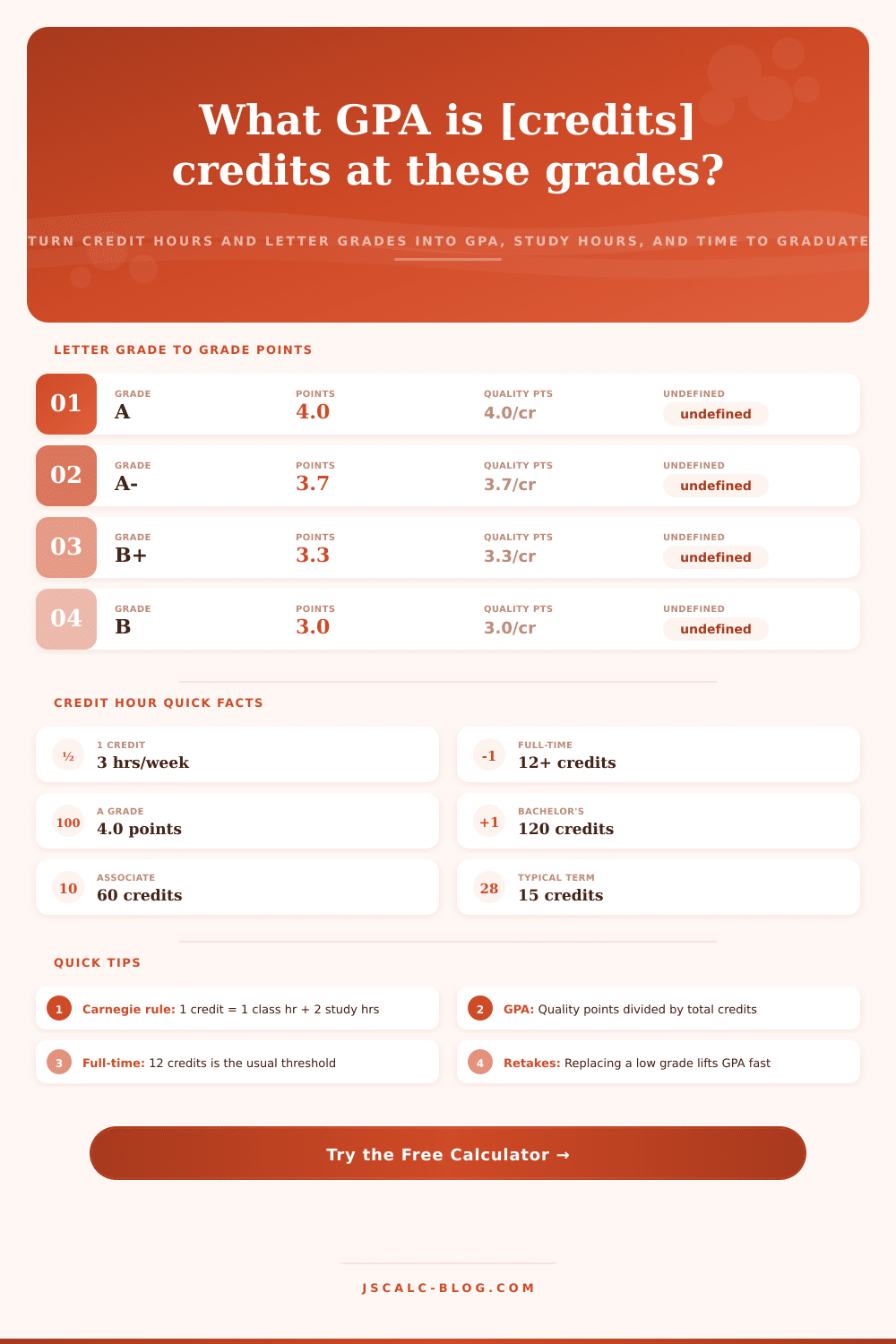
| Letter Grade | Grade Points | Percentage Range | Meaning |
|---|---|---|---|
| A | 4.0 | 93 to 100% | Excellent, top of the class |
| A- | 3.7 | 90 to 92% | Strong, near the top |
| B+ | 3.3 | 87 to 89% | Very good work |
| B | 3.0 | 83 to 86% | Good, above average |
| B- | 2.7 | 80 to 82% | Solid but slipping |
| C+ | 2.3 | 77 to 79% | Fair, room to grow |
| C | 2.0 | 73 to 76% | Average, often the minimum |
| D | 1.0 | 60 to 66% | Passing but weak |
| F | 0.0 | Below 60% | Failing, no credit earned |
Quality points for a course = credit hours × grade points. A 3-credit B earns 3 × 3.0 = 9.0 quality points.
⏱Credit Hours to Weekly Study Time
| Credit Hours | In-Class Hours | Study Hours (2x) | Total Weekly | Load Type |
|---|---|---|---|---|
| 3 credits | 3 hrs | 6 hrs | 9 hrs | One typical course |
| 6 credits | 6 hrs | 12 hrs | 18 hrs | Part-time minimum |
| 9 credits | 9 hrs | 18 hrs | 27 hrs | Three-quarter time |
| 12 credits | 12 hrs | 24 hrs | 36 hrs | Full-time threshold |
| 15 credits | 15 hrs | 30 hrs | 45 hrs | On-time bachelor pace |
| 18 credits | 18 hrs | 36 hrs | 54 hrs | Heavy overload |
The Carnegie rule assumes 1 hour in class plus 2 hours of study for every credit hour, so total weekly hours = credits × 3.
🎭Full-Time Status Thresholds
| Enrollment Status | Undergrad Credits | Grad Credits | Financial Aid Note |
|---|---|---|---|
| Full-time | 12 or more | 9 or more | Full aid and scholarships |
| Three-quarter time | 9 to 11 | 6 to 8 | Prorated aid |
| Half-time | 6 to 8 | 4 to 5 | Minimum for most loans |
| Less than half-time | 1 to 5 | 1 to 3 | Limited or no aid |
Thresholds are standard U.S. federal guidelines. Your school may set its own cutoffs, so confirm with the registrar.
🎓Degree Credit Requirements
| Degree | Typical Credits | Full-Time Years | At 15 cr/term | At 12 cr/term |
|---|---|---|---|---|
| Certificate | 18 to 30 | Under 1 year | 1 to 2 terms | 2 to 3 terms |
| Associate | 60 | 2 years | 4 terms | 5 terms |
| Bachelor's | 120 | 4 years | 8 terms | 10 terms |
| Bachelor's (heavy) | 150 | 5 years | 10 terms | 13 terms |
| Master's | 30 to 36 | 1.5 to 2 years | 2 to 3 terms | 3 terms |
Terms count fall and spring only. Summer sessions can shorten these timelines if you take extra credits.
📊Grade Scale Comparison Grid
| Letter | 4.0 Scale | +/- Scale | Percentage | Quality Pts (3cr) | Quality Pts (4cr) |
|---|---|---|---|---|---|
| A | 4.0 | 4.0 | 93 to 100% | 12.0 | 16.0 |
| A- | 4.0 | 3.7 | 90 to 92% | 11.1 | 14.8 |
| B+ | 3.0 | 3.3 | 87 to 89% | 9.9 | 13.2 |
| B | 3.0 | 3.0 | 83 to 86% | 9.0 | 12.0 |
| B- | 3.0 | 2.7 | 80 to 82% | 8.1 | 10.8 |
| C+ | 2.0 | 2.3 | 77 to 79% | 6.9 | 9.2 |
| C | 2.0 | 2.0 | 73 to 76% | 6.0 | 8.0 |
| D | 1.0 | 1.0 | 60 to 66% | 3.0 | 4.0 |
| F | 0.0 | 0.0 | Below 60% | 0.0 | 0.0 |
The +/- scale rewards fine gradations. A school on the unweighted 4.0 scale treats A and A- both as 4.0, which slightly inflates GPA.
⚙Formula Breakdown
credit hours × grade points. A 4-credit B+ earns 4 × 3.3 = 13.2 quality points.total quality points / total credit hours. Sum every course's quality points, then divide by the credits attempted.credits × (1 + study ratio). With the standard 2 study hours per credit, that is credits × 3.12+ credits, half-time at 6. Grad students are usually full-time at 9 credits.required − completed − this term. It floors at zero once you meet the requirement.remaining / credits per term, rounded up because you cannot take a partial term.📋Worked Example: Four Courses
| Course | Credits | Grade | Grade Points | Quality Points |
|---|---|---|---|---|
| English Comp | 3 | A | 4.0 | 12.0 |
| Calculus I | 4 | B+ | 3.3 | 13.2 |
| World History | 3 | A- | 3.7 | 11.1 |
| Intro Biology | 3 | B | 3.0 | 9.0 |
| Total | 13 | — | — | 45.3 |
GPA = 45.3 quality points / 13 credits = 3.48. Weekly workload = 13 × 3 = 39 hours. That load counts as full-time.
💡GPA and Course-Load Tips
This site does three things at once: calculates how many semesters until graduation, predicts the number of hours per week to study given your course load, and translates your courses into a grade point average. Rather than having multiple Excel spreadsheets tracking your schedule and grades separately, you input your classes one time. Then it crunches the numbers. That way, you can design a term that matches your real calendar while still hitting all your academic targets.
In US colleges, basic unit of academic work is called a credit hour. The name sounds complicated, but it refers simply to one hour of classroom instruction per week during a typical fifteen-week semester, plus some assumed amount of study time outside of class. Typically, most lecture courses will count for three credits (that’s three hours in the classroom every week). Other types of classes (seminars, labs) has different values. So a full-time class schedule might include four or five distinct classes, totaling fifteen credits.
How This College Tool Helps You Plan Your Classes
Beyond just scheduling, credit hours impact your enrollment status and you’re eligibility for financial aid. They also contribute to the total number required for your degree. For example, an associate degree typically requires 60 credits, whereas a bachelor’s degree require 120. To graduate on time, you need to know how you’re accruing those credits.
The “g” stands for grade point average; it’s basically the weighted average of your grades. Every letter corresponds with a number on the 4.0 scale (A = 4.0, B = 3.0). The calculator calculates your GPA. It multiplies the quality points of each course (the grade multiplied by the credit hours), adds those totals together, and then divides by total number of credits attempted.
That’s why a course worth 4 credits will count more than a 1-credit lab, and this weight is more important than you’d imagine. A higher course will move your GPA much further if you get the same letter grade as a lower course. For example, if you ace a big course, you’ll lift your average more quickly then if you ace a smaller elective. It’s not complicated math, but it does impact which classes you should focus most of your energy on during each semester.
The other function calculates based off the Carnegie rule; the old formula that underlies the concept of the credit hour itself. According to the Carnegie rule, each credit hour equate to an hour spent in class plus two hours spent studying independently. So total weekly commitment equals credits times three. If you have a schedule with fifteen credits, that means around 45 hours per week will be spent in class/studying. That’s nearly a full-time gig.
Because fifteen credits seems like a light load, students are prone to grossly underestimating what it will take. Fifteen credits only adds up to around 15 hours of scheduled class time. All the real time gets spent in the two-to-one study ratio. You can tweak the study ratio if your program is either heavier or lighter than average. Having the ability to see both class hours and study hours helps you know exactly how much any given term will ask from you before registering.
The third function calculates the number of semesters left before you reach the end. Enter your existing credits (which ones?), select the number of required credits for your degree, and input how many credits you intend to take per term. The tool will then calculate the remaining credits, divide them by your intended load, and give you a rough guess at the number of semesters until completion. Since we don’t do fractional terms, this rounds up.
And, this view keeps a four-year plan honest. When you slip back into a part time load, the timeline instantly lengthens. When you add a summer term, your graduation date pulls closer. It is the difference between paying for another semester of fees and housing or graduating on schedule.
You’re also considered full- or part-time based on credit hours. Generally speaking, full time is 12+ credits for undergraduate student, while part time is six to 11 credits. The minimum required to keep most student loans in good standing is usually around six credits. However, graduate students are generally considered full time if they take at least nine credits. Loan deferment, health insurance eligibility, and scholarship terms all hinge on these cut offs. As you adjust your credit hours, the calculator alerts you to your classification. Remember: Some schools have different requirements, so always double check with your registrar exactly what those numbers are.
With one click, their preset buttons loads realistic scenarios. These show you quickly how different grade patterns and course loads affect your timeline and GPA. Reference tables below the calculator display typical degree requirements, the credit-to-study-hour mapping, and the full letter-grade scale.
Run your actual courses through this thing every semester. Whether you’re trying to recover from a low GPA, chase honors, or just make sure you can fit that job while carrying a heavy term, you’ll always know precisely how many terms are left before graduation, what your true weekly workload is, and what your GPA actualy looks like.