Lexile Estimate Calculator
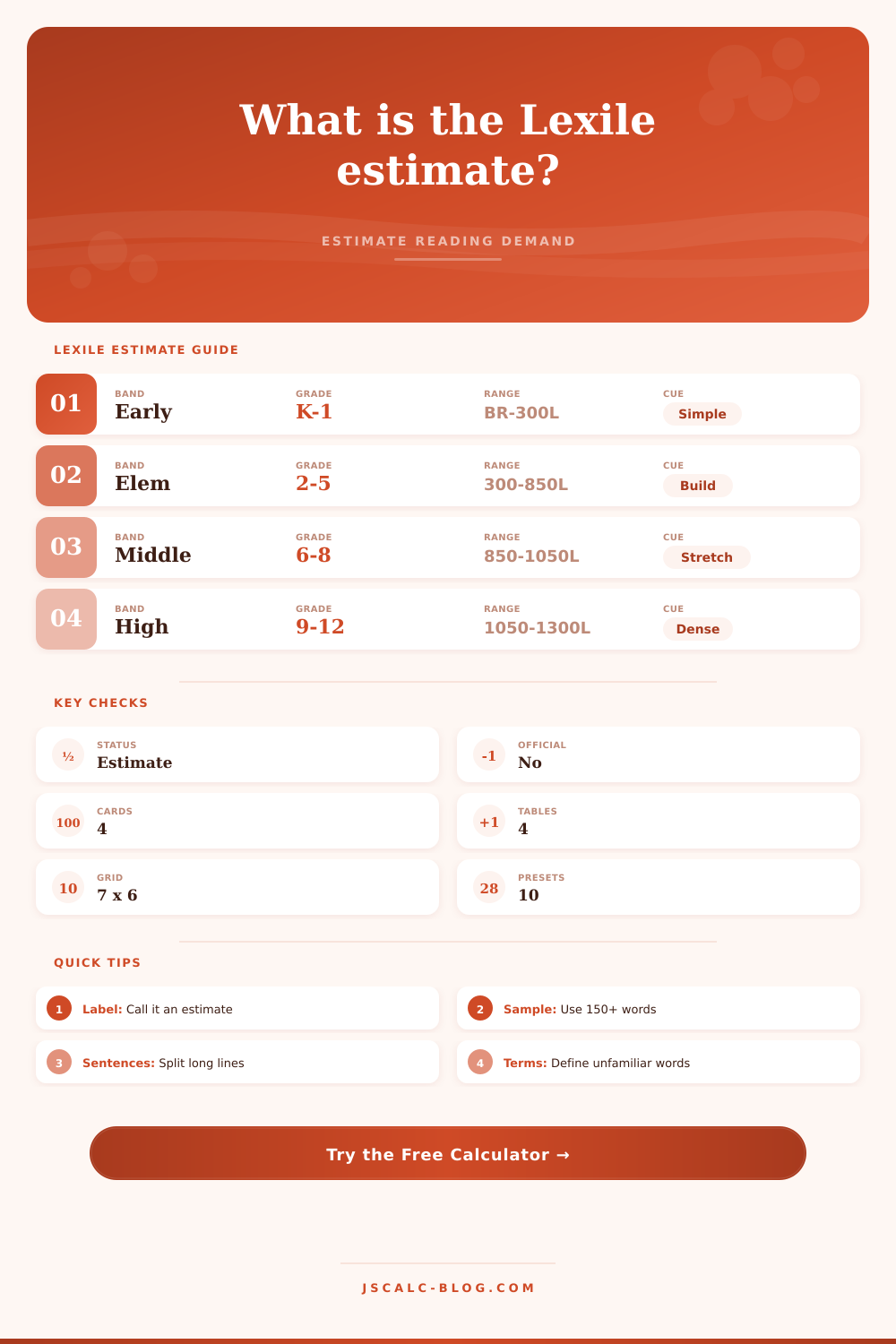
Estimate a Lexile-style reading range from a grade-band proxy, average sentence length, and unfamiliar word rate. This JSCalc-Blog.com tool is an educational estimate, not an official MetaMetrics Lexile measure.
📌Named Presets
Load a realistic text sample, then adjust the grade-band proxy, sentence target, and unfamiliar word method.
Lexile-style estimate
Paste text and calculate to see the estimated range.
🔢Text And Estimate Inputs
📊Live Count Cards
🗂Grade Proxy Grid
📋Reference Tables
| Grade-Band Proxy | Base Estimate | Sentence Target | Unfamiliar Target | Use This When |
|---|---|---|---|---|
| K to grade 1 | 150L | 7 words | 4% | Text is controlled, repetitive, and strongly supported by context. |
| Grades 2 to 3 | 450L | 10 words | 7% | Readers handle simple chapters and short informational passages. |
| Grades 4 to 5 | 770L | 14 words | 10% | Readers meet subject vocabulary but still need clear sentence structure. |
| Grades 6 to 8 | 970L | 18 words | 13% | Middle-grade content includes more abstract terms and longer explanations. |
| Grades 9 to 10 | 1120L | 21 words | 16% | High-school passages can support analysis, argument, and source detail. |
| Grades 11 to 12 | 1250L | 24 words | 19% | Upper-level readers can handle denser syntax and specialized vocabulary. |
| College | 1370L | 27 words | 22% | Academic or professional text assumes background knowledge. |
| Adjustment Part | Rule Used | Why It Moves The Estimate | Practical Check |
|---|---|---|---|
| Base proxy | Selected grade band | Provides a starting point before text features are measured. | Choose the intended reader, not the writer's grade. |
| Sentence length | 12L per word above or below target | Longer sentences usually increase processing demand. | Compare the average to the band target. |
| Unfamiliar words | 18L per percentage point above target | New terms increase decoding and background-knowledge load. | Use manual rate if a teacher has a vocabulary list. |
| Text type | -40L to +110L adjustment | Fiction, directions, technical, and academic passages place different demands on readers. | Do not use the adjustment to hide difficult vocabulary. |
| Sample stability | Range widens for short samples | Small excerpts swing sharply when one long sentence or term is added. | Use 150 or more words when possible. |
| Text Type | Adjustment | Common Pattern | Editing Priority |
|---|---|---|---|
| Narrative or fiction | -20L | Story context can support unfamiliar words. | Keep voice, trim only confusing syntax. |
| Informational article | 0L | Balanced explanation with topic terms. | Define important terms on first use. |
| Directions or help page | -40L | Short steps and action verbs lower demand. | Use one action per sentence. |
| Technical explanation | +70L | Specialized terms and dependencies add load. | Add examples and plain definitions. |
| Academic passage | +110L | Abstract nouns and complex relationships are common. | Split claims, evidence, and exceptions. |
| Assessment item set | +40L | Questions add precision and inference demand. | Keep stems direct and choices parallel. |
| Rewrite Move | Count Impact | Estimate Direction | Use When |
|---|---|---|---|
| Split one 32-word sentence | Lowers average sentence length | Estimate usually decreases | One sentence carries multiple events or claims. |
| Preview key terms | Lowers unfamiliar rate for the reader | Estimated access improves | Terms are necessary for the topic. |
| Replace a needless long word | May lower unfamiliar rate | Estimate can decrease | A shorter word is equally accurate. |
| Add a concrete example | May add short sentences | Often improves clarity | An abstract idea needs support. |
| Keep domain vocabulary | Unfamiliar rate may stay high | Estimate may remain high | Precision matters more than broad access. |
💡Practical Tips
Give a fifth grader a dense chunk of history. Their eyes glaze over. Give a ninth grader an easy folk tale. Their eyes zone out. It’s not often a lack of smarts. It is more likely a mismatch. Books don’t match readers.
And you want to match readers with books they can read and yet stretch them just a little bit more. That’s what you are looking for when you measure reading levels. The official version is both owned by a company and complex. This is a practical tool to help you estimate that need. You can do it without sending anyone to a lab or getting a license.
A Simple Tool to Check Reading Levels
The calculator above will do all the math for you… but here’s where it gets good, what goes into the math? First off, we’re using a grade-band stand-in. Selecting something like grades two to three set the anchor at approximately four hundred fifty Lexiles. That’s our starting point.
From there, we adjust up or down based on two main variables: unfamiliar word rate and average sentence length. Those two variables really drive how hard it is to read any given book at any given moment. Why? Because we only have so much working memory in our brain. Twenty-five words strung together in one breath require the brain to decode the end while holding onto the start, draining mental energy.
The calculator uses your average sentence length compared to what’s considered normal (the target) for your grade band. A higher-than-normal estimate means your sentences is running long. Splitting up long lines lowers the score. This is often easier than rewriting the entire paragraph.
The other half is vocabulary: How many are unknown words? It’s a rough guess. It is based off things like word length or a list of common words that we assume people understand. If the text have many long technical words, the estimate goes up.
For example, it matters when you’re reading something specific to a subject. Even at the same grade level, a story about friendship will have a lower score then a biology text, which assumes greater background knowledge. That reference table on the page explains all this. Instructions get downgraded; technical explanations, upgraded. It’s a matter of the kind of thinking it calls for.
And many people treat these numbers as final verdicts. It’s not. These scores are snapshots of structural difficulty. Higher score = more dense doesn’t equal higher score = worse book. Lower score = easier to read doesn’t equal lower score = better book.
The range they spit out is wide for good reason. Shorter samples vary wildly. A complex sentence can throw off an entire score. This is why you want to have longer chunks of text that smooth out those spikes. When you’re looking at a snippet, the broader confidence interval keeps you from overcorrecting.
Most people’s biggest problem is that they try to dumb a text down by deleting all the difficult words. That usually doesn’t work… It can make it worse. You lose the precision, you lose the voice.
Define the hard words when you use them the first time. Break up the syntax. Keep the vocabulary and lower the cognitive load required to find it. This way, you preserve the integrity of the content AND make it accessible.
It’s a question of how much do you want to lower the level of access versus how deep do you need to go? There has to be some kind of tradeoff between those two things, depending on who your audience are.
This type of analysis helps teachers and editors triage text. You run it through the metrics before investing hours in a rewrite. And then you examine the drivers when the number comes out way off. Are those long sentences? Or is it all that jargon? Tackle the right driver, and you save time.
Convert your fuzzy sense of “this is too hard” into a plan you can use: start cutting down clauses; add a glossary here and there. Do it with data instead of gut feel.
You should of used more samples. But here’s the thing: The estimate is transparent. You’re looking at the exact reason behind the number change. It’s measurable. It’s not guesswork.
It provides a map for you as a reader (a teacher planning a lesson, a parent selecting a book) of where the reading experience gets difficult. Where does it get rocky? How do I avoid climbing the entire mountain if all I want to do is reach a certain spot? What happens when the path changes?
This information creates a clear understanding of what will happen, and that makes all the difference between a productive stretch and a frustrating struggle. It brings clarity to the chaos of selecting the right read.
You’ll find it helps with luxurios books. A teacher should of checked the word rate first. If you use modern text, its better. You need to check if vocabularies is too hard. Most people find it naturaly difficult. The moddern student needs help. It is a complicated process. We want to make sure students can read comfortablyy.
One must recieve feedback. This helps them more then before. There are many books that sits on the shelf. A armchair is not needed for this task. You should of checked the grammar. All furnitures in the room was moved. The student wants to read two adult-sized sofa.
It’s better than any other option. We must use a dictionary if words is hard. This makes the process easier than before.