Average Sentence Length Calculator
Paste text or enter counts to calculate average sentence length as total words divided by total sentences, then compare the result with a target, bucket-based median estimate, and sentence density per 100 words on JSCalc-Blog.com.
📌Text Presets
Load a sample with a different sentence pattern, then tune the target profile and counting method.
Sentence length result
Paste text and calculate to see words per sentence.
🔢Text And Count Inputs
📊Current Sample Metrics
🗂Reader Profile Grid
📋Reference Tables
| Average Sentence Length | Reading Signal | Typical Use | Review Move |
|---|---|---|---|
| Under 8 words | Very short and punchy | Kids copy, alerts, steps | Check that the rhythm does not feel choppy. |
| 8 to 14 words | Fast public reading | Help pages, summaries, product copy | Add context only where a decision needs it. |
| 15 to 20 words | Balanced general prose | Blogs, essays, workplace notes | Trim sentences that carry unrelated ideas. |
| 21 to 30 words | Dense but manageable | Policy, technical, academic explanation | Split the longest sentence before simplifying terms. |
| Over 30 words | High sentence load | Legal, specialist, draft prose | Look for clauses joined by commas and conjunctions. |
| Formula Part | Expression | Input Source | Meaning |
|---|---|---|---|
| Average sentence length | total words / total sentences | Text analysis or manual counts | The primary ASL result in words per sentence. |
| Sentence density | sentences / words x 100 | Same counts as ASL | How many sentence breaks appear per 100 words. |
| Target gap | actual ASL - target ASL | Profile target or custom target | Positive values mean sentences run longer than target. |
| Median estimate | middle sentence bucket midpoint | Sentence-length distribution | A rough middle sentence length when exact ordering is not the focus. |
| Bucket Name | Standard Range | Compact Range | Academic Range | Interpretation |
|---|---|---|---|---|
| Short | 1 to 8 words | 1 to 6 words | 1 to 10 words | Good for direct actions and emphasis. |
| Plain | 9 to 14 words | 7 to 12 words | 11 to 17 words | Comfortable public reading range. |
| Standard | 15 to 20 words | 13 to 18 words | 18 to 25 words | Normal explanatory sentence length. |
| Long | 21 to 30 words | 19 to 26 words | 26 to 38 words | Review for split points and stacked clauses. |
| Dense | 31 plus words | 27 plus words | 39 plus words | Usually the first place to revise. |
| Rewrite Move | Count Effect | ASL Direction | Use When |
|---|---|---|---|
| Split one 36-word sentence into two 18-word sentences | Words unchanged, sentences increase | Average falls | The sentence contains two claims or actions. |
| Delete a filler phrase | Words decrease, sentences unchanged | Average falls slightly | The phrase adds no decision value. |
| Add a short example sentence | Words and sentences increase | Average may fall | A concept needs concrete support. |
| Merge choppy fragments | Sentences decrease | Average rises | The sample has too many abrupt sentence breaks. |
| Keep precise legal wording | Words often stay high | Average may stay high | Meaning would change if split incorrectly. |
💡Practical Tips
That’s where the calculator above comes in. It will run through the numbers for you, taking chunk of prose and turning it into actionable data. You’ll see that the same piece of writing can feel effortless to read (or not).
This varies largely based off sentence length. Your brain counts how much effort it has to put into digesting one thought after another when faced with a wall of text. An overly long average sentence mean a spike in effort; an overly short one mean choppy reading. Finding the sweet spot, then, is a matter of mechanics. It is the number of words divided by the number of sentences. Simple enough, though everyone seem to miscalculate this (probably guessing instead of counting).
How to Make Your Writing Easier to Read
This gives us just one metric, which is fine. However, the mean value on its own might not tell whole story. If there are one or two very long sentence in your work, then this will pull the mean up higher, masking the reality that all your other sentences is fine. Here’s where the median estimate comes into play: It examines the distribution of sentence lengths. If your median is normal but your mean is high, you probably have one or two runaway sentences. Finding these outliers let you address the readability problem.
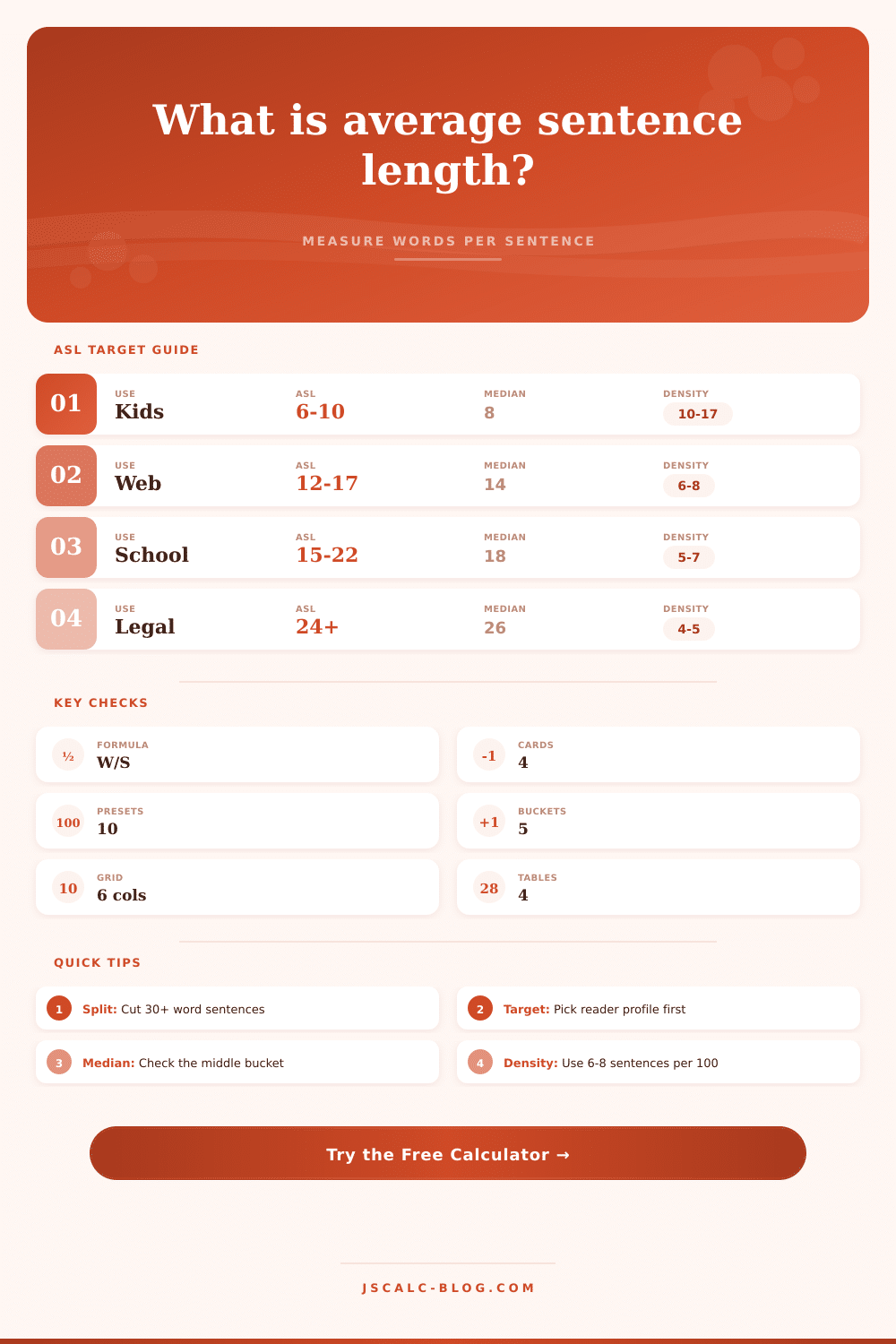
Remember that this is all about context. You’re not working in a vacuum here. The rhythm of a blog post differs from that of a legal contract. This is why I’ve included a reference table for acceptable density by audience. In general, on the web, we shoot for somewhere in the range of twelve to seventeen words per sentence. Longer then that and things start feeling dense.
Technical documentation? Go up maybe as high as twenty-two: the reader expects it, and there’s usually an understanding that it will be complex. You pick the target profile for whom you’re writing, and the calculator will give you a comparison. That way you know whether you’re ahead or behind curve.
The raw number is more than just a diagnostic. You should also watch density, which is the number of sentences in every hundred words. Sentences are places where we stop. Lots of sentences = lots of stopping = urgency but also fatigue. Fewer sentences = longer thoughts, smart but difficult-to-follow thoughts.
You’re looking at cognitive load here. When a sentence conclude, the reader takes a micro-break. A pileup of clauses within one sentence rob them of this break, with the result being fatigue.
Rewriting my voice doesn’t mean rewriting your voice. That’s mechanical editing. Sentence length. Grab a copy of your draft and find the longest sentences. Identify conjunctions like “and,” “but,” and “because.” These tend to be seams where a sentence can be cut. Splitting a thirty-word sentence into two, fifteen-word sentences won’t reduce your word count at all. But your sentence count will go up. Your average goes down. The text becomes easier to read. It is a little change, but one that matters.
Don’t get hung up on making each sentence “x” words exactly (whatever x is). Let the data guide your eye. Don’t let the data substitute for your judgment. So maybe it tells you that you’re a sentence or two too long. Look at your sentences. Are they really needed? If so, keep ’em. If not, trim ’em. You don’t want all your sentences to be short. You want the flow to feel predictable and comfortabley.
Cut and paste your draft into the calculator. Watch the numbers change as you edit. You’ll see that clarity isn’t a mystery. It’s simply a question of controlling the space between the periods. The counting part is easy; the math does it for you. The flow part is yours.