Syllables Per Word Calculator
Measure average syllables per word, 3+ syllable word rate, target reduction, and confidence for a pasted text sample or audited manual counts.
🎯Presets
📝Text and Count Inputs
Paste text for automatic syllable estimation, or switch to manual counts after an editorial audit.
Syllable Complexity Result
Ready📊Current Sample Grid
📘Target Tables
| Audience | Target avg | Polysyllable range | Sentence note | Best use |
|---|---|---|---|---|
| Elementary readers | 1.15 to 1.25 | 0% to 5% | Very short | Instructions, labels, early lessons |
| Middle school readers | 1.25 to 1.38 | 4% to 9% | Short to medium | Class handouts and explainers |
| General web readers | 1.30 to 1.45 | 6% to 12% | Plain language | Help pages, articles, forms |
| Workplace memo | 1.35 to 1.55 | 8% to 15% | Scan friendly | Policies, updates, internal notes |
| Technical audience | 1.50 to 1.75 | 12% to 22% | Define terms | Specs, procedures, analysis |
| Academic audience | 1.65 to 2.00 | 18% to 32% | Dense allowed | Abstracts, papers, literature review |
| Word shape | Example | Typical syllables | Reader effect | Revision move |
|---|---|---|---|---|
| Short everyday word | help | 1 | Easy scan | Keep when exact |
| Compound word | workflow | 2 | Usually clear | Split only if needed |
| Long noun | implementation | 5 | Raises average | Use doing, setup, or rollout |
| Technical term | calibration | 4 | May be required | Define once, then shorten |
| Name or acronym | California | 5 | Estimator risk | Manual audit for final copy |
| Hyphenated phrase | reader-friendly | 4 or split | Policy dependent | Match your style guide |
| Contraction | shouldn't | 2 | Conversational | Good for plain tone |
| Confidence signal | Stronger result | Weaker result | What to do |
|---|---|---|---|
| Sample size | 100+ words | Under 30 words | Analyze a fuller passage |
| Counting mode | Manual audited counts | Pure spelling estimate | Manually count key copy |
| Unusual words | Few names or jargon terms | Many names and compounds | Review flagged terms |
| Hyphen policy | Consistent style guide | Mixed treatment | Choose split or combined |
| Text cleanliness | Normal prose | Tables, codes, URLs | Remove non-prose tokens |
| Target gap | Near target | Large reduction needed | Revise and remeasure |
| Metric | Formula | Good check | Editorial use |
|---|---|---|---|
| Syllables per word | Total syllables / total words | 1.30 to 1.45 for web copy | Tracks word complexity |
| Polysyllable rate | 3+ syllable words / words × 100 | Under 12% for plain language | Finds long-word pressure |
| Target syllables | Words × target average | Compare with current total | Shows allowable syllable load |
| Reduction needed | Current syllables - target syllables | Zero means on target | Sets revision size |
| Confidence | Sample score - ambiguity penalty | 80%+ is strong | Guides whether to audit manually |
💡Revision Tips
Writing an email or a help page might feel like you’re trying to hard. But don’t worry: You aren’t alone. You want to sound smart!
Smart words make things confusing! How dense does your writing seem? That’s what you don’t realize until you measure it out based off of scale.
How to Measure Writing Difficulty
People generaly think that sentence length determine complexity. They overlook number of syllables in each sentence. That’s a mistake. The brain doesn’t just read visual blocks of text; it also recognizes sound pattern.
How many syllable are there per word? The question above asks how many syllables is in each word. This is a tiny thing, but it’s what makes a text flow. Or it might not.
When you add some text to the textbox up top, this system will estimates how loaded with syllables each word in your text is. It then adds them all up and divides by number of words in your text to spit out a complexity score.
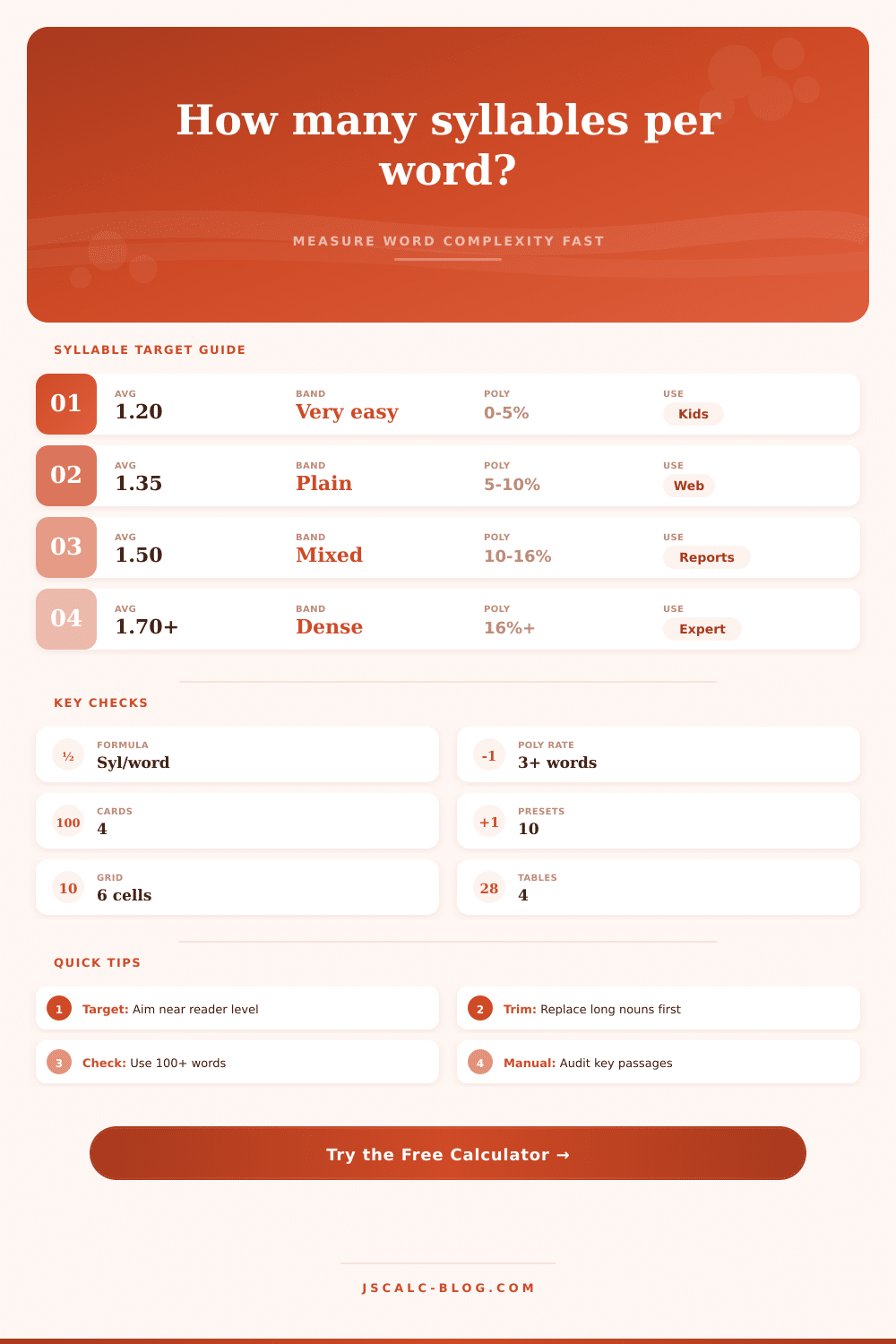
If your score is around one point two, you’ve written something easy to read. If the score are higher than one point seven, you’ve got a dense piece of text which asks readers to do a bit more mental lifting. Enter your text and let the calculator do its thing; then determine if they’ll want to do that mental work for you.
Adjust the hyphen setting. Does a reader-friendly phrase count as one long word (with a hyphen) or two short words? It does affect results very slight, but it’s also according to your house style. It’s important to be consistent; mixing things up can skew results.
Try manual mode if you are auditing a piece of text (like a tech manual or a legal document). In this case, switch to manual mode to enter counts that you know from looking at the text is correct. For example, maybe your text has lots of acronyms or proper names that you want counted correctly, since the automatic counter could of missed them.
How many words do I use with three or more syllables? The output give you this number as a percentage (a.k.a., polysyllable rate). This is an important score; it tells you where you may be creating friction for your reader.
When the rate is high, they’re stopping every few words to figure out what you mean. The numbers provided in the reference tables on the page shows what’s normal for whom.
If you’re aiming at general web readers, keep your long-word rate below twelve percent. Academic types will tolerate more. If you know your audience, you’ll also know whether your draft is over their heads: Is your long word rate high for a middle school lesson plan? Simplify.
How do you reduce your score? By replacing long nouns with short ones, of course. No one said you have to dumb down your message, you simply need to replace longer words with shorter ones that convey the same thing. Calibration becomes adjustment, setup becomes implementation. They mean the same thing but they takes less mental effort to process.
And if you don’t know how many fewer syllables you need, the calculator will tell you. How many words do you have to edit so your writing match your target average? It converts a vague concept, “I want to improve my readability”, into a specific action: “I’ll edit these words.” It gives you the distance between what’s on the page now and where you want it to be.
There’s also the business of confidence scores: How many words did they count from? What was the variety? That inform how confident they can be in their estimate. If there were few words, especially if some are unique to that author, your confidence is lower; rely more on manual counts.
It’s a note that this sort of thing isn’t a source of truth. It’s an aid. Read it for yourself. Feel the rhythm. The numbers help you edit; then empathy and ear complete the task.
It respects your reader’s time. Removes extra trouble. Delivers the message intact.
If you’re working on a blog post or a policy, measuring your syllable density will help you be honest with yourself about how complex your words are. Run your copy through the calculator. Then adjust based on your decision.
Try for clarity, yes, but try also for care and precision. Tracking these metrics removes guesswork. Now you control the experience instead of being controlled by it. That distinction between good and great is what makes the difference in writing.
You control the pen. Data gives you the mirror.