Dale-Chall Readability Calculator
Paste text or enter counts to calculate the Dale-Chall raw score, adjusted score, difficult-word percentage, average sentence length, and grade-level interpretation.
📌Dale-Chall Presets
Load realistic text samples or manual count scenarios, then adjust the difficult-word count, target audience, and rounding rule.
Dale-Chall result
Calculate to see raw score, adjusted score, and grade band.
🔢Text and Count Inputs
📊Current Sample Metrics
🗂Grade and Use Grid
📋Reference Tables
| Dale-Chall Score | Estimated Grade | Typical Reader | Plain-Language Signal | Revision Priority |
|---|---|---|---|---|
| 4.9 or less | 4th grade and below | Early readers | Very familiar words and short sentences | Keep accuracy, avoid over-simplifying |
| 5.0 to 5.9 | 5th to 6th grade | Upper elementary | Public-friendly wording | Check any unfamiliar terms |
| 6.0 to 6.9 | 7th to 8th grade | Middle school or broad web | Usually suitable for general guidance | Split the longest sentences |
| 7.0 to 7.9 | 9th to 10th grade | High school readers | More abstract or specialized vocabulary | Define field terms and remove stacked clauses |
| 8.0 to 8.9 | 11th to 12th grade | Advanced student readers | Dense wording or many non-list words | Audit hard-word percentage first |
| 9.0 to 9.9 | 13th to 15th grade | College readers | Specialized reading load | Use examples and shorter transitions |
| 10.0 plus | 16th grade and above | Graduate or expert readers | Heavy technical or legal load | Check whether difficulty is required |
| Formula Step | Expression | Input Source | Effect |
|---|---|---|---|
| Difficult-word percent | difficult words / words x 100 | Manual count or easy-list estimate | Raises the score through the 0.1579 factor. |
| Average sentence length | words / sentences | Detected or manual sentence count | Raises the score through the 0.0496 factor. |
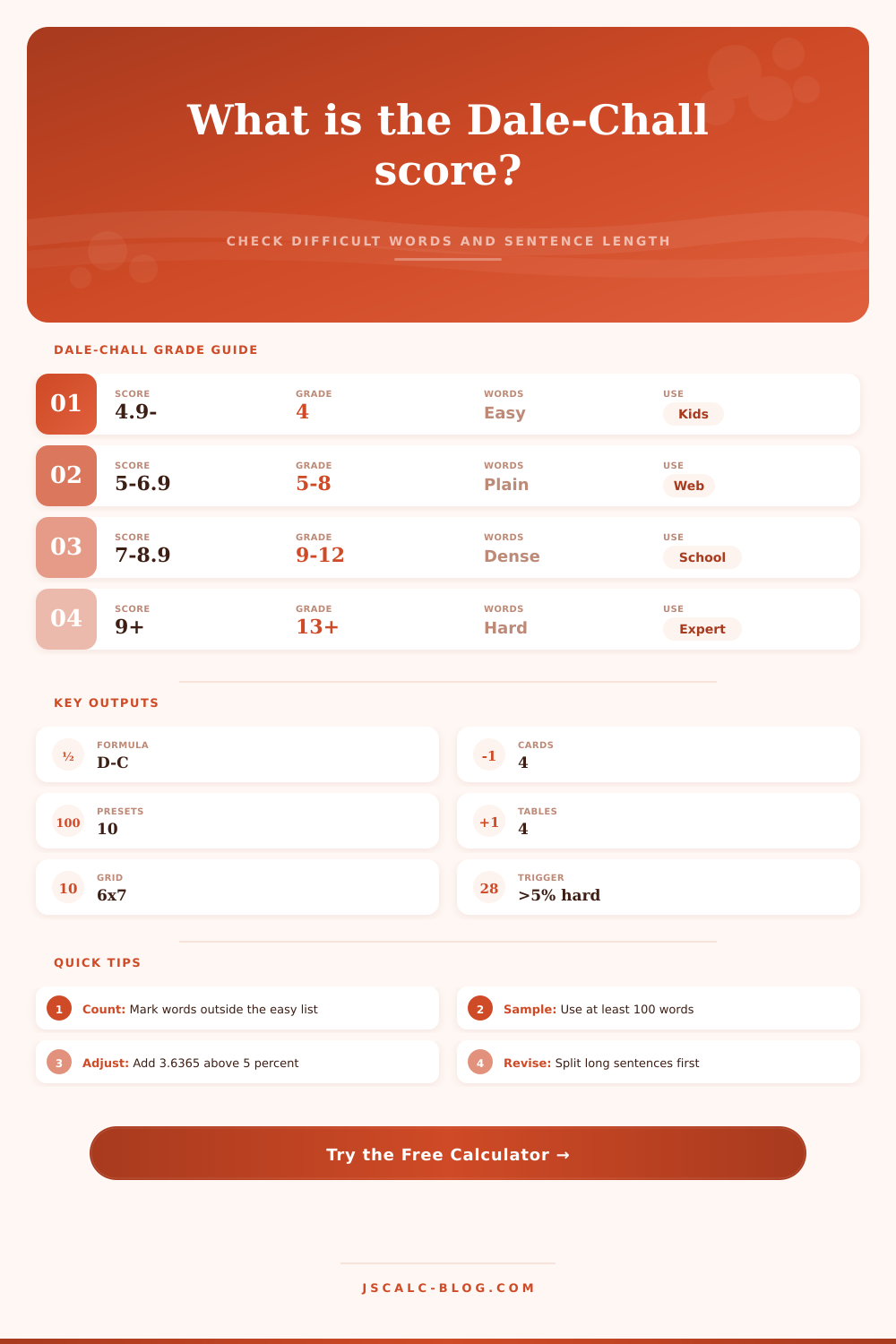
| Raw score | 0.1579*hardPercent + 0.0496*sentenceLength | Both ratios | Shows the unadjusted difficulty level. |
| Adjustment | add 3.6365 if hardPercent is greater than 5 | Difficult-word threshold | Creates the reported Dale-Chall adjusted score. |
| Sample Type | Best Word Count | Sentence Check | Difficult-Word Check | Common Risk |
|---|---|---|---|---|
| Short notice | 100 to 200 words | Confirm fragments | Manual count if important | One hard word changes percent quickly. |
| Help article | 200 to 500 words | Count steps as sentences when punctuated | Review repeated terms once | Product names can inflate difficulty. |
| Class handout | 250 to 750 words | Keep examples in the sample | Leave required subject terms if defined | Definitions may add sentence length. |
| Policy memo | 300 to 1000 words | Split bullet-like clauses | Check legal and administrative terms | Nominalizations raise unfamiliar-word load. |
| Research abstract | Full abstract | Do not merge headings into sentences | Manual list review is best | Necessary terms may still score hard. |
| Rewrite Move | Formula Impact | When To Use | Watch For |
|---|---|---|---|
| Replace an unfamiliar word | Lowers difficult-word percent | A common word is equally precise | Do not lose technical accuracy. |
| Define a necessary term | May not lower the score | The term must remain | Definitions help readers even if score stays high. |
| Split a long sentence | Lowers words per sentence | One sentence has two or more actions | Too many fragments can feel choppy. |
| Remove filler phrases | Can lower both ratios | Repeated setup words add length | Keep transitions that aid flow. |
| Use examples | May add familiar words | An abstract point needs support | Retest after adding the example. |
🧮Formula Method
💡Dale-Chall Tips
This is where the Dale-Chall formula comes in. This measures how easy writing is to understand compared to what it is trying to say. In other words, can someone understand this? Does it use overly complicated syntax? Remove those elements and run the test. Push a chunk of text through the calculator above, and you’ve got a grade-level score. But now what does that mean?
It all depends on two things: reading fatigue. This is about vocabulary difficulty. Researchers made a list of about 3,000 words known by an average American fourth grader. For every word out of their list you use the score increases.
How to Write Clearly for Your Readers
Sentence length. Each sentence require holding several clauses in your working memory. The longer it is, the worse you do. As these two factors increase, comprehension plummets.
You can express complex concepts clearly. But you can also hide those ideas behind unnecessary complexity. Readability scores are often used by most of us as a final decision: it’s readable/it isn’t. Use them to diagnose what may be wrong instead.
Do you get a score below five? (That’s in the elementary band.) (That’s in the high-school band.) The tool will indicate if that’s because the words are obscure or sentences is long-winded. Perhaps you’re writing short sentences filled with jargon that nobody can understand. Or perhaps your words are simple enough, but your sentences is so tangled they trip readers up.
The chart on the page divides the score into bands. Below five is elementary. It is made from short structures and common words, which is great for something like a broad public notice. Above nine is about college reading. It is fine for a technical manual but terrible for a patient information leaflet.
The thing that catches folks off guard is there’s this little twist in how it does its math. It penalizes your raw score greatly if over five percent of words are hard. So, it has this cliff effect. Maybe you’ve got something moderately challenging that comes back with an OK grade. Swap out one or two harder word, go past that five percent mark, bam! Grade level skyrockets. It favors simple language heavily. Pay attention to that edge. A few word tweaks have big effects on outcome.
Who are you writing for? Do you write a fourth grade reading level policy memo for a room full of lawyers? No! You’ll lose crucial nuance in that process. Do you expect a graduate student to be able to understand your consumer contract? Again, no! The point here is to match the reading level with the intended reader. If it’s a piece for the common man or woman, shoot for middle school band. There, you’re sophisticated enough without excluding anyone. You want to respect the reader’s intelligence and at the same time remove entry barriers.
Revision is an iterative process: write, measure, adjust. Split that long sentence in two. Replace that abstract noun with a concrete verb. Define that technical term rather than assume your reader knows it already. Every move reduces the friction. That’s what the calculator gives us: the feedback loop. It tells us where resistance lies. No need to guess. We know precisely which part of the text is doing the heavy lifting.
At its most fundamental level, though, reading well is a matter of respect. It means recognizing that someone else’s time and mental capacity are precious to them. Writing clearly isn’t dumbing down. It’s making something more efficient. It communicates what you want to say with minimal additional thought for your reader.
Simplifying things makes the underlying message even clearer. The idea comes through instead of the words obscuring it. That is the bar we should of all aspire to. It’s an indicator of how much you care about who’s recieveing this piece of paper.