Reading Level Calculator
Paste any passage to measure readability with six standard formulas: Flesch Reading Ease, Flesch-Kincaid Grade, Gunning Fog, SMOG, Coleman-Liau, and the Automated Readability Index, plus an averaged grade and reading time.
📚Real Sample Texts
📝Text and Options
The calculator splits sentences on periods, exclamation points, and question marks, then counts words, syllables, and complex words.
Leave 0 to auto-count from the text above.
Leave 0 to auto-count from punctuation.
🔢Counted Text Stats
🧮Formula Breakdown With Your Values
📊Formula Comparison Grid
| Formula | Score | Grade | Reading Age | Best Used For |
|---|---|---|---|---|
| Paste text above to fill this grid with live scores. | ||||
🎯Flesch Reading Ease Score Bands
| Ease Score | Grade Level | Difficulty | Typical Audience |
|---|---|---|---|
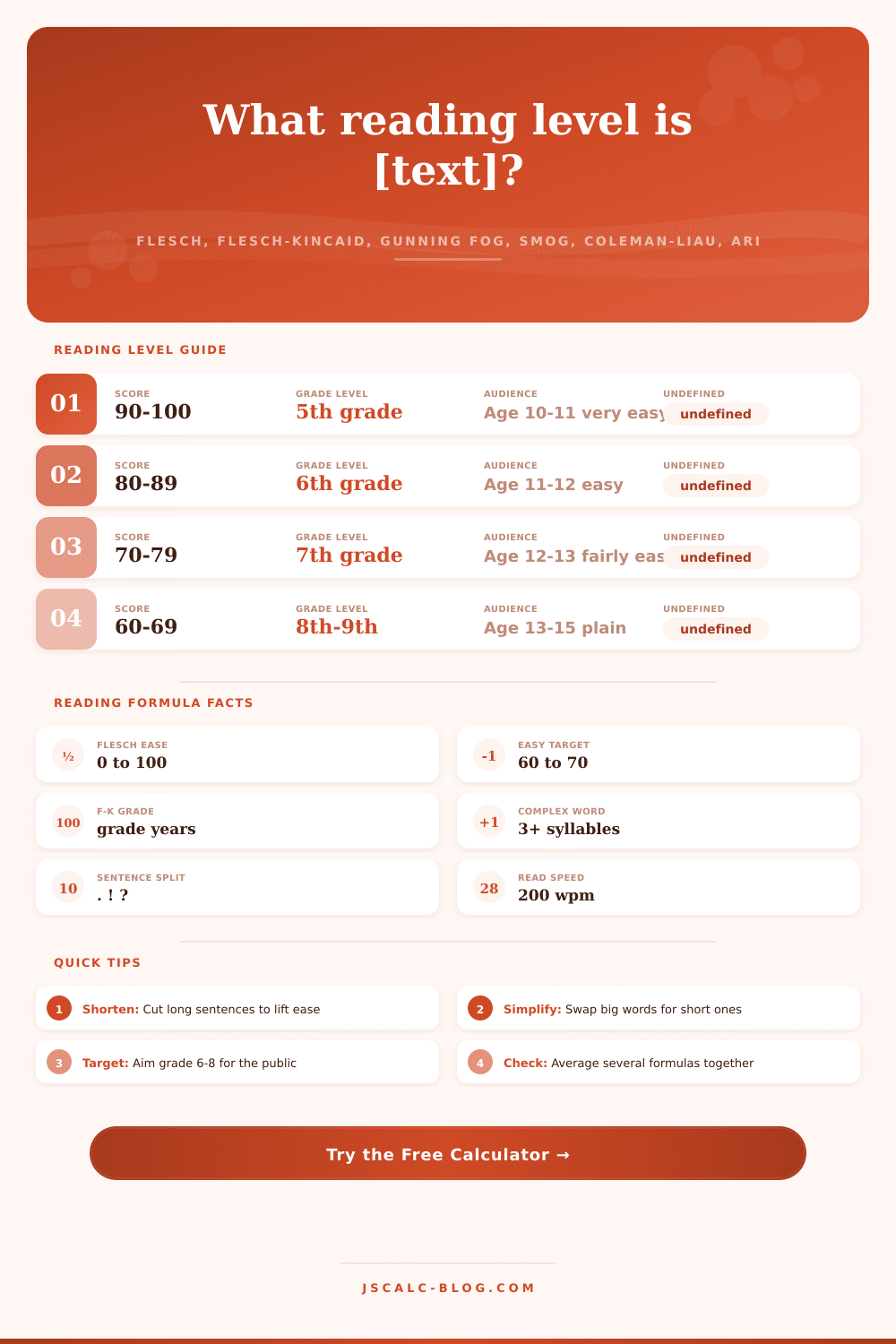
| 90 - 100 | 5th grade | Very easy | Age 10-11, early readers |
| 80 - 89 | 6th grade | Easy | Age 11-12, plain writing |
| 70 - 79 | 7th grade | Fairly easy | Age 12-13, casual reading |
| 60 - 69 | 8th - 9th grade | Plain English | Age 13-15, general public |
| 50 - 59 | 10th - 12th grade | Fairly hard | Age 15-18, high school |
| 30 - 49 | College | Difficult | Age 18-22, university |
| 0 - 29 | Graduate | Very confusing | Professionals, specialists |
🎓Grade to Age Mapping
| US Grade | Approx. Age | School Stage | What It Signals |
|---|---|---|---|
| Grade 1 - 3 | 6 - 9 | Early elementary | Short words and sentences |
| Grade 4 - 5 | 9 - 11 | Upper elementary | Simple, clear prose |
| Grade 6 - 8 | 11 - 14 | Middle school | Ideal for wide audiences |
| Grade 9 - 10 | 14 - 16 | Early high school | Standard news writing |
| Grade 11 - 12 | 16 - 18 | Senior high school | Longer, denser sentences |
| Grade 13 - 16 | 18 - 22 | College | Technical or academic tone |
| Grade 17+ | 22+ | Graduate | Specialist, jargon heavy |
📑Complex Word and Syllable Reference
| Item | Rule Used | Example | Effect on Score |
|---|---|---|---|
| Syllable count | Count vowel groups, drop silent e, minimum 1 | reading = 2 | Higher syllables lower ease |
| Complex word | 3 or more syllables | calculator = 4 | Raises Gunning Fog |
| Polysyllable | 3 or more syllables (SMOG) | readability = 5 | Raises SMOG grade |
| Letters | Alphabetic characters only | Feeds Coleman-Liau | More letters raise grade |
| Characters | Letters plus digits, no spaces | Feeds ARI | Longer words raise ARI |
⚙How Each Formula Works
💡Practical Readability Tips
Built for writers and editors by JSCalc-Blog.com. Readability scores are estimates from established formulas and should guide, not replace, human editing.
You know what happens when you have to read a complicated manual? It’s frustrating. Why is it written in such an unnecesaryly complicated way? Chances are that writer got caught up in their own sophistication and believed that long sentences and big words made something more complex then it actualy was.
Enter reading level calculators which take out all the subjectivity and runs some math on your content. The tool above use six readability algorithms to analyze your writing and gives you a complete picture instead of just a single number.
How to Write in Plain English
You have likely heard of Flesch Reading Ease. It is based off the idea that the easier a text is to read, the better. Shorter sentences and simpler words leads to a higher score. A reading ease score around 60 to 70 is considered plain English, while lower scores indicates more dense material.
Other formulas differ in how heavily they weight certain factors. For example, Gunning Fog determine a text’s grade level, taking into account both the complexity of its words (it punishes polysyllables) and length of the sentences. If your reader is technical, consider using SMOG, which only considers the length of words and doesn’t get thrown off by academic nature of the writing.
That’s where the meat of this comes into play: understanding the input data. Vowel groups is syllables. This is great for average prose, but might be a bit confusing when it come to jargon words or proper nouns. Sentences are split based on periods, question marks, and exclamation points (meaning the way you punctuate influences the score). Run-on sentences? They’ll penalize them all.
Stats panel is where you want to check word/sentence count. Why? Because you’re looking for balance. Sure, short words is good… but very long sentences can also result in poor scores. Mental effort increase as time passes; the brain gets tired of keeping track of everything. Give the reader a chance to pause regular.
Set your goal of aiming for a middle-school (grade 6-8) reading level for most public facing content. Why? It’s about as hard as people can read when they’re not paying full attention, when they’re tired. While news stories often hover around grade 9, academic papers and legal contracts tends toward a high school to college reading level (or even higher). For the large swath of the public, if you go beyond grade 8, well, good luck finding any takers. There is nothing wrong with their IQ. They just won’t read what you wrote.
If your sentences gets too long, break them up. Replace “utilize” with “use.” Change “subsequently” with “then.” You immediately improve the ease score. The readability calculator lets you customize the complexity word cut off, giving you an idea of how rigidly you need to edit things.
Another useful output here is the reading time estimate. Which assumes that people read silently at an average pace. That way you know how long they’re going to give you their attention, until they might look away. So if the estimate say it’s five minutes for this short intro, that tells you you’ve got a pacing issue.
The calculator has some presets so you can compare your work with established norms. Compare your draft alongside a common news article or a Hemingway-style excerpt, then see where the scores fall apart. Chances are, your average sentence size will be larger than it should of been.
“Readability editing doesn’t mean you’re dumbing anything down. It means reducing friction. You let the idea breathe by breaking apart any chunks of dense text and eliminating extra syllables. Numbers on the screen? Those are just the diagnostics. You need to recognize what feels heavy in your writing and know if that is the right weight for it, or a weight that hides its message. Because clear writing builds trust, engages readers longer, and reaches further. Use the score to start. But use your own judgment to end up with something both accurate and accessible.”