Speedometer Tire Size Calculator
Change to bigger or smaller tires and your speedometer reads wrong. Enter your stock and new tire sizes to see true speed, speedometer error, odometer drift, revs per mile, and the effective gear ratio change at highway speed.
🚗Real Tire Swap Presets
📏Tire Sizes
Original (stock) tire
Used only when mode is direct diameter.
New tire
Used only when mode is direct diameter.
Optional. Used for the RPM drop estimate.
Optional. Used for the regear suggestion.
🔢Formula Snapshot
📊Indicated vs Actual Speed
| Indicated | Actual Speed | Difference | Error % | GPS Check |
|---|---|---|---|---|
| Enter tire sizes above to build the speed table. | ||||
📏Common Tire Size to Diameter Chart
| Tire Size | Style | Diameter (in) | Revs / Mile | Circumference (in) |
|---|---|---|---|---|
| 245/75R16 | P-metric | 30.5 | 661 | 95.9 |
| 265/70R17 | P-metric | 31.6 | 638 | 99.3 |
| 285/75R17 | P-metric | 33.8 | 596 | 106.3 |
| 31x10.50R15 | Flotation | 31.0 | 650 | 97.4 |
| 33x12.50R17 | Flotation | 33.0 | 611 | 103.7 |
| 35x12.50R17 | Flotation | 35.0 | 576 | 110.0 |
| 37x12.50R17 | Flotation | 37.0 | 545 | 116.2 |
| 205/55R16 | Passenger | 24.9 | 809 | 78.2 |
🔄Error % by Diameter Jump
| Old Diameter | New Diameter | Change (in) | Speedo Error | Verdict |
|---|---|---|---|---|
| 31.6 in | 32.0 in | +0.4 | +1.3% | Within spec |
| 31.6 in | 32.6 in | +1.0 | +3.2% | Borderline |
| 31.6 in | 33.0 in | +1.4 | +4.4% | Recalibrate |
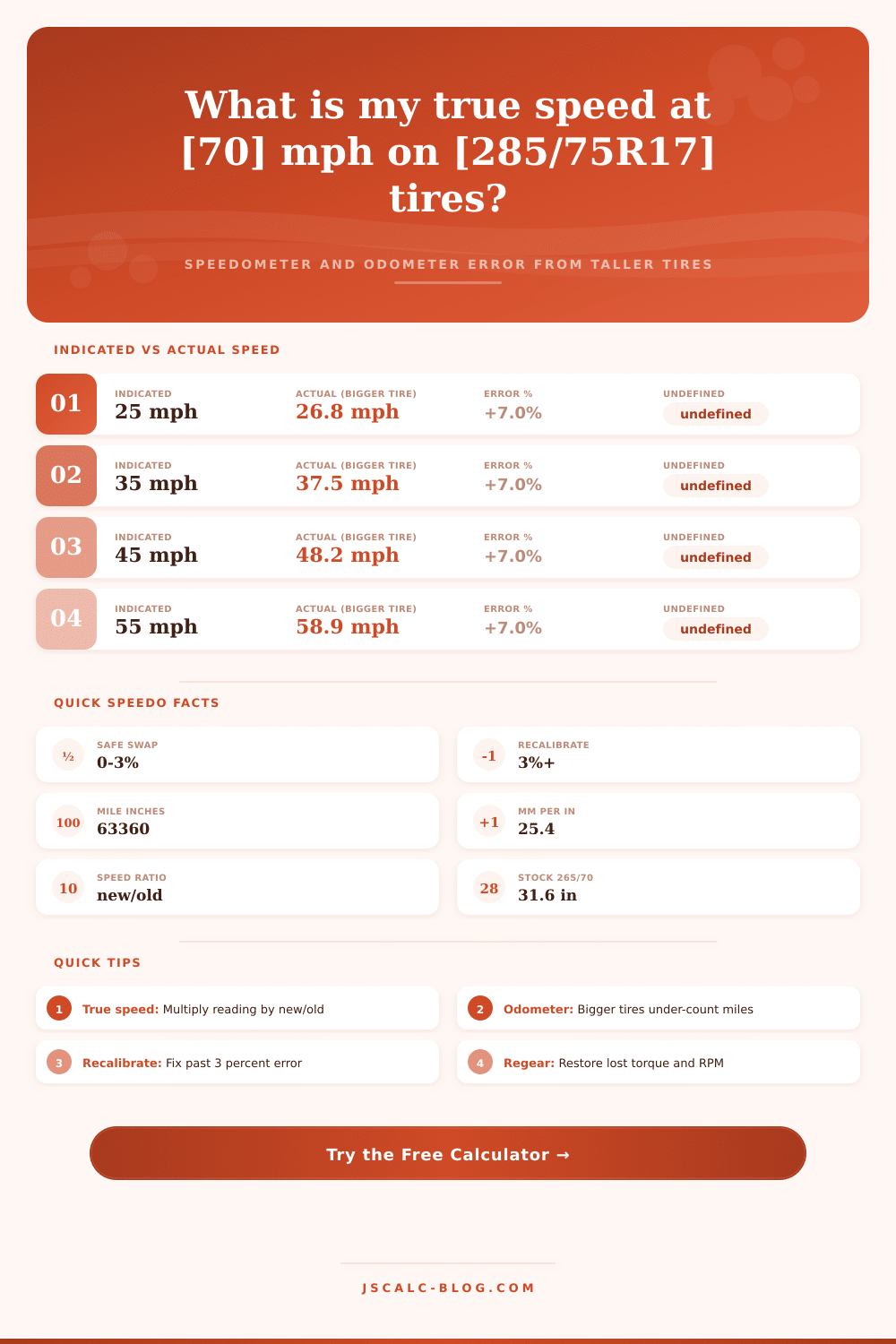
| 31.6 in | 33.8 in | +2.2 | +7.0% | Recalibrate |
| 31.6 in | 35.0 in | +3.4 | +10.8% | Regear zone |
| 31.6 in | 37.0 in | +5.4 | +17.1% | Regear zone |
| 31.6 in | 30.5 in | -1.1 | -3.5% | Reads high |
⚙Gear Ratio Compensation Guide
| Tire Jump | Diameter Gain | Stock Ratio | Suggested Ratio | Goal |
|---|---|---|---|---|
| Stock to 33 in | +4% | 3.21 | 3.55 | Restore RPM |
| Stock to 35 in | +11% | 3.55 | 4.10 | Restore torque |
| Stock to 37 in | +17% | 3.73 | 4.56 | Restore torque |
| 33 in to 37 in | +12% | 4.10 | 4.88 | Heavy off-road |
| Downsize winter | -3% | 3.73 | 3.73 | No change needed |
⚙Full Formula Breakdown
📋Revs Per Mile by Diameter
| Diameter (in) | Circumference (in) | Revs / Mile | RPM at 65 (3.73) | Feel |
|---|---|---|---|---|
| 29.0 in | 91.1 | 695 | Higher | Peppy, buzzy |
| 31.6 in | 99.3 | 638 | Stock | Factory feel |
| 33.0 in | 103.7 | 611 | Lower | Slightly lazy |
| 35.0 in | 110.0 | 576 | Lower | Needs regear |
| 37.0 in | 116.2 | 545 | Much lower | Regear a must |
🛠Recalibration and Regear Tips
Built by JSCalc-Blog.com. Verify speedometer readings against a GPS or a measured mile before recalibrating.
After upgrading to bigger tires you might find yourself traveling at a higher speed than indicated by your speedometer. Not because you think it’s reading incorrectly, but because your new wheels has different circumferences and suspension geometry. By installing larger tires for reasons like clearance or looks, your speedo continues to display as if the stock-sized tire were mounted.
Road speed isn’t measured by your speedo. Rather, it measure how fast the wheels are turning and multiplies that number according to manufacturer’s setting. Changing the tire diameters throws off this calculation.
Why Big Tires Make Your Speedometer Wrong
Put in the diameter of each set of tires (directly or from their P-metric code) into our tire-size difference calculator above and it will tell you the difference between them. There’s no need to remember conversion factors. Simply put in the diameters (or P-metric codes) and it figure out the error rate for you.
That said, that’s where most drivers go wrong, when looking at the numbers. “A three percent error doesn’t sound like much,” right? But it means I’m going 75 mph while the gauge says 70.” Your fuel economy readings won’t be accurate. Your cruise control will also has to work harder to keep pace with road.
Tire diameter is the key. A taller tire is the opposite of a shorter tire. A taller tire travels further with every spin compared to a shorter tire. And with each turn, your vehicle will move faster because its wheels is pushing it forward an additional distance with same number of turns. This ratio (diameter divided by previous diameter) is how the tool computes the true speed you’re traveling. It also calculates how accurately your odometer read, how much load is on your engine, and whether or not you’re lugging your engine during low RPMs.
Over time, the Odometer can get out of calibration (drift). A low speedometer means the mile counter does not calculate correctly either. So you think you have five thousand miles left before service, but really it’s at six thousand. That difference make a big impact on resale value and lease returns. To make up for that, use the odometer factor in the calculator. Multiply those miles by it and that will be your true mileage. You won’t have any more dealership surprise.
There’s also a price to pay mechanically from bigger tires aside from errors on dash. Because they’re taller, their wheels are equivalent to a higher gear ratio in the drivetrain. This slows engine speed at freeway cruise and sounds good on paper…until it comes time to go up a hill or pass someone. Now the engine is spinning more slowly than intended for that load and it feel sluggish.
How low is too low? That depends on something called revs per mile (RPM). The lower your cruising RPM with the new setup, the closer you’ve come to end of the torque curve. The calculator displays this shift nicely, allowing you to see whether or not a gear change might be in order.
Moddern cars can be recalibrated via both a plug-in tuner and a dealer flash, which corrects mileage and speed issues without touching metal. But it won’t recover lost throttle response. Recalibrating can’t fix that; only swapping out axle gears can. If the diameter jump is over ten percent, software can’t fix that lost acceleration. It does recommends a gear ratio to get your power back, so you have something to work from when talking to drivetrain guys.
First, check the math against the real world. Different brands & size tires don’t all measure alike so the tire size is a guess using common sizes in the calculator. Set cruise & drive slowly while watching GPS to see if it match. If so, that will be a starting point for deciding when to get it fixed mechanically or adjusted slightly through a software change. You want engine rpm, actualy speed and what shows up on instruments to match.