Horsepower to Amperage Calculator
Convert motor horsepower into full-load amperage (current draw) for DC, single-phase, and three-phase motors. See amps, kilowatts, kVA, and the NEC 125% breaker size, or reverse amps back into horsepower.
⚡Real Motor Presets
📝Motor Inputs
Reverse mode solves horsepower from a measured current.
Motor nameplate or rated shaft horsepower.
Used only when direction is amps to horsepower.
Typical 78% to 95% depending on size.
DC motors ignore power factor (set to 1).
Max continuous overload the motor tolerates.
🔢Formula Snapshot
⚙Formula With Your Numbers
📊NEC Motor Full-Load Amps (Single-Phase)
| HP | 115V FLA | 200V FLA | 230V FLA |
|---|---|---|---|
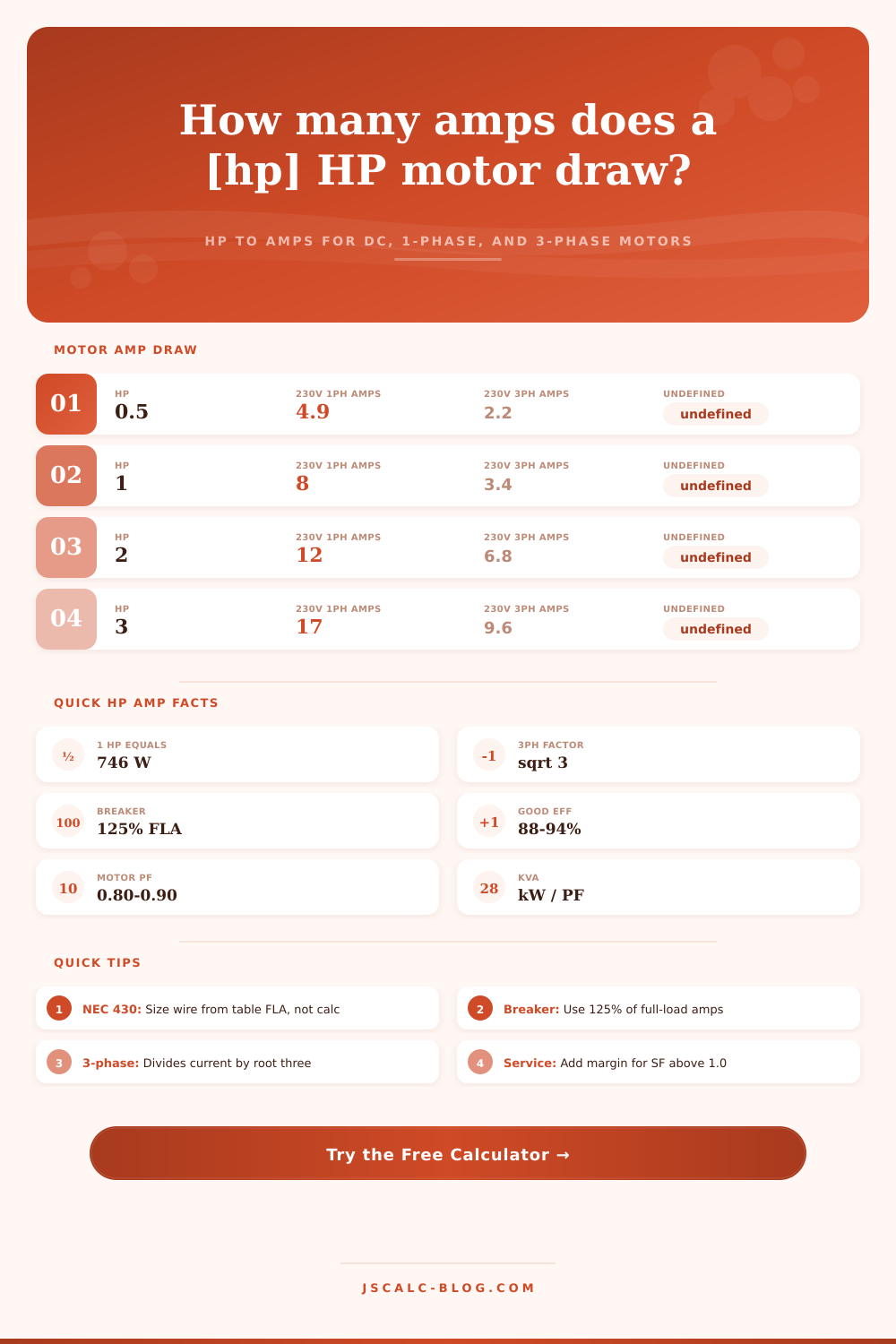
| 0.5 | 9.8 A | 5.6 A | 4.9 A |
| 1 | 16 A | 9.2 A | 8.0 A |
| 1.5 | 20 A | 11.5 A | 10 A |
| 2 | 24 A | 13.8 A | 12 A |
| 3 | 34 A | 19.6 A | 17 A |
| 5 | 56 A | 32.2 A | 28 A |
| 7.5 | 80 A | 46 A | 40 A |
| 10 | 100 A | 57.5 A | 50 A |
Values follow NEC Table 430.248 for single-phase AC motors. Use these table amps for wire and overload sizing, not a raw calculation.
🔋NEC Motor Full-Load Amps (Three-Phase)
| HP | 208V FLA | 230V FLA | 460V FLA | 575V FLA |
|---|---|---|---|---|
| 1 | 4.6 A | 4.2 A | 2.1 A | 1.7 A |
| 2 | 7.5 A | 6.8 A | 3.4 A | 2.7 A |
| 3 | 10.6 A | 9.6 A | 4.8 A | 3.9 A |
| 5 | 16.7 A | 15.2 A | 7.6 A | 6.1 A |
| 7.5 | 24.2 A | 22 A | 11 A | 9 A |
| 10 | 30.8 A | 28 A | 14 A | 11 A |
| 15 | 46.2 A | 42 A | 21 A | 17 A |
| 25 | 74.8 A | 68 A | 34 A | 27 A |
| 50 | 143 A | 130 A | 65 A | 52 A |
Values follow NEC Table 430.250 for three-phase AC motors. Calculated amps run slightly lower because nameplate FLA includes real-world losses.
🛠HP to kW and Typical Motor Ratings
| HP | Output kW | Typical Efficiency | Typical PF | Wire Ampacity Note |
|---|---|---|---|---|
| 0.5 | 0.37 kW | 78% | 0.72 | 14 AWG carries 15 A |
| 1 | 0.75 kW | 82% | 0.78 | 14 AWG carries 15 A |
| 2 | 1.49 kW | 84% | 0.80 | 12 AWG carries 20 A |
| 3 | 2.24 kW | 86% | 0.82 | 10 AWG carries 30 A |
| 5 | 3.73 kW | 88% | 0.84 | 10 AWG carries 30 A |
| 10 | 7.46 kW | 90% | 0.86 | 8 AWG carries 40 A |
| 25 | 18.65 kW | 92% | 0.88 | 4 AWG carries 70 A |
| 50 | 37.3 kW | 93% | 0.89 | 1/0 AWG carries 125 A |
Ampacity based on 75°C copper conductors (NEC Table 310.16). Always confirm against the motor nameplate and local code.
🗑HP Amp Comparison Grid
| HP | 120V 1PH | 230V 1PH | 230V 3PH | 460V 3PH | DC 180V |
|---|---|---|---|---|---|
| 0.5 | 5.6 A | 2.8 A | 2.2 A | 1.1 A | 2.5 A |
| 1 | 10.8 A | 5.4 A | 3.4 A | 1.7 A | 4.7 A |
| 2 | 20.5 A | 10.3 A | 6.8 A | 3.4 A | 9.1 A |
| 3 | 29.8 A | 14.9 A | 9.6 A | 4.8 A | 13.3 A |
| 5 | 48.5 A | 24.3 A | 15.2 A | 7.6 A | 21.6 A |
| 7.5 | 70.8 A | 35.4 A | 22 A | 11 A | 31.4 A |
| 10 | 92.5 A | 46.3 A | 28 A | 14 A | 41.0 A |
| 15 | 136 A | 68 A | 42 A | 21 A | 60.4 A |
Approximate full-load amps at typical efficiency and power factor. Doubling the voltage roughly halves the current; three-phase lowers it further by root three.
📑Full Formula Breakdown
📋Reference Values
| Item | Common Range | How It Is Used | Effect On Amps |
|---|---|---|---|
| Efficiency | 78% to 95% | Divides input power | Lower efficiency raises current |
| Power factor | 0.72 to 0.92 | AC denominator term | Lower PF raises current |
| Voltage | 90V to 575V | Denominator | Higher voltage lowers current |
| Phase factor | 1 or √3 | Three-phase multiplier | Three-phase lowers current |
| Breaker factor | 125% typical | Times full-load amps | Sets overcurrent device |
💡Practical Sizing Tips
That means we’re in the math zone now. This is where knowing how many amps a piece of equipment draw applies. Amperes, or amps, measure the amount of electricity needed to produce horsepower (mechanical work) from shaft. Horsepower is the other side of the equation. It’s fixed at 746 watts per horsepower. So if a piece of equipment is advertised as “one horsepower”, then it must draws at least 746 watts to make itself useful. However, no motor are efficient; it will consume more than what comes off shaft. A ninety percent efficient motor consumes 83 watts for each 75 watts it produce.
Now divide that power by voltage and you have current, provided you remember to consider power factor and phase. Enter your actual parameters into the calculator above and math is done for you. You don’t have to guess coefficients. It depends who you are supplying with what. For direct current, simple: just divide wattage by voltage and efficiency.
How to Calculate Motor Amps Safely
For single phase AC, add the power factor in the denominator since part of this current is actualy cycling back and forth building up magnetic fields instead of actually working. Three phase adds a little triangle and a square root, which results in about one point seven three two; this is why industrial-sized equipment draw far fewer amps on the line than similarly sized residential units. It’s a tiny little geometric thing but over long distances, it means thousands saved in copper wire.
So now we know both sides of the equation (right? Input and output). The latter part matters too! How do we measure mechanical work coming out? Horsepower. Amps. Full load amps at all times. Your steady state draw. And what about breaker size? The tool tells you that too, according to rules in the NEC.
Section 430 of the National Electrical Code says that conductors should be sized from published tables, not calculated straight off math sheet. Why? It accounts for real world losses by building in a margin of safety. You’ll see that values in table are usually a bit more than if you did calculation using only pure physics. On purpose. Rather than tripping precisely when the math would predict, the code demands that you trip before insulation burns.
In fact, a regular breaker has to be rated for up to 250 percent of its load. So that it can ride through the starting inrush current which is six times larger (for a second or two) than the running current. The reverse mode are handy for determining what size motor you might have by knowing the amp draw of it but not having the data sheet to tell you how big it is. A 12 amp draw on a twenty-three hundred volt single phase line means what? The calculator gives it to you in horsepower terms. Note that this is based off average power factors and efficiencies, so it’s an estimate.
For one thing, light load won’t produce as much current as the amperage rating on the nameplate. Folks who go around testing older motors gets tripped up by this. To read the figure accuratley you need to know if the motor is running hot (loaded) or just barely moving air (idling). This also gets tricked by voltage sags. During high-heat times, the motor pull more amps to make up for reduced volts, bringing wire nearer to its capacity while the actual power doesn’t change at all.
Another “hidden” variable is service factor. For instance, a motor rated for a 1.15 service factor can operate continuously 15% over its nameplate rating. The current draw increase accordingly. You may have sized the circuit based off the base rating and now could of asking for trouble when running heavy loads consistently. Before making your breaker decision always make sure to reference the sticker on the motor itself.
Theory vs. Practice: This comes down to wiring. Voltage drops and amperage goes up at source with long runs, and hot attic spaces limits wire capacity. Code’s reference tables assume typical conditions, yours may be anything but that (c’mon, who has a neat basement?). Use those figures as a good starting point and build in some leeway for stuff you don’t know about. Better to go big enough than to have an annoying breaker trip on a steamy Tuesday afternoon.
Remember, there is code and math involved with electrical. You get one from the inspector and one from the calculator. The code require following the rules and the math provides the physics. Never underestimate the heat generated by loose connections, keep your inputs realistic, and be sure to reference any local amendments. Wondering how many amps that motor normally draws ends up in a more complete, safer install altogether.