Section 179 Depreciation Calculator
Estimate your 2024 first-year write-off on business equipment. This tool stacks the Section 179 deduction, 60% bonus depreciation, and regular MACRS, then shows the real cash tax savings after applying phase-out and business-income limits.
🚚Real Equipment Presets
📝Equipment & Tax Inputs
Total purchase price of the single asset you want to write off.
Only the business-use share qualifies. Must exceed 50% to use Section 179.
First-year MACRS uses the half-year convention: 20% for 5-yr, 14.29% for 7-yr.
Heavy SUVs are limited to a $30,500 Section 179 deduction in 2024.
All qualifying property this year. Above $3,050,000 the 179 cap drops dollar-for-dollar.
Section 179 cannot exceed business income or create a loss. Bonus and MACRS can.
2024 bonus is 60%. It applies to the basis remaining after Section 179.
Combined federal (and state, if you add it) rate applied to the total deduction.
📊First-Year Snapshot
🧮Deduction Build-Up
| Layer | Amount | How It Is Figured |
|---|---|---|
| Enter values above to build the deduction layers. | ||
⚙Formula Breakdown
📅2024 vs 2023 Section 179 Limits
| Limit | Tax Year 2024 | Tax Year 2023 |
|---|---|---|
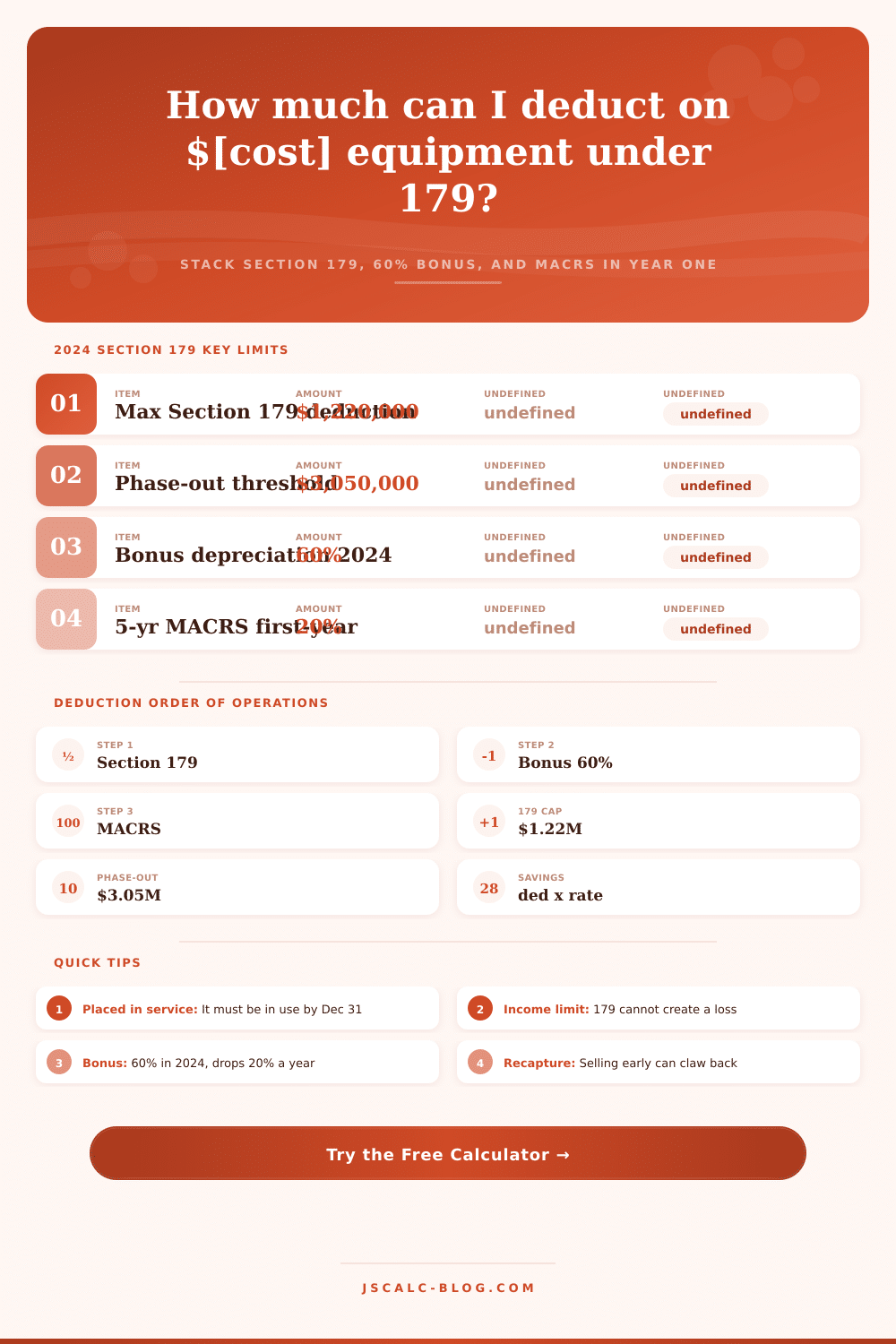
| Maximum Section 179 deduction | $1,220,000 | $1,160,000 |
| Phase-out (spending) threshold | $3,050,000 | $2,890,000 |
| Deduction fully phased out at | $4,270,000 | $4,050,000 |
| Bonus depreciation rate | 60% | 80% |
| Heavy SUV (6,000-14,000 lb) 179 cap | $30,500 | $28,900 |
📏MACRS First-Year Rates (Half-Year)
| Property Class | First-Year % | Typical Assets |
|---|---|---|
| 3-year | 33.33% | Tractor units, some tools, breeding hogs |
| 5-year | 20.00% | Cars, trucks, computers, office machinery |
| 7-year | 14.29% | Furniture, fixtures, most machinery |
| 10-year | 10.00% | Vessels, single-purpose farm structures |
| 15-year | 5.00% | Land improvements, qualified restaurant work |
📉Bonus Depreciation Phase-Down Schedule
| Placed In Service | Bonus Rate | What It Means For You |
|---|---|---|
| 2023 | 80% | First step down from the old 100% expensing era |
| 2024 | 60% | Current year used by this calculator |
| 2025 | 40% | Section 179 becomes relatively more valuable |
| 2026 | 20% | Bonus is nearly gone; front-load with 179 |
| 2027 | 0% | Bonus sunsets unless Congress extends it |
🚗Vehicle & SUV Deduction Caps (2024)
| Vehicle Type | Weight (GVWR) | First-Year Limit | Notes |
|---|---|---|---|
| Passenger car / light truck | Under 6,000 lb | ~$20,400 with bonus | Luxury-auto caps under Sec 280F apply |
| Heavy SUV | 6,000-14,000 lb | $30,500 (179) + bonus | Special SUV cap, then bonus on remainder |
| Heavy pickup (6+ ft bed) | Over 6,000 lb | Full cost eligible | Not treated as an SUV; no $30,500 cap |
| Cargo / work van | Over 6,000 lb | Full cost eligible | No seating behind driver; qualifies fully |
🗃Equipment Deduction Comparison Grid
| Equipment Cost | Section 179 | Bonus (60%) | 1st-Yr MACRS | Total Deduction | Tax Savings (24%) |
|---|---|---|---|---|---|
| $30,000 | $30,000 | $0 | $0 | $30,000 | $7,200 |
| $65,000 | $65,000 | $0 | $0 | $65,000 | $15,600 |
| $100,000 | $100,000 | $0 | $0 | $100,000 | $24,000 |
| $180,000 | $180,000 | $0 | $0 | $180,000 | $43,200 |
| $250,000 | $250,000 | $0 | $0 | $250,000 | $60,000 |
| $500,000 | $500,000 | $0 | $0 | $500,000 | $120,000 |
| $1,000,000 | $1,000,000 | $0 | $0 | $1,000,000 | $240,000 |
| $1,500,000 | $1,220,000 | $168,000 | $22,400 | $1,410,400 | $338,496 |
| $2,000,000 | $1,220,000 | $468,000 | $62,400 | $1,750,400 | $420,096 |
| $3,200,000 | $1,070,000 | $1,278,000 | $170,400 | $2,518,400 | $604,416 |
💡Section 179 Planning Tips
Heavy equipment is no joke when it comes to buying. Buying heavy equipment are expensive enough without worrying about whether the tax code will help you offset the cost.
One way to encourage investment in your business is through Section 179 depreciation rules, which allow you to take an immediate write-off of assets. No need to stretch out deduction across years. How does it work? There are a few different pieces stacked on top of each other (and if you get them in the wrong order, you’ll lose money).
How to Save Money on Heavy Equipment Taxes
The core of Section 179 is that you get to expense the entire purchase price during the tax year the qualified property is placed into service. Qualifying property include office furniture, computers, machinery and most business vehicle. To qualify, over half the asset must be used for business purposes. So if you purchase a truck for mixed use, only the business part qualifies. Basis calculations becomes complicated with partial qualification. This can also result in the application of recapture rules if the percentage of business use decline later.
But there’s a cap here: This tax break targets small- to mid-sized businesses. In 2024, they can deduct up to $1.22 million. But that amount starts phasing out on a dollar-for-dollar basis as their total capital expenditures rises above $3.05 million. The calculator above handles the math for you by asking for both the individual asset cost and your total annual spending.
That’s an important nuance: A massive expense could fall inside the cap… But if it causes your total spending to exceed $3.05 million, it could also start pulling you toward the phase-out. Once your spending reaches $4.27 million, Section 179 is completely gone; leaving you only with regular depreciation rules.
Whatever basis isn’t covered by section 179 goes into a bucket that gets covered by bonus depreciation (the amount that gets bonus treatment in 2024 is 60%). The bonus depreciation portion can be realy powerful for larger purchases. There’s no spending limit, and there’s no limit on your income.
And here’s how the rules work: You have to do section 179 first, followed by bonus depreciation on any remaining basis, followed by straight-up MACRS on the leftover amount. Swapping these around can make a huge difference to the overall write-off.
The next step is the Modified Accelerated Cost Recovery System. If building lasted for five years (the half-year convention), then it would reduce its remaining basis by twenty percent during year one. Finally, even if section 179 and bonus depreciation completely cover the building’s value, this layer will still let you take a significant write-off up front. This last layer is what the tool calculates. It combines the three layers into one figure representing your total first-year write off. Then it applies your marginal tax rate to turn that into real money saved.
New business owners are frequently surprised that Section 179 cannot generate a net operating loss. You can only deduct up to your taxable business income during the year. For example, if your spending exceeds your earnings, then section 179 will cap out at the income you earned. Whatever amount of section 179 you didn’t use will carry forward to the next year.
This is not true with bonus depreciation or MACRS. Even if section 179 is capped because of the income limitation, you may still be able to push your taxable income into negative land with these other two methods.
Here’s where it gets complicated, especially if you’re talking about cars and trucks. The section 179 deduction have a different cap for heavy-duty vehicles like SUVs (between six thousand and fourteen thousand pounds). That cap will be $30,500 in 2024. It’s only for the section 179 amount; it doesn’t count toward bonus depreciation. Typically, cargo vans without seats in back and work trucks with beds longer than six feet is exempt from this rule. Those get fully expensed.
It’s all about timing: If your equipment is put in service on or before Dec. 31, it counts toward the prior tax year. So don’t think it’s convenient to order equipment near the end of the month, then have the installation run through the first week in January. In that case, it’s not a good deal because you’ll forfeit the benefit of using the full tax year.
Bonus depreciation will phase out during the coming several years, as shown in the reference table. By 2027, it’s gone entirely, which makes spending now more attractive than before.
The flipside to big write-offs is recapture. If you sell something early and/or it’s no longer used more than half for business, you might owe the IRS part of that deduction back. If you’ve aggressively expensed, then you have a low tax basis. You could end up with a bigger-than-expected taxable gain when you sell down the road; run through some scenarios first.
The math works like this: A few lines of simple code become real cash flow calculations using a calculator. Plug in your income, experiment with various purchase amounts, and observe where the income limits and phase-out intersect. Such calculations helps you decide if it’s smart to rush or postpone a significant capital expenditure. Numbers don’t lie… Just that you need to enter them correctly.
Tax benefits aren’t necessarily about saving paper dollars… They’re a cash-flow management tool. The purpose of front loading deductions is to keep more money in your business when it costs the most. If you know how all of this ties together, you can set up purchases to get maximum relief immediately (within compliance bounds). That is what transforms a complicated piece of tax law into a financial advantage.