Depreciation Recapture Calculator
Estimate adjusted basis, total gain, Section 1250 unrecaptured gain taxed to a 25% maximum, Section 1245 ordinary recapture, capital gains tax on the remaining gain, and the total tax due when you sell a depreciated property or asset.
🎯Real Sale Presets
📝Sale & Depreciation Inputs
Purchase price plus capital improvements and buying costs.
Allowed or allowable depreciation across the holding period.
Agent commission, closing fees, transfer taxes.
Optional 3.8% surtax for higher-income investors.
🔢Formula Snapshot
⚖Section 1250 vs 1245 Comparison
| Feature | Section 1250 | Section 1245 |
|---|---|---|
| Asset type | Real property (buildings, rentals) | Personal property (equipment, machinery) |
| Recapture taxed as | Unrecaptured 1250 gain | Ordinary income |
| Maximum recapture rate | 25% (or ordinary if lower) | Your ordinary rate (up to 37%) |
| Recapture amount | Depreciation, capped by gain | Depreciation, capped by gain |
| Remaining gain | Long-term capital gains rate | Long-term capital gains rate |
| Common recovery life | 27.5 yr rental, 39 yr commercial | 3, 5, 7, 15 yr MACRS |
📊Recapture Scenario Grid
| Scenario | Cost / Sale | Depreciation | Recapture Tax | Cap-Gains Tax | Total Tax |
|---|---|---|---|---|---|
| Rental home 27.5yr | $300k / $450k | $80k | $20,000 | $22,500 | $42,500 |
| Commercial 39yr | $800k / $1.05M | $205k | $51,250 | $9,000 | $60,250 |
| Section 1245 equipment | $120k / $70k | $95k | $16,800 | $0 | $16,800 |
| Full-cycle rental sale | $250k / $500k | $227k | $56,750 | $3,450 | $60,200 |
| Short-hold flip | $275k / $340k | $18k | $4,500 | $7,050 | $11,550 |
| High-income 37% bracket | $600k / $900k | $160k | $40,000 | $28,000 | $68,000 |
| Duplex investor | $420k / $560k | $110k | $27,500 | $4,500 | $32,000 |
| Depreciated machinery | $90k / $55k | $72k | $8,400 | $0 | $8,400 |
⚙Full Formula Breakdown
💵Capital-Gains Brackets (0 / 15 / 20%)
| Rate | Single Taxable Income | Married Filing Jointly | Applies To |
|---|---|---|---|
| 0% | Up to about $48,350 | Up to about $96,700 | Remaining long-term gain |
| 15% | About $48,351 to $533,400 | About $96,701 to $600,050 | Remaining long-term gain |
| 20% | Above about $533,400 | Above about $600,050 | Remaining long-term gain |
| 25% cap | Any income | Any income | Unrecaptured 1250 gain ceiling |
| +3.8% | MAGI above $200,000 | MAGI above $250,000 | Net investment income surtax |
📅MACRS Recovery Periods
| Asset Class | Recovery Life | Recapture Section | Typical Method |
|---|---|---|---|
| Residential rental building | 27.5 years | 1250 | Straight line |
| Commercial / nonresidential | 39 years | 1250 | Straight line |
| Land improvements | 15 years | 1250 | 150% declining |
| Office furniture & fixtures | 7 years | 1245 | 200% declining |
| Machinery, autos, computers | 5 years | 1245 | 200% declining |
| Tools & certain equipment | 3 years | 1245 | 200% declining |
💡Tax-Planning Tips
Disclaimer: This calculator gives simplified estimates for planning and education only and is not tax, legal, or accounting advice. Real returns involve NIIT thresholds, state tax, prior passive losses, partial dispositions, and other rules. Confirm every figure with a qualified tax professional before filing.
One example is that over the years you gets tax breaks for having a rental house. Because of those depreciation write-offs, you have less taxable income. Then at some point down the line, you sell the house. Sure, the equity seems robust (but when you see that closing statement), it could be weak if you forget about depreciation recapture.
It’s not a penalty against your profit. The government just wants some of the tax breaks back that they gave you long ago. Knowing how this works will spare you a nasty surprise on your net proceeds.
How to Understand Depreciation Recapture Taxes
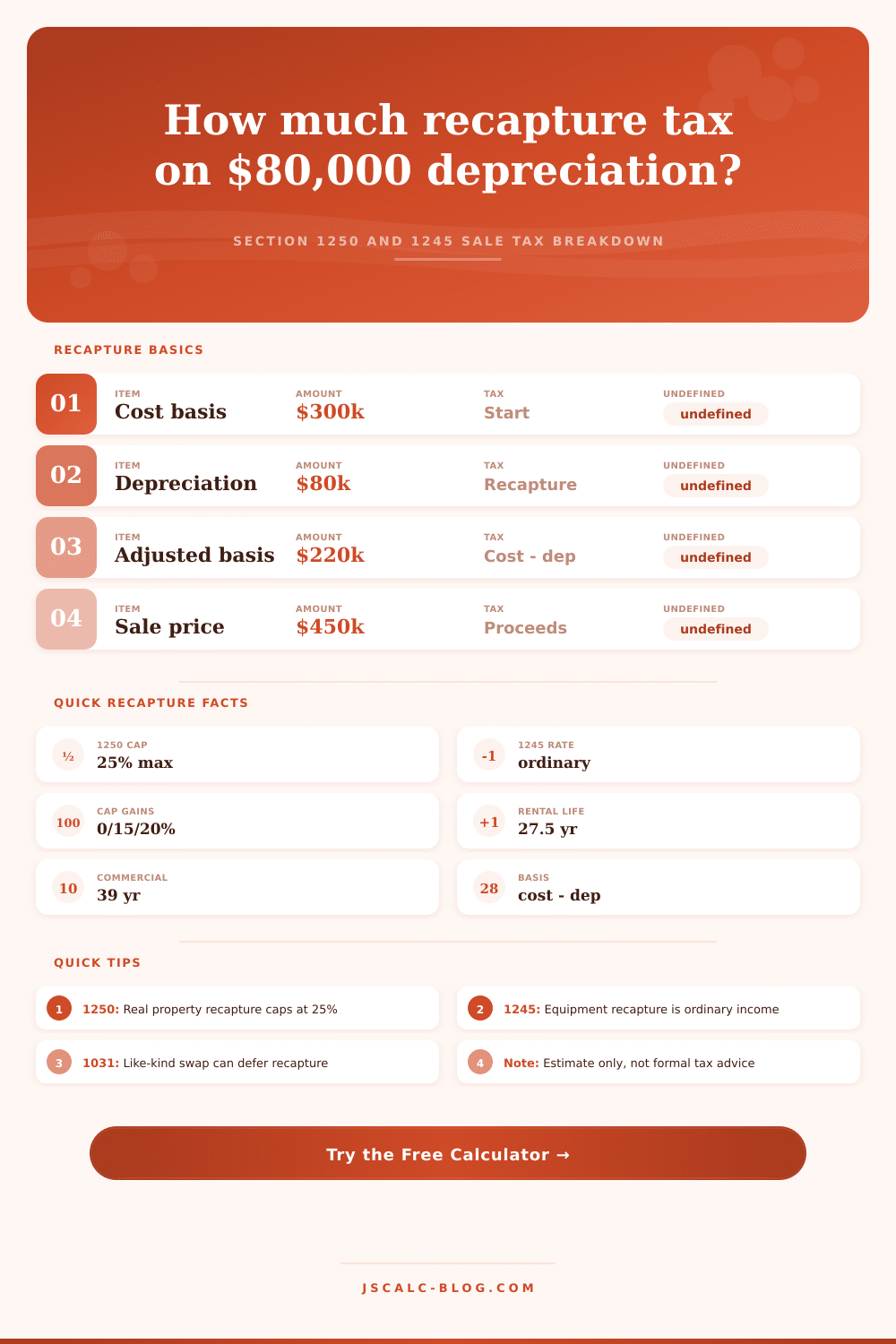
Over time, depreciation reduces your cost basis. Let’s say that you purchased a building for three-hundred-thousand dollars and depreciated it by eighty-thousand dollars. Your adjusted basis is now two-hundred-twenty-thousand dollars. When you sell the property, your gain isn’t simply sale price, original purchase price. It’s sale price, adjusted basis.
Depending on kind of asset, this additional gain may be subject to recapture rules. Equipment is Section 1245, while real estate is Section 1250. Why does that matter? It matters because the tax rate vary. Up to twenty-five percent of the recaptured amount for real property is taxed, that’s usually less than the thirty-seven percent tax on your ordinary income! There’s no such reprieve for personal property. If you’ve got Section 1245 assets, the recapture will be charged at your entire ordinary income rate.
So the calculator does a split between the two types of gains to show how it’ll affect each bracket. Simply plug in your sales price, initial cost and total depreciation to let the calculator do the work.
All that sounds simple, until you remember to subtract the commissions and other selling costs from your gross proceeds. Those deductions knock down your net proceeds and they knock down your total gain too. The smaller your gain, the less recapture you’ll have. Remember to adjust for your capital gains rate, too. Whatever’s left over once you’ve recaptured will be subject to long term capital gains rates of zero, fifteen, or twenty percent based off your level of income. If you’re highly compensated, you could face an additional 3.8 percent surtax on net investment income.
The timing makes a big difference. If you sell in a lower-income year, that could reduce the remaining profit to a lower capital gains bracket. And it’ll keep your regular rate lower (assuming you have any Section 1245 recapture). Certain investors use the one-zero-three-one exchange: They roll their proceeds into another property and defer paying both taxes. Thereby saving their cash flow for years. The tax doesn’t go away. It just rides along with new basis. It’s a deferral, not an escape.
If you sell for a loss, or break even, there’s nothing to worry about: there’s no recapture. If you gain more then you ever realized, you don’t pay any taxes on that additional gain. The reason for this is built into the tool and caps recapture based on the total gain.
Run through some scenarios before listing the place. What happens if you sell it for 5% less? What happens if you guess low/high on your selling costs? How much does your tax bill change because of these variables? You could save yourself thousands of dollars on taxes with a five percent drop in price. This may make it better to hold instead of selling now.
Depreciation lowers basis, regardless of if you claimed it or not (most investors forget). Basis = Original cost minus allowed/allowable depreciation, > The IRS wants to know what was allowed or allowable. If you didn’t claim it, your basis is reduced anyhow and you’ll owe them the recapture tax upon sale. That’s a painful learning experience for many who realize this too late.
From day one, keep careful records on all deductions. It’s harder to calculate your adjusted basis otherwise, and there are no pleasant surprises down the road. A basic sale can become a complex tax transaction when Recapture shows up. Cash today pays for benefits received years ago. By planning in advance you can price this cost into your ask, or arrange the deal so it minimizes recapture’s sting.
The tables above show how various asset class get taxed; compare the numbers and see the difference between a delivery truck versus a rental house (even though they might have identical depreciation amounts). Avoid being blindsided by not knowing which rules apply. Save yourself from overpaying. In short, it is about clarity.
At the end of the day, you don’t want to sign papers and then realize you’ll have only $x left once the IRS gets their cut. That’s why the calculator spits out an estimate immediately, so you can adjust accordingly before it’s too late. Wouldn’t you rather learn about a twenty thousand dollar tax bill on a spreadsheet instead of the title company? Make plans for the recapture and you’ll walk away with something more than you imagined.