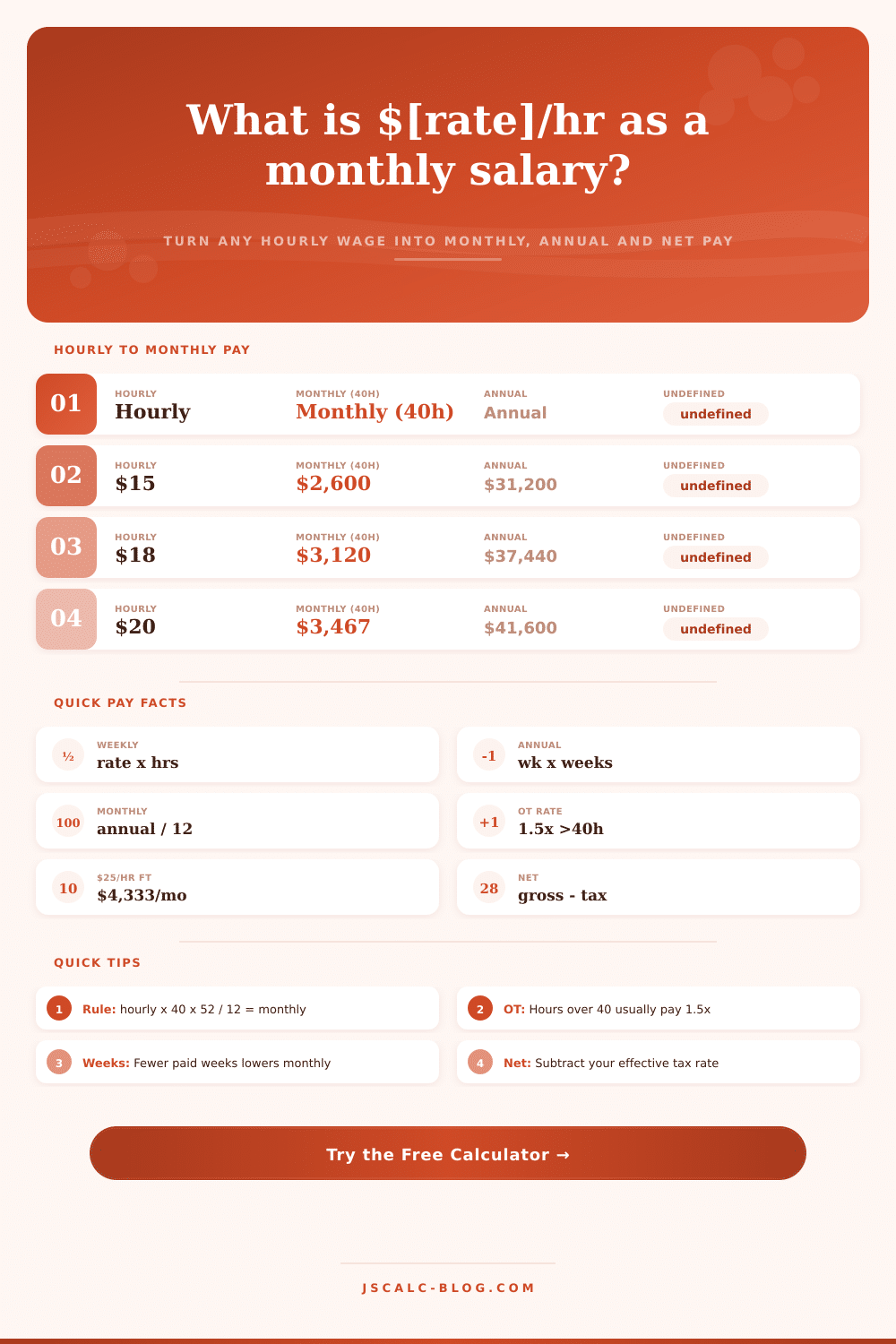
Hourly to Monthly Salary Calculator
Convert any hourly wage into a monthly, annual, biweekly and take-home figure. Factor in your hours per week, overtime at time-and-a-half, the number of weeks you actually work each year, unpaid time off, and an effective tax rate to see real pay.
🎯Real Wage Presets
📝Wage & Schedule Inputs
Reverse mode solves the implied hourly rate.
Your base pay for each regular hour worked.
Only used in reverse (monthly → hourly) mode.
Hours above 40 are treated as overtime below.
Default 52. Lower it for contract or school-year work.
Vacation or gaps with no pay. Subtracted from weeks.
Blended federal, state and payroll rate for net pay.
🔢Formula Snapshot
⚙How Your Pay Was Built
📊Hourly to Monthly Quick Chart
| Hourly Rate | Weekly (40h) | Monthly Gross | Annual Gross |
|---|---|---|---|
| $10 / hr | $400 | $1,733 | $20,800 |
| $15 / hr | $600 | $2,600 | $31,200 |
| $18 / hr | $720 | $3,120 | $37,440 |
| $20 / hr | $800 | $3,467 | $41,600 |
| $25 / hr | $1,000 | $4,333 | $52,000 |
| $30 / hr | $1,200 | $5,200 | $62,400 |
| $40 / hr | $1,600 | $6,933 | $83,200 |
| $50 / hr | $2,000 | $8,667 | $104,000 |
| $75 / hr | $3,000 | $13,000 | $156,000 |
| $100 / hr | $4,000 | $17,333 | $208,000 |
📅Pay Frequency Conversions
| Pay Frequency | Paychecks / Year | Divide Annual By | On $52,000 / yr |
|---|---|---|---|
| Weekly | 52 | 52 | $1,000.00 |
| Biweekly | 26 | 26 | $2,000.00 |
| Semi-monthly | 24 | 24 | $2,166.67 |
| Monthly | 12 | 12 | $4,333.33 |
| Quarterly | 4 | 4 | $13,000.00 |
| Annual | 1 | 1 | $52,000.00 |
🕓Full-Time vs Part-Time Hours
| Schedule | Hours / Week | At $20/hr Monthly | At $25/hr Monthly | Annual at $25/hr |
|---|---|---|---|---|
| Full-time | 40 | $3,467 | $4,333 | $52,000 |
| Reduced full-time | 37.5 | $3,250 | $4,063 | $48,750 |
| Four-day (32h) | 32 | $2,773 | $3,467 | $41,600 |
| Part-time | 30 | $2,600 | $3,250 | $39,000 |
| Half-time | 20 | $1,733 | $2,167 | $26,000 |
| Side gig | 10 | $867 | $1,083 | $13,000 |
⏱Overtime Multiplier Reference
| Multiplier | Name | OT Rate at $20/hr | OT Rate at $30/hr | 5 OT Hours Add (at $30) |
|---|---|---|---|---|
| 1.0× | Straight time | $20.00 | $30.00 | $150.00 |
| 1.5× | Time and a half | $30.00 | $45.00 | $225.00 |
| 2.0× | Double time | $40.00 | $60.00 | $300.00 |
| 2.5× | Holiday premium | $50.00 | $75.00 | $375.00 |
📈Full Pay Comparison Grid
| Hourly | Weekly (40h) | Biweekly | Semi-Monthly | Monthly | Annual |
|---|---|---|---|---|---|
| $12 / hr | $480 | $960 | $1,040 | $2,080 | $24,960 |
| $15 / hr | $600 | $1,200 | $1,300 | $2,600 | $31,200 |
| $18 / hr | $720 | $1,440 | $1,560 | $3,120 | $37,440 |
| $22 / hr | $880 | $1,760 | $1,907 | $3,813 | $45,760 |
| $25 / hr | $1,000 | $2,000 | $2,167 | $4,333 | $52,000 |
| $30 / hr | $1,200 | $2,400 | $2,600 | $5,200 | $62,400 |
| $45 / hr | $1,800 | $3,600 | $3,900 | $7,800 | $93,600 |
| $60 / hr | $2,400 | $4,800 | $5,200 | $10,400 | $124,800 |
| $75 / hr | $3,000 | $6,000 | $6,500 | $13,000 | $156,000 |
| $100 / hr | $4,000 | $8,000 | $8,667 | $17,333 | $208,000 |
📋Reference Values
| Input | Typical Entry | How It Is Used | Effect On Monthly |
|---|---|---|---|
| Hourly rate | $12 to $100 | Pay per regular hour | Scales every result |
| Hours / week | 20 to 40 | Regular hours, capped at 40 | More hours, more pay |
| Overtime hours | 0 to 15 | Paid at the OT multiplier | Adds premium pay |
| Weeks worked | 44 to 52 | Paid weeks in the year | Fewer weeks lower it |
| Effective tax | 10% to 30% | Blended tax on gross | Only changes net pay |
💡Practical Pay Tips
Maybe you’ve stared down your lease agreement, wondering: Can I afford this? Then you realize it’s time to pay rent, but you get paid every other week. Budgeting isn’t easy when your calendars don’t match up, and that’s why translating an hourly wage into a monthly salary are more than math… It’s a sensible tactic.
Once you input your rate and schedule, the calculator do the rest, saving you the guesswork about whether $25 an hour will cover the bills or barely budge them.
How to Change Hourly Pay into Monthly Income
It’s easy to do the standard formula: take your hourly rate, multiply it by 40 (the number of hours in a standard week), multiply THAT by 52 (the number of weeks in a standard year) and divide it by 12 (to make result look like money). The problem is, real life isn’t quite so textbook. The idea that you’ll work every single hour of every single day of every single week throughout the entire year are hardly realistic.
Let’s say you earn $25/hour and work 40 hours a week. This averages out to about $4,333 per month. People often gets confused by this number because they think it is a fixed monthly amount. They forget that some weeks you don’t get paid for vacation, while other weeks you earns double for overtime.
However, overtime complicates things entireley. Overtime is always premium pay (typically time-and-a-half), which means that ten hours of overtime per week won’t sound like much, and yet it’s fifty percent higher then your normal wage! That premium amounts to thousands of dollars annually; this mean your total pay grows far above just multiplying “hours” times “hourly wage.
Furthermore, perhaps you’re planning on working 48 weeks out of the year (vacationing four weeks without pay). If so, the tool will adjust for this and show you what your real monthly income will be once taxes comes out of the picture.
When you get paid, there’s a difference between gross pay (which appears on your paystub) and your net pay (the amount deposited into your bank account). Overbudgeting based off gross will result in overdraft fees; and there’s a large gap between the two. Payroll contributions (Medicare, Social Security, etc.), along with federal and state taxes (if applicable), take roughly fifteen to twenty-five percent of every worker’s paycheck. An effective tax rate plugs this hole, allowing you to convert the vague idea of “taxes” into something tangible: a specific dollar figure you can deduct from your paycheck. That way, you’ll know how much money you have available for food or rent.
If someone throws you a salary offer instead of an hourly wage, reverse mode comes into play as well. A monthly salary of $5,000 sounds great, but what if you tend to put in 50-hour workweeks? When you break that salary down per hour, you may find that the hourly rate could be a small amount! It’s important to calculate this because then you’re able to accurately compare jobs. One position may pay a high base salary and not allow for any overtime; another pays a lower base salary but guarantees additional hours.
If you’re asking for a raise, you’ll get more results if you frame it as an annual amount instead of an hourly one. It’s easy to shrug off an extra two bucks/hour (that’s nothing!), but that works out to more than four grand/year. That puts things into perspective: Instead of a modest tweak, it becomes a large improvement in your lifestyle.
Whatever your situation, whether you’re a salaried worker who wants to know her value by-the-hour or a contract worker who deals in weird weeks, knowing this stuff will save you from some budgetary blunders. You’ll begin planning around the value of each paycheck, rather than having to guess how much it represents.