Break-Even ROAS Calculator
Find the minimum ROAS where ad revenue exactly covers product cost plus ad spend. Enter your price and costs to see profit margin, break-even ROAS, target ROAS for a profit goal, and your maximum allowable CPA.
📈Real Product Presets
🛒Product & Cost Inputs
Packaging, pick-and-pack, insert cards, etc.
Used for the target ROAS card.
Enter 0 to skip the comparison.
🔢ROAS Snapshot
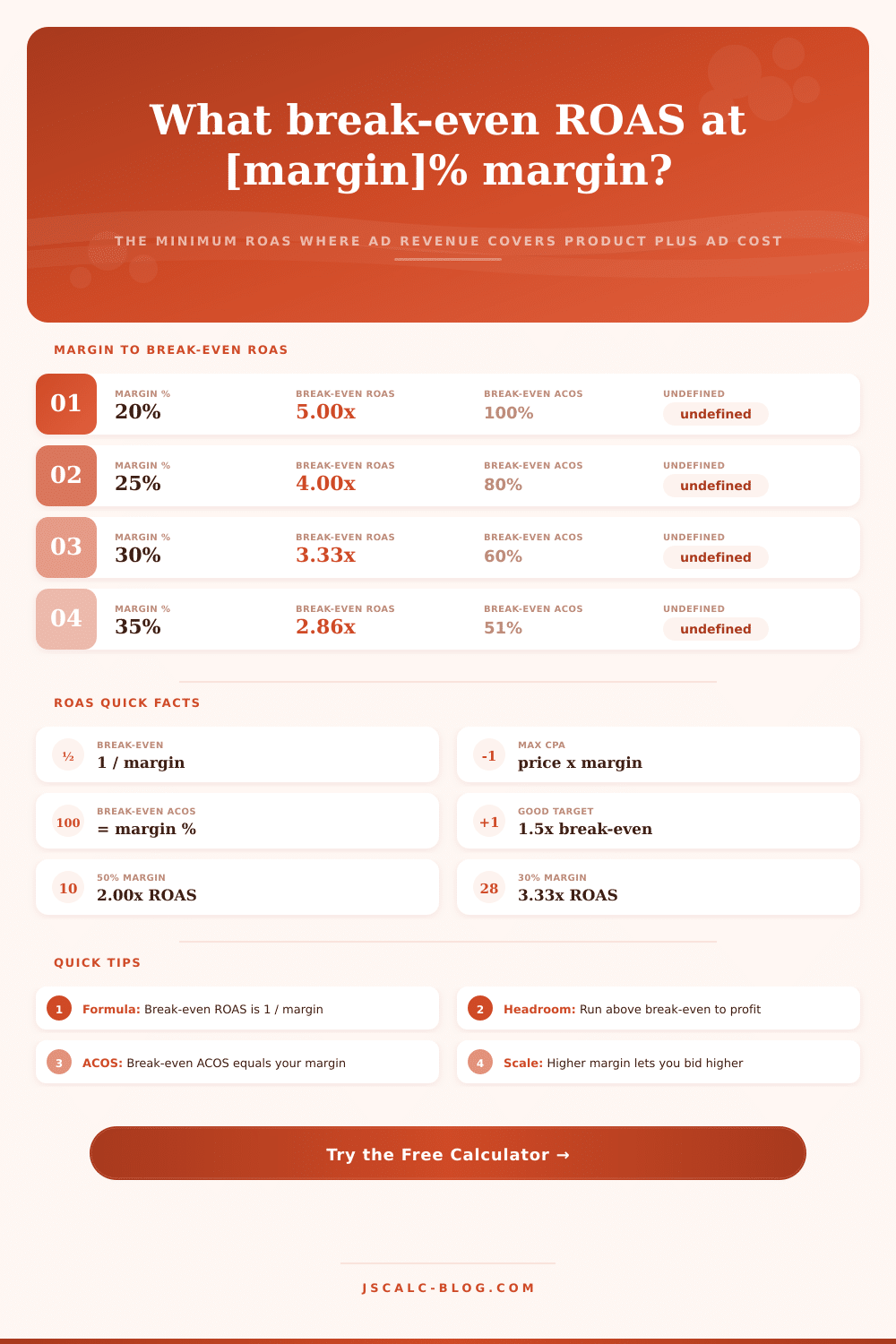
📏Margin to Break-Even ROAS Lookup
| Profit Margin | Break-Even ROAS | Break-Even ACOS | Read |
|---|---|---|---|
| 15% | 6.67x | 100% | Ads must be extremely efficient |
| 20% | 5.00x | 100% | Very tight, low-margin dropship |
| 25% | 4.00x | 80% | Hard to scale paid traffic |
| 30% | 3.33x | 60% | Common electronics zone |
| 40% | 2.50x | 40% | Healthy general-store range |
| 50% | 2.00x | 33% | Comfortable to scale ads |
| 60% | 1.67x | 27% | Strong margin, easy ROAS |
| 70% | 1.43x | 20% | Digital and print-on-demand |
Break-even ROAS = 1 / margin. Break-even ACOS = margin percent (they are reciprocals expressed differently).
🔄ROAS to ACOS Conversion
| ROAS | ACOS | Ad Share of Revenue | Meaning |
|---|---|---|---|
| 1.00x | 100% | All revenue is ad spend | Every dollar of sales spent on ads |
| 1.50x | 66.7% | Two thirds to ads | Break-even near 67% margin |
| 2.00x | 50% | Half to ads | Break-even at 50% margin |
| 2.50x | 40% | 40% to ads | Break-even at 40% margin |
| 3.33x | 30% | 30% to ads | Break-even at 30% margin |
| 4.00x | 25% | 25% to ads | Break-even at 25% margin |
| 5.00x | 20% | 20% to ads | Break-even at 20% margin |
ACOS = 1 / ROAS. ROAS = 1 / ACOS. ACOS is the inverse of ROAS shown as a percentage.
🎯Target ROAS by Desired Profit (50% Margin Example)
| Desired Profit | Target ROAS | vs Break-Even (2.00x) | Effort |
|---|---|---|---|
| 0% (break-even) | 2.00x | Baseline | Covers cost only |
| 5% profit | 2.22x | +11% | Thin cushion |
| 10% profit | 2.50x | +25% | Reasonable target |
| 15% profit | 2.86x | +43% | Solid goal |
| 20% profit | 3.33x | +67% | Ambitious |
| 25% profit | 4.00x | +100% | Demands efficient ads |
Target ROAS = 1 / (margin − desired profit fraction). At 50% margin, wanting 20% profit needs a 3.33x ROAS.
💰Max CPA Benchmarks by Channel
| Channel | Typical CPC | Typical Conv. Rate | Implied CPA | Fit For Max CPA |
|---|---|---|---|---|
| Google Search | $1 to $3 | 3% to 5% | $25 to $60 | Mid to high-ticket |
| Meta (FB/IG) | $0.50 to $2 | 1% to 3% | $20 to $80 | Impulse and mid-ticket |
| TikTok Ads | $0.50 to $1.50 | 1% to 2% | $25 to $90 | Low-ticket viral products |
| $0.30 to $1.50 | 1% to 2.5% | $15 to $70 | Home, apparel, decor | |
| Amazon Sponsored | $0.50 to $2 | 8% to 12% | $6 to $20 | In-market buyers |
| Email / SMS | Near $0 | 2% to 5% | Very low | Owned audience, best margin |
If your max allowable CPA is below a channel's implied CPA, that channel will lose money at your current price and margin.
📊Margin vs ROAS Comparison Grid
| Profit Margin | Break-Even ROAS | Break-Even ACOS | ROAS for 10% Profit | ROAS for 20% Profit | ROAS for 30% Profit |
|---|---|---|---|---|---|
| 20% | 5.00x | 100% | 10.00x | n/a | n/a |
| 30% | 3.33x | 60% | 5.00x | 10.00x | n/a |
| 40% | 2.50x | 40% | 3.33x | 5.00x | 10.00x |
| 50% | 2.00x | 33% | 2.50x | 3.33x | 5.00x |
| 60% | 1.67x | 27% | 2.00x | 2.50x | 3.33x |
| 70% | 1.43x | 20% | 1.67x | 2.00x | 2.50x |
| 80% | 1.25x | 18% | 1.43x | 1.67x | 2.00x |
Cells show n/a when the desired profit meets or exceeds the margin, since no finite ROAS can deliver more profit than the margin allows.
⚙Formula Breakdown
price × fee%, so it scales with price.(price − COGS − shipping − fee − other) / price. This is your contribution margin before any ad spend.1 / margin. At this ROAS, ad revenue exactly covers product cost plus the ad spend, so profit is zero.margin as a percent, and also 1 / break-even ROAS. ACOS and ROAS are reciprocals.1 / (margin − desired profit fraction). Raising the profit goal pushes the required ROAS higher.price × margin. Spend more than this to acquire a customer and the order loses money.📋Worked Example at $50 Price
| Line Item | Basis | $50 Order | Effect |
|---|---|---|---|
| Product price | Revenue in | +$50.00 | Starting point |
| COGS | Per unit | −$15.00 | Cost of the goods |
| Shipping | Per order | −$5.00 | Fulfillment out |
| Payment fee | 3% of $50 | −$1.50 | Scales with price |
| Other variable | Per order | −$0.00 | Packaging, inserts |
| Contribution | What is left | =$28.50 | 57.0% profit margin |
| Break-even ROAS | 1 / 0.57 | 1.75x | Zero-profit ad point |
| Max CPA | $50 × 0.57 | $28.50 | Ceiling per new sale |
💡Scaling Ad Spend Tips
Most people treat ROAS like a scoreboard, chasing the largest number without realizing that even a five-point return on a thin margin can still bleed cash. Two points on a fat margin prints profit: It’s accounting for unit economics instead of vanity metrics. Once you know what goes into each sale (and plug it into calculator above), it takes care of the math for you.
But first you has to look beneath the hood to understand what all these numbers mean. Break-even ROAS means your ads generates just enough cash for you to cover your ad spend + product costs. No gain, no loss. Think of it as a floor rather then a target.
Understanding Your Break-Even ROAS
Mathematically, it’s very straightforward: divide one by your margin. For every 50% margin, a two-point ROAS break even. Reduce that to 25%, however, and the benchmark shoots up to 4.0… An incredibly difficult number to maintain long term. That’s because your margin determine everything. It creates an inverse relationship between ROAS and margin. This means you can adjust bids until you’re blue in the face, but if your margin isn’t thick enough, you’ve lost before you started.
Every dollar that goes out of your pocket before your ad spend cuts down on the space you have for advertising. So we ask for all those variable costs, shipping, payment fees, COGS. Because these add up, they reduces the money you have left to advertise. Payment fees are typically the sneaky killer here: They eat into what appears to be a healthy top-line revenue but scale with price.
The calculator adds them all up to find your contribution margin, and from there it finds exactly how much you can afford to pay per acquisition. That maximum allowable CPA is perhaps more useful than just ROAS alone, because it translates abstract ratios into concrete budget limits for each channel.
Note: Many (though not all) agencies report using ACOS, which is just the inverse of ROAS expressed as a percentage. If your ROAS is four, then it’s an ACOS of 25%. If your margin percent is 40%, your break-even ACOS will be 40% too. The page’s reference tables clearly show how these metrics relates to each other so you can work with whatever reporting style your ad platform uses. (Many Amazon sellers talk about their business in ACOS.)
But don’t go right up to break-even either. Bad days with ads, refunds, and the increasing cost-per-thousand (CPM) of real campaigns all mean that you should of some buffer. One practical rule: try to shoot for around one-point-three to one-point-five times your break-even ROAS. Two-point-zero break even? Try for two-point-six or maybe three-point.zero.
More rigorous than guessing the multiplier, the calculator allow you to specify exactly what you want, enter your desired profit margin. For instance, if you’re selling a fifty-percent margin product but want to make fifteen percent profit, then you’ll need an ROAS of about two-point-eight-six. Armed with your max CPA, you’ll be able to rule out certain channels more easy.
For example: maybe Google Search is sending in customers for $40 each. But your max CPA is only $25! That channel will lose you money, regardless of the quality of traffic, unless you can reduce your product’s cost or improve its margin. Email/SMS to your own list costs virtually zero per order and safeguards your margins most effectiveley.
By sorting through the benchmark data, you’ll be able to identify which channels falls within your financial guardrails without spending a single dime. Instead of squeezing the ads, widen the margin. Margin lifts are usually the best way to improve your numbers… Raising price, negotiating down your COGS, or getting better packaging that reduces shipping. Each point of margin lowers the ad return bar.
Going from a margin of 40 percent to 50 percent lowers your break-even ROAS from two-point-five to two-point-zero, and simultaneously raises your max CPA. That leaves your campaigns with so much more room to scale profitablly.
Your break-even ROAS makes advertising a discipline, not a guessing game. You’ll always know exactly what keeps the lights on.