Vehicle Tire Size Calculator
Enter a P-metric tire size such as 215/65R15 to find overall diameter, circumference, revolutions per mile, sidewall height and section width. Then compare a new size against the original to see the diameter percentage difference, speedometer error and how much clearance changes.
🚗Display Units
🏁Real Tire Size Presets
📝Tire Size Inputs
Original tire (currently on the vehicle)
First number in the size, e.g. 215.
Sidewall as a percent of width, e.g. 65.
Rim size in inches, the R number.
New tire (size you are considering)
Width of the replacement tire in mm.
Sidewall percent of the new tire.
Rim size for the new tire in inches.
Speedometer check
Speed your dash shows on the original tire.
Controls rounding on the result cards.
Safe diameter change, industry norm is 3.
🔢Formula Snapshot
📋Common Sizes: Diameter and Revs per Mile
| Tire Size | Sidewall | Overall Diameter | Revs per Mile |
|---|---|---|---|
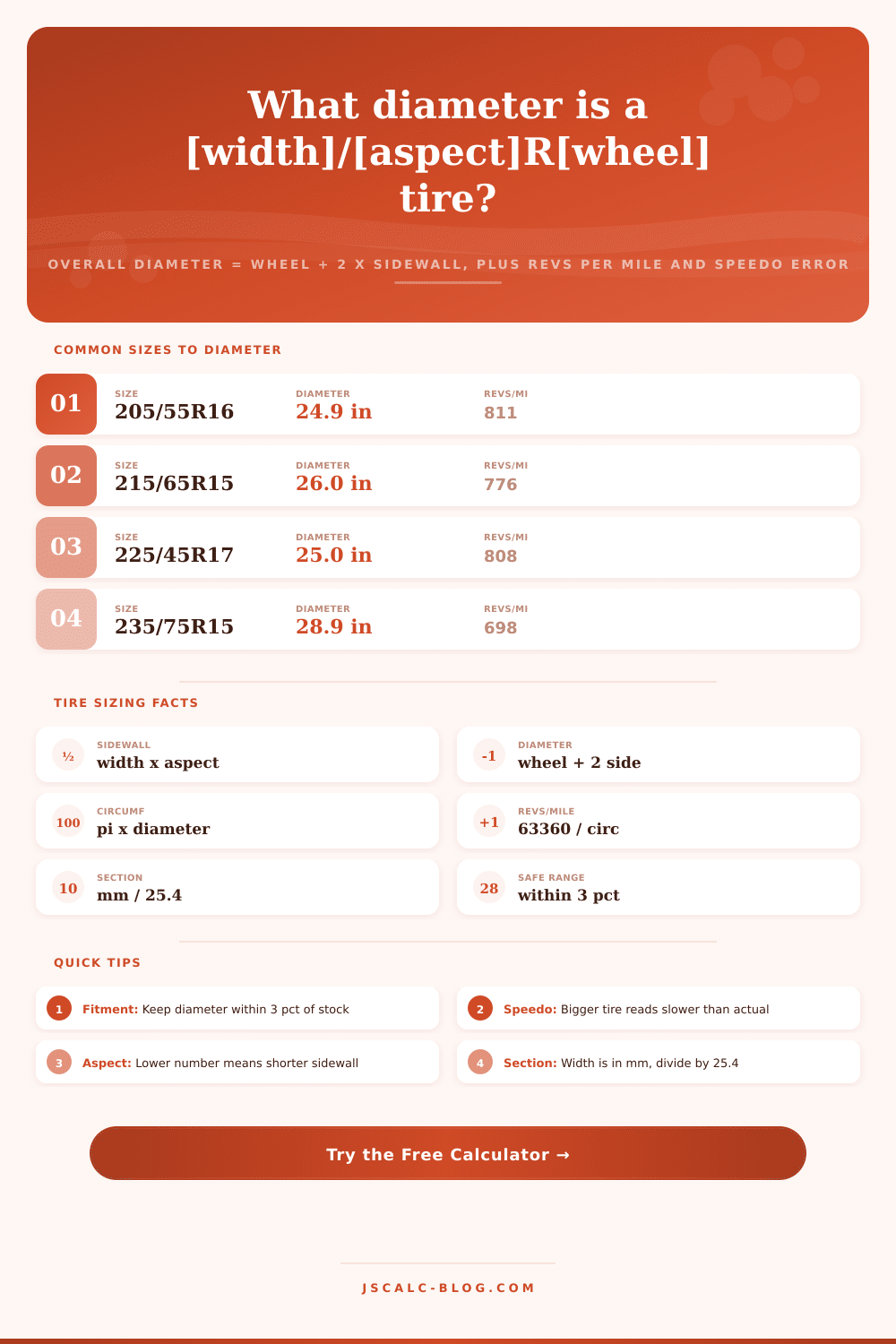
| 205/55R16 | 4.44 in | 24.88 in | 811 |
| 195/65R15 | 4.99 in | 24.98 in | 807 |
| 225/45R17 | 3.99 in | 24.97 in | 808 |
| 245/40R18 | 3.86 in | 25.72 in | 784 |
| 255/35R19 | 3.51 in | 26.03 in | 775 |
| 215/65R15 | 5.50 in | 26.00 in | 776 |
| 235/75R15 | 6.94 in | 28.88 in | 698 |
| 265/70R17 | 7.30 in | 31.61 in | 638 |
| 275/55R20 | 5.95 in | 31.91 in | 632 |
| 285/75R16 | 8.42 in | 32.83 in | 614 |
📐What the Aspect Ratio Means
| Aspect Ratio | Sidewall Profile | On a 225 mm Tire | Typical Use |
|---|---|---|---|
| 35 | Very low profile | 3.10 in sidewall | Sports, big rims |
| 40 | Low profile | 3.54 in sidewall | Performance sedans |
| 45 | Low profile | 3.99 in sidewall | Sport touring |
| 55 | Standard | 4.87 in sidewall | Daily commuters |
| 65 | Taller | 5.76 in sidewall | Comfort sedans |
| 70 | Tall | 6.20 in sidewall | Crossovers, vans |
| 75 | Very tall | 6.64 in sidewall | Trucks, off-road |
🛞Plus-Sizing Rule: Keep Diameter Within 3 Percent
| Step | Original | New Size | Diameter Change | Verdict |
|---|---|---|---|---|
| Plus 0 | 225/45R17 | 245/40R18 | +2.98% | Safe, under 3% |
| Plus 1 | 205/55R16 | 225/45R17 | +0.36% | Ideal match |
| Plus 1 | 195/65R15 | 205/55R16 | -0.40% | Ideal match |
| Plus 2 | 215/65R15 | 235/60R16 | +2.42% | Safe, under 3% |
| Lift | 245/75R16 | 265/70R17 | +3.73% | Check clearance |
| Lift | 245/75R16 | 285/75R16 | +7.75% | Needs lift kit |
🕜Speedometer Error by Diameter Change
| Diameter Change | Dash Reads 60 | Actual Speed | Odometer Effect |
|---|---|---|---|
| -3% | 60 mph | 58.2 mph | Reads 3% high |
| -1% | 60 mph | 59.4 mph | Reads 1% high |
| 0% | 60 mph | 60.0 mph | Accurate |
| +1% | 60 mph | 60.6 mph | Reads 1% low |
| +2% | 60 mph | 61.2 mph | Reads 2% low |
| +3% | 60 mph | 61.8 mph | Reads 3% low |
| +5% | 60 mph | 63.0 mph | Reads 5% low |
🗄Size Comparison Grid
| Tire Size | Sidewall | Diameter | Circumference | Revs per Mile | Section Width |
|---|---|---|---|---|---|
| 195/65R15 | 4.99 in | 24.98 in | 78.48 in | 807 | 7.68 in |
| 205/55R16 | 4.44 in | 24.88 in | 78.16 in | 811 | 8.07 in |
| 225/45R17 | 3.99 in | 24.97 in | 78.45 in | 808 | 8.86 in |
| 235/45R18 | 4.16 in | 26.33 in | 82.71 in | 766 | 9.25 in |
| 245/40R18 | 3.86 in | 25.72 in | 80.79 in | 784 | 9.65 in |
| 215/65R15 | 5.50 in | 26.00 in | 81.69 in | 776 | 8.46 in |
| 225/60R16 | 5.31 in | 26.63 in | 83.66 in | 757 | 8.86 in |
| 265/70R17 | 7.30 in | 31.61 in | 99.29 in | 638 | 10.43 in |
| 275/55R20 | 5.95 in | 31.91 in | 100.25 in | 632 | 10.83 in |
| 285/75R16 | 8.42 in | 32.83 in | 103.14 in | 614 | 11.22 in |
⚙Formula Breakdown
💡Tire Fitment Tips
Ever look at a tire’s sidewall and think, “that’s a bunch of numbers and letters?” Well, it turns out those numbers and letters is an exact blueprint describing the shape. In English: the first number is the tire width in millimeters, the second is the aspect ratio (which tells you how high the sidewall is compared to the width), and the last two numbers describes the rim size in inches. These three numbers are important, since aside from making your vehicle look good, they also tell you if your new tires will rub on fender as you swing your steering wheel full lock to the curb; how accurate your speedo reads; what your fuel mileage will be; etc.
This tire calculator doesn’t require guesswork about whether a swap will fit; it takes that confusing string and turns it into real world inches and revolutions. Overall diameter is the single most important dimension. And I mean total diameter; it’s not just the rim size. It includes amount of sidewall above and below the wheel. For example, say you have a 15-inch wheel and want to upgrade to a 16 inch rim. But you reduce the aspect ratio so the overall diameter remains the same. Your car will sit at the exact same height. It won’t after. That’s how plus-sizing works. By increasing the width of the tire without altering gearing or ride quality, enthusiasts fill out the wheel well.
How to Use the Tire Calculator
The tool take your original size and compares it to a potential replacement. The resulting percentage indicates whether you’re getting too close (within three percent) or too far away (beyond three percent). Within that margin, the speedo won’t be off enough to cause any real concern during everyday driving. If it is above three percent, there is a chance you’ll confuse the transmission computer and anti-lock brake system.
The connection between physics and your dash is revolutions per mile. A smaller wheel require more revolutions to go a mile than a larger wheel. It also changes how quickly you think you’re traveling versus actual speed. Bigger tires mean less rotations per mile. You will travel farther with every turn. At sixty miles per hour, your speedometer read slower than you are really going. On the highway this is treacherous when checking radar zones or trying to maintain pace with other traffic.
The calculator gives you precisely how much off you are at sixty miles per hour. Every time the diameter changes by three percent, your speedometer shows sixty when you are actualy going closer to sixty-two. That is enough for a speeding ticket if you don’t know it’s changed.
Not all fitment problems are advertised, but rather buried deeper in the details of the spec sheets. How wide does it has to be to clear the brakes and suspension components? Is the width of wheel sufficient to accommodate a larger tire on the stock rim? Can I just stick a wide tire on my stock rim? Not necessarily. No, unless you can fit the wheel into the wheel well in person. Does it matter what the aspect ratio is? A lower aspect ratio (shorter sidewall) means the tire will be stiffer and sharper, since it has less rubber to flex under cornering forces. A taller side wall soaks up bumps better at the cost of vagueness on fast turning. So it’s a give and take between feeling good on the rough stuff vs turning precise on the corners.
The calculator helps you compare relative diameters of all common sizes using presets that will guide you to seeing how they relate to one another. For instance, a 205/55R16 sedan tire has roughly the same diameter as a sportier 225/45R17. They’re both fine mechanically, though you’ll note the change in car’s overall appearance by swapping one for the other.
If you’re a hard-core off-road enthusiast seeking greater clearance, you have other constraints. If you move from a twenty-four-inch tire up to a thirty-two-inch, you’ll need larger fender flares and maybe some suspension lift, otherwise the tires will start to shred the plastic liners. The math does not change, but the mechanical work becomes much more difficult.
No more guessing when it comes to tires. Enter in your existing specifications and desired specifications. Click calculate. Review your speedo error and difference in diameter. Is it within safe tolerance and do the numbers match what you’re looking for? Then you have verified fitment before purchasing rubber. You won’t have to pay return fees. You will have no more hassle at install time.
Keep in mind, it’s not rocket science. Once you break it down, the formula make sense. The sidewall is the width times the aspect ratio. The overall height is the rim diameter plus two sidewalls. The circumference is the overall height times pi. The number of revolutions is inches per mile divided by the circumference. Simply plug it in and let the calculator do the work while you concentrate on selecting tires based off how they’ll make your ride look and feel. Get the math out of the way and the rest should of fall into place.