Horsepower Calculator (Engine HP from Torque and RPM)
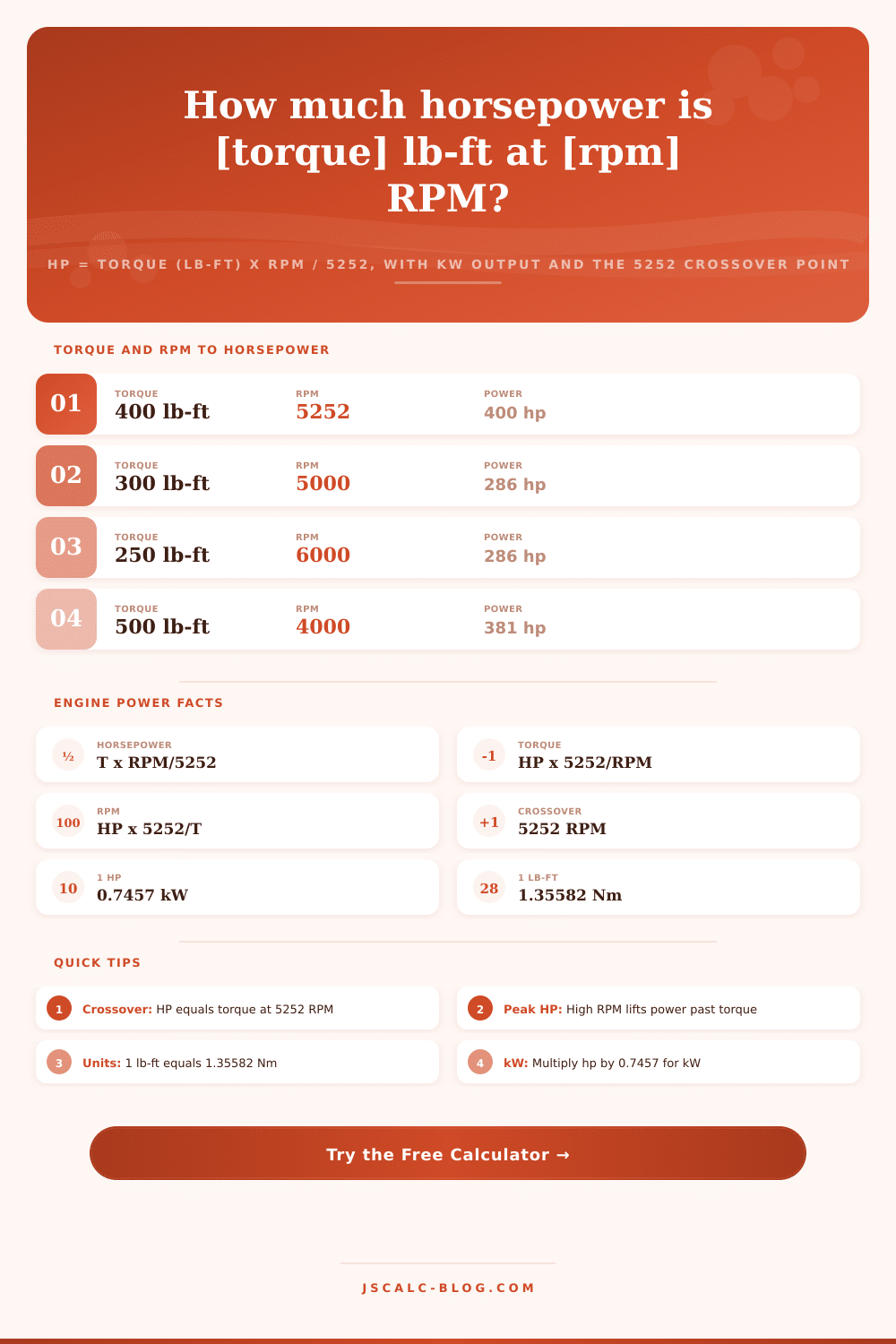
Compute engine horsepower from torque and RPM using the classic dyno relationship HP = Torque (lb-ft) x RPM / 5252. Solve for horsepower, torque, or RPM when you know the other two, or estimate horsepower from engine displacement and a tuning factor. Results show power in both hp and kW, torque at that point, and the 5252 RPM crossover where horsepower and torque are numerically equal.
🚗Choose a Mode
🏁Real Engine Presets
🛠Engine Inputs
Pick the unknown; enter the other two values below.
Engine torque measured at the crank at the chosen RPM.
1 lb-ft = 1.35582 Nm. Applies to the torque field.
Crankshaft revolutions per minute at the power point.
Used when you solve for torque or RPM.
Total swept volume of all cylinders.
1 L = 61.024 ci = 1000 cc.
Rough output density; higher for boost and tuning.
RPM used to back out an implied peak torque.
Controls rounding on every result card.
🔢Formula Snapshot
📋Torque and RPM to Horsepower
| Torque (lb-ft) | RPM | HP = T x RPM / 5252 | Power (kW) |
|---|---|---|---|
| 400 | 5252 | 400.0 hp | 298.3 kW |
| 300 | 5000 | 285.6 hp | 213.0 kW |
| 250 | 6000 | 285.6 hp | 213.0 kW |
| 500 | 4000 | 380.8 hp | 283.9 kW |
| 150 | 7000 | 199.9 hp | 149.1 kW |
| 350 | 5252 | 350.0 hp | 261.0 kW |
| 200 | 3000 | 114.2 hp | 85.2 kW |
| 100 | 8000 | 152.3 hp | 113.6 kW |
📏Horsepower to Kilowatt Conversions
| Horsepower | Kilowatts (hp x 0.7457) | Metric PS | Typical Vehicle |
|---|---|---|---|
| 75 hp | 55.9 kW | 76.0 PS | City economy car |
| 120 hp | 89.5 kW | 121.7 PS | Compact hatchback |
| 200 hp | 149.1 kW | 202.8 PS | Mid-size sedan |
| 300 hp | 223.7 kW | 304.1 PS | Sport sedan |
| 400 hp | 298.3 kW | 405.5 PS | Muscle car |
| 500 hp | 372.9 kW | 506.9 PS | Supercar |
| 707 hp | 527.2 kW | 716.7 PS | Hellcat V8 |
🔄Torque Unit Conversions
| Torque | Equals | In lb-ft | Note |
|---|---|---|---|
| 1 lb-ft | 1.35582 Nm | 1 lb-ft | Base US unit |
| 1 Nm | 0.73756 lb-ft | 0.7376 lb-ft | Metric torque |
| 100 Nm | 73.756 lb-ft | 73.76 lb-ft | Small engine |
| 200 lb-ft | 271.16 Nm | 200 lb-ft | Hot hatch |
| 400 lb-ft | 542.33 Nm | 400 lb-ft | V8 muscle |
| 1 kg-m | 9.80665 Nm | 7.233 lb-ft | Older JDM spec |
🚗Engine Type Power Comparison
| Engine Type | Peak Torque | Peak RPM | Horsepower | Power (kW) | Character Notes |
|---|---|---|---|---|---|
| Economy 4-cyl | 130 lb-ft | 4400 | 108.9 hp | 81.2 kW | Low-rev efficiency |
| Turbo 4-cyl | 258 lb-ft | 5000 | 245.6 hp | 183.1 kW | Flat boost torque |
| NA V6 | 260 lb-ft | 6300 | 311.9 hp | 232.6 kW | Smooth mid-range |
| V8 muscle | 400 lb-ft | 5500 | 418.9 hp | 312.4 kW | Big low-end pull |
| Diesel truck | 925 lb-ft | 2800 | 493.1 hp | 367.7 kW | Torque-heavy, low RPM |
| Sport motorcycle | 83 lb-ft | 13000 | 205.5 hp | 153.2 kW | Peaky, revs to redline |
| Supercar V12 | 509 lb-ft | 8500 | 824.0 hp | 614.5 kW | High-rev screamer |
| Big-block V8 | 565 lb-ft | 5100 | 548.7 hp | 409.2 kW | Displacement torque |
⚙Formula Breakdown
💡Engine Power Tips
If you’ve ever debated power output with another person who claims that torque make a vehicle move, well then you’re both correct. Depending on which side of 5252 RPM you reside, that magic number isn’t some random figure dreamed up by marketing departments. Rather, it’s a mathematical meeting point between rotational speed and twisting force.
This meeting point will change the way you read every dyno sheet you come across. Simply input your variables into the calculator above and let it do all the math for you. Round error be gone; now get to studying what your engine is producing.
Understanding Horsepower and Torque
When your foot hits the accelerator pedal, you experience an instantaneous push called torque. As the engine spin quicker, this push sustains longer, which is horsepower. Mechanical horsepower equals torque multiplied by RPM divided by 5252. James Watt originally defined this number. He did so by defining a horse lifting weight and factoring in geometry of a circle. It connects the linear world of force with the rotational world of crankshafts.
If you use exactly 5252 RPM and 400 pound-feet, you get 400 horsepower. At this one and only point, torque will equal horsepower. Anywhere below 5252 RPM torque is greater then horsepower. Anywhere above, horsepower stays ahead. It maintains this lead until the engine reaches its limit or loses power.
Peak horsepower isn’t everything that matters for speed. Most enthusiasts assume this is true, which is why most of them gets confused. However, that assumption is not completely right. Power is necessary for top speed, but available torque in street-usable RPMs play an enormous role in getting up to speed quickly in low gear.
A sports sedan may have more horsepower than a diesel truck, but the latter will leave it standing at the light because its torque peaks early and stays broad. With the calculator you can plug in whichever variable is unknown. If you have the peak horsepower number and know what RPM it occurs at, you can work your way backwards from there and solve for the torque that produced it. That comes in handy if a spec sheet has one number listed and not the other, you work your way back into filling in the blanks by figuring out the relationship instead of guessing.
If you don’t have any numbers, displacement is a very loose guideline. Typically, a normally aspirated V8 will produce roughly one horsepower for every cubic inch of displacement. A forced-induction four can drive that number way up because boost increases amount of oxygen in the cylinder.
In the absence of other information, there’s also an estimate option that multiplies your engine size with a tuning multiplier. This gives you a ballpark guess, which isn’t necessarily gospel, but it’s helpful if you’re trying to decide between supercharger sizes or blocks at the beginning of a project. It puts a peg in the ground to help temper your expectations before you start dropping coin on parts.
There’s another level of confusion in unit conversions… That is when comparing American muscle cars with European turbos. Here are some equivalents: 1 mechanical horsepower equals 0.7457 kilowatts and one pound-foot equals 1.35582 newton-metres. To make it easy for you to compare a metric spec sheet to an American one, the calculator will convert units on the fly as well. It even calculates the implied torque based off any specified power number, allowing you to see what the curve looks like.
For instance, a high-revving motorcycle will have modest torque, but it will spin up to 13,000 RPM, producing significant horsepower. A heavy hauler will have tons of torque down low, where they need less revs to get the job done moving weight around. They both make power, just differently.
The next time you see a chart, take a moment to study where the 5252 crossover sits. Wherever those two lines intersect on your chart should be at exactly the 5252 mark. Anything else means something about the chart isn’t quite right, either the scales is off on the axes or the information itself isn’t accurate. That point of intersection will line up on any chart, a quick sanity check to make sure the numbers add up before you put any stock in what they say.
But once you know how it relates to time and speed and force, then it ceases to be some abstraction of mathematics. It becomes a road map to an engine’s behavior under load. Understanding how all of this works together give you a better picture than any one headline number can tell you. Whether learning about automotive theory or tweaking your daily driver, it will help you get from point A B more clearly. And while the twist is always there, it would of been the spin that gets you home.