Business Days Between Two Dates Calculator
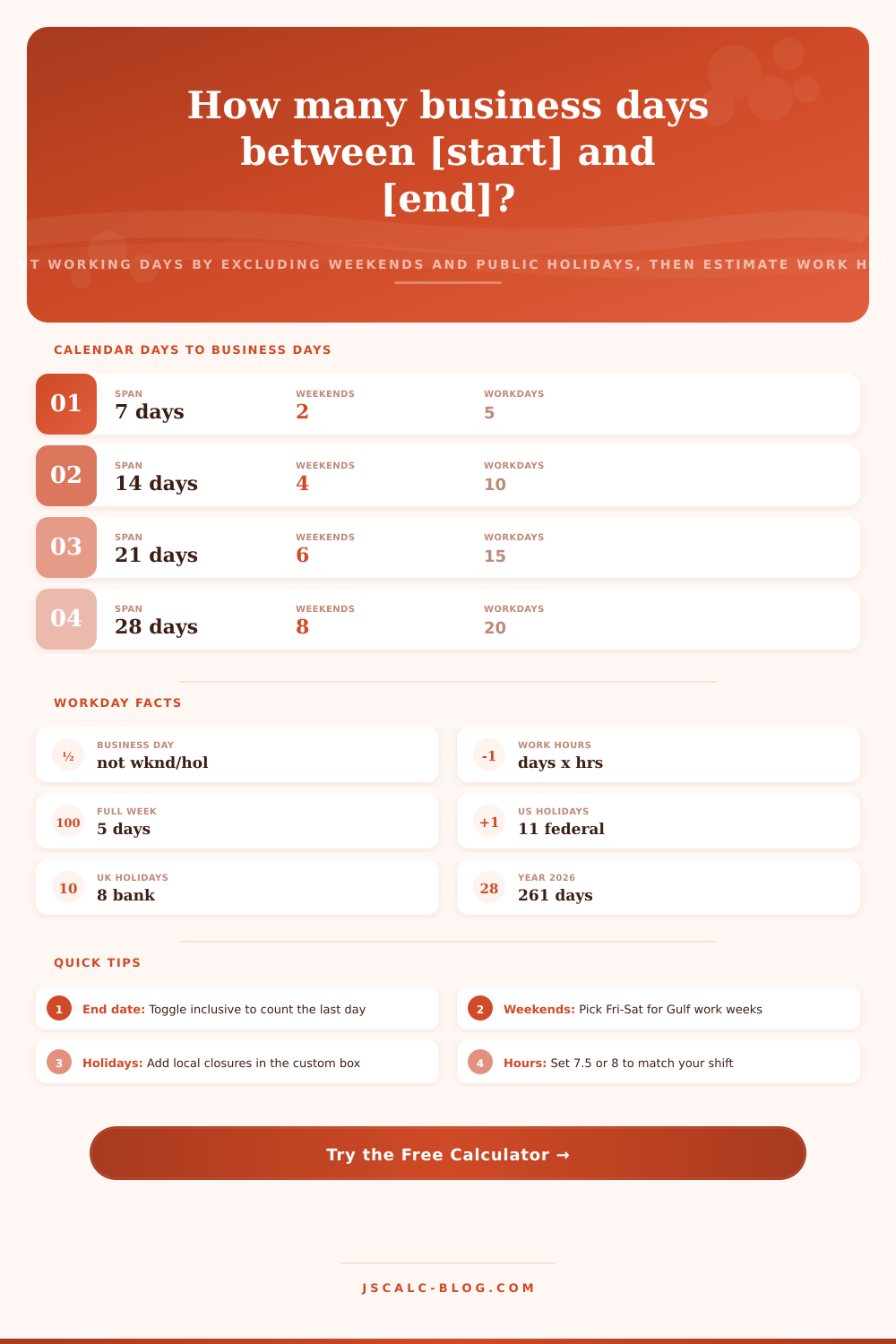
Count the working days between a start and end date by skipping weekends and public holidays. Choose your weekend pattern, apply a US Federal or UK bank holiday set, add your own closures, and get net business days plus an estimate of total work hours.
🎯Quick Date-Range Presets
📅Date Range and Rules
First day of the span you are measuring.
Last day of the span you are measuring.
Inclusive counts both endpoints; exclusive omits the last day.
Days treated as non-working each week.
Built-in public holidays to exclude from the count.
Used to estimate total work hours across business days.
Extra closures added on top of the selected set. Weekday holidays are the only ones that reduce the count.
🔢Formula Snapshot
📋US Federal Holidays 2026
| Holiday | Date 2026 | Weekday | Rule |
|---|---|---|---|
| New Year's Day | Jan 1 | Thursday | Fixed Jan 1 |
| MLK Jr. Day | Jan 19 | Monday | 3rd Mon Jan |
| Presidents' Day | Feb 16 | Monday | 3rd Mon Feb |
| Memorial Day | May 25 | Monday | Last Mon May |
| Juneteenth | Jun 19 | Friday | Fixed Jun 19 |
| Independence Day | Jul 4 | Saturday | Fixed Jul 4 |
| Labor Day | Sep 7 | Monday | 1st Mon Sep |
| Columbus Day | Oct 12 | Monday | 2nd Mon Oct |
| Veterans Day | Nov 11 | Wednesday | Fixed Nov 11 |
| Thanksgiving | Nov 26 | Thursday | 4th Thu Nov |
| Christmas Day | Dec 25 | Friday | Fixed Dec 25 |
🇬🇧UK Bank Holidays 2026 (England & Wales)
| Holiday | Date 2026 | Weekday | Rule |
|---|---|---|---|
| New Year's Day | Jan 1 | Thursday | Fixed Jan 1 |
| Good Friday | Apr 3 | Friday | Before Easter |
| Easter Monday | Apr 6 | Monday | After Easter |
| Early May | May 4 | Monday | 1st Mon May |
| Spring Bank | May 25 | Monday | Last Mon May |
| Summer Bank | Aug 31 | Monday | Last Mon Aug |
| Christmas Day | Dec 25 | Friday | Fixed Dec 25 |
| Boxing Day | Dec 28 | Monday | Substitute day |
📆Weekend Definitions by Region
| Pattern | Non-working Days | Working Days | Where Used |
|---|---|---|---|
| Sat + Sun | Saturday, Sunday | Mon to Fri | US, UK, EU, most |
| Fri + Sat | Friday, Saturday | Sun to Thu | UAE, Egypt, Israel |
| Sun only | Sunday | Mon to Sat | Six-day work weeks |
| Fri only | Friday | Sat to Thu | Iran |
| Thu + Fri | Thursday, Friday | Sat to Wed | Older Gulf schedule |
📊Business Days per Month 2026 (US Federal)
| Month | Calendar Days | Weekend Days | Holidays | Business Days | Work Hours (8/day) |
|---|---|---|---|---|---|
| January | 31 | 9 | 2 | 20 | 160 |
| February | 28 | 8 | 1 | 19 | 152 |
| March | 31 | 9 | 0 | 22 | 176 |
| April | 30 | 8 | 0 | 22 | 176 |
| May | 31 | 10 | 1 | 20 | 160 |
| June | 30 | 8 | 1 | 21 | 168 |
| July | 31 | 8 | 0 | 23 | 184 |
| August | 31 | 10 | 0 | 21 | 168 |
| September | 30 | 8 | 1 | 21 | 168 |
| October | 31 | 9 | 1 | 21 | 168 |
| November | 30 | 9 | 2 | 19 | 152 |
| December | 31 | 8 | 1 | 22 | 176 |
⚙How the Count Works
💡Working-Day Planning Tips
The common understanding of a business day is “Anyday that’s not Saturday or Sunday.” Sure, go ahead and begin there; but that fails to account for how organizations realy function. There is legal deadlines, project milestones, payroll schedules, none of these take into consideration the grid-like calendar. What matters is simply: When does the work get done?
That’s where the tool on this page come in. It walks through the calendar day-by-day. Each date are checked against the rules that define weekdays and weekends. And so, it provides a net count of working days, no more, no less.
How to Count Your Working Days
Sure, doing this kind of math… Manually counting over months (or leap years!), sounds trivial…until you actualy have to do it. The problem with dividing something like that up by weeks is that each week isn’t always equal. A quick divide-by-7 won’t work if your desired range has any “off” weeks. And even then: that doesn’t account for the fact that each week can be different; that July 4th might land on a Saturday or a Tuesday.
The calculator use proper date objects to go through actual dates. It doesn’t guess, it just knows. It knows exactly how many days there is in February. It knows which holidays will fall on Tuesdays, Saturdays, etc. That kind of precision comes into play when you’re negotiating a delivery window or billing someone by the day. Yeah, that kind of precision come into play.
The biggest mistake people make is with the end date. Do you want the last day included in the number of days, or do you want it as the cutoff? If you’re working on a thirty-day project, do you want to count the end day, or does the end day mark the day you run out of time?
The switch on the page let you pick inclusive (counting both ends), or exclusive (stopping a day early, which matches a lot of deadlines where you run out at the end of the day). That’s an off-by-one difference that can skew an entire schedule.
Beyond what you might think, there are many different types of weekend for employees around the world. While UK and US workers keep to a Monday-Friday schedule, a large part of the Gulf region works a Friday-Saturday weekend. The calculator covers these shifts out-of-the-box. There’s no math you have to do in your head to account for an alternative workweek. Just choose whichever one best fits your team’s actual work life. That makes it valuable for coordinating across teams internationally.
Working with people who understand your workweek is key to avoiding misunderstandings that could ruin a project. Accurate configuration help ensure that doesn’t happen.
And then there’s public holidays. Major closures like those on national holidays are part of the US Federal and UK bank holiday sets. But what if there’s a local festival or your company shut down for an annual week? For that, we have the custom holiday field. Here, you can paste in exact dates (in the format YYYY-MM-DD) on top of the national lists. If a holiday happens to land on a weekend day, the system doesn’t count it twice. It only subtracts the actual days you had off before marking them off.
Once you understand what goes into it, you reframe time management. Instead of “guessing” if something will fit in your schedule (Is there enough time to launch this product?), you’ll know exactly how many hours are on the clock. Your “capacity”; your typical shift length x net business days… Becomes a hard-and-fast number. This turns vague deadlines into real resource estimates.
Whether launching a marketing campaign or hiring contractors, you won’t overpromise because you know your actual range of working days. Simply enter your variables and let the calculator do the arithmetic. It’s about seeing the tension between your productive time and calendar time. Weekends, holidays; they’re all breaks in momentum. Seeing them clearly on paper helps you make more robust plans.
You no longer treat each day as if it’s the same. You respect the rhythm of work. It’s such a minor shift in thinking but it really changes your execution. Knowing precisely which days you’ll be able to get hands-on means making plans based off what is certain rather than what you hope for.