Catalytic Converter Temperature Calculator
Enter the inlet and outlet temperatures your infrared gun reads at the converter, pick the engine condition, and this tool computes the exotherm delta out minus in, tells you whether the cat has reached light-off, judges efficiency from healthy to failed, and flags overheating that points to a rich mixture or misfire.
🌡Temperature Unit
🎯Real Diagnostic Presets
📝Converter Readings
IR reading on the pipe entering the converter.
IR reading on the pipe leaving the converter.
Outdoor temperature during the test, same unit.
Sets the expected temperature band for context.
Under 10 minutes the cat may not be lit yet.
Shell readings run cooler than internal gas.
🔢Threshold Snapshot
🌡Temperature Zones and Meaning
| Zone | Range °F | Range °C | What It Means |
|---|---|---|---|
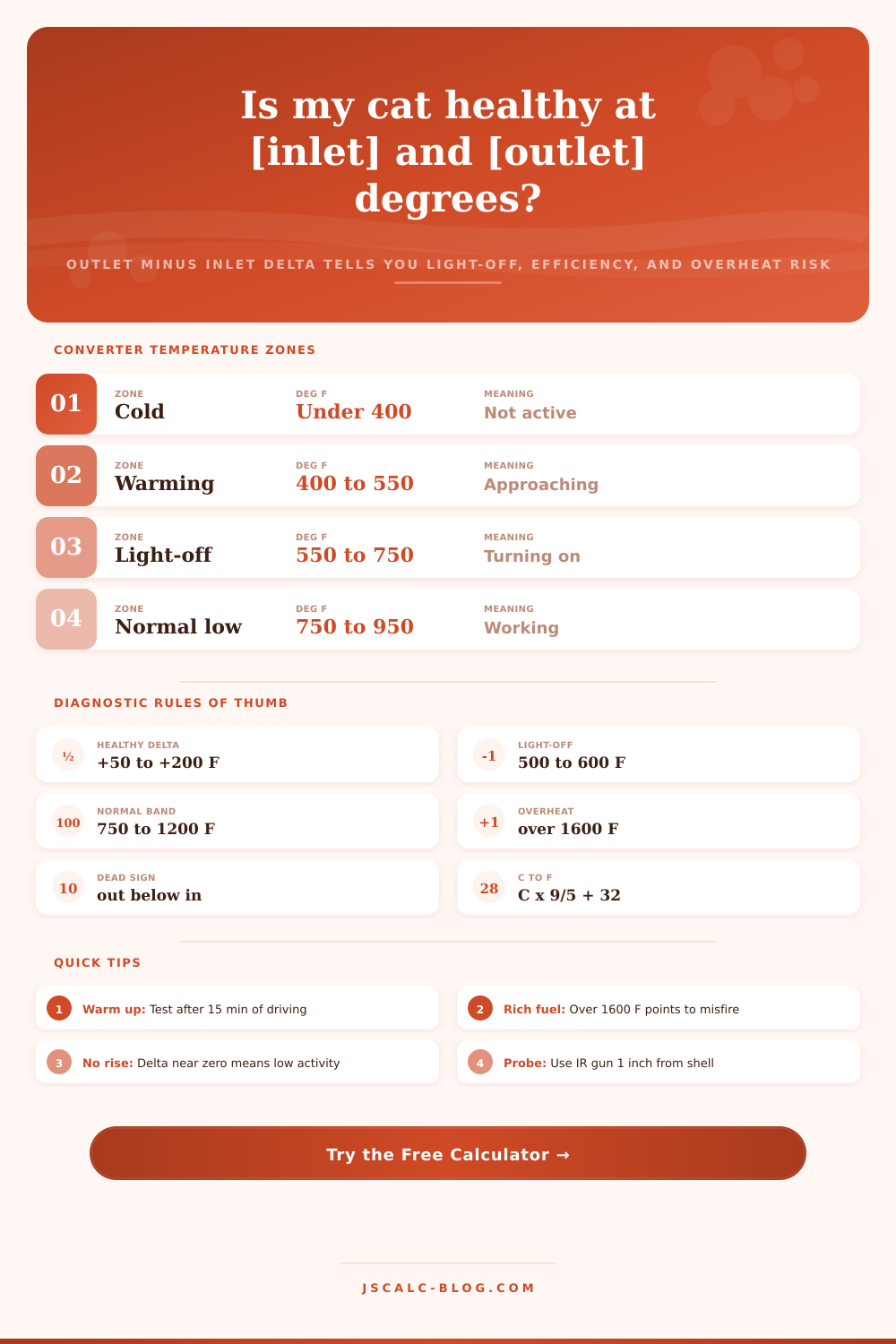
| Cold / off | Under 400 | Under 204 | No reaction, warming up |
| Approaching | 400 - 550 | 204 - 288 | Nearly at light-off |
| Light-off | 550 - 750 | 288 - 399 | Reactions starting |
| Normal low | 750 - 950 | 399 - 510 | Efficient operation |
| Normal high | 950 - 1200 | 510 - 649 | Peak efficient range |
| Elevated | 1200 - 1400 | 649 - 760 | Heavy load, watch it |
| Hot | 1400 - 1600 | 760 - 871 | Nearing damage limit |
| Overheat | Over 1600 | Over 871 | Rich, misfire, meltdown |
📏Fahrenheit to Celsius at Key Thresholds
| Threshold | Fahrenheit | Celsius | Meaning |
|---|---|---|---|
| Ambient warm day | 75 °F | 24 °C | Starting point |
| Light-off begins | 500 °F | 260 °C | Catalyst wakes up |
| Fully active | 600 °F | 316 °C | Conversion climbing |
| Normal low end | 750 °F | 399 °C | Healthy floor |
| Normal high end | 1200 °F | 649 °C | Healthy ceiling |
| Damage limit | 1600 °F | 871 °C | Substrate stress |
| Meltdown | 1800 °F | 982 °C | Ceramic melts |
📋Symptoms by Temperature
| Reading | Delta Out - In | Symptom | Likely Meaning |
|---|---|---|---|
| Outlet under inlet | Negative | Fails emissions | Dead or hollow cat |
| Delta near zero | 0 to +30 °F | Weak power, odor | Low activity, aging |
| Delta +50 to +200 | Healthy rise | Runs clean | Working converter |
| Outlet 1400 - 1600 | Large rise | Heat, smell | Slightly rich mix |
| Outlet over 1600 | Very large | Glowing shell | Misfire or rich fuel |
| Outlet over 1800 | Extreme | Power loss, stall | Melting substrate |
🗃Condition Comparison Grid
| Condition | Typical Inlet °F | Typical Outlet °F | Delta °F | Status | Likely Cause |
|---|---|---|---|---|---|
| Cold start (2 min) | 250 | 240 | -10 | Not lit yet | Warming up, normal |
| Warm idle | 650 | 760 | +110 | Light-off | Healthy low output |
| Light cruise 45 mph | 850 | 1000 | +150 | Normal | Healthy converter |
| Highway load | 1050 | 1180 | +130 | Normal high | Healthy under load |
| Aging converter | 900 | 915 | +15 | Marginal | Catalyst wearing out |
| Dead converter | 950 | 900 | -50 | Failed | Substrate gone hollow |
| Slightly rich | 1150 | 1500 | +350 | Hot | Fuel trim too rich |
| Suspected misfire | 1200 | 1720 | +520 | Overheat | Raw fuel burning in cat |
⚙How the Diagnosis Works
💡Testing and Safety Tips
To measure how well your catalytic converter is working, you simply need to know how hot it gets. A catalytic converter in your vehicle are basically a chemical reactor that cleans exhaust gases by burning off any remaining carbon monoxide and other hydrocarbons. That means the reaction will give off some form of energy. You’ve felt it on a hot day; it’s warm when you stand near your muffler. That heat helps tell if your unit is functioning propery. And you’ll find more accurate data from measuring with an IR gun than just visually.
The formula will take your infrared gun measurements and turn them into something you can understand. The exhaust temperature increase as gasoline moves through a working converter and creates heat while converting. That’s why you’ll see an increase in exhaust temp from its inlet pipe (where the hot gases come into) to its outlet pipe (where they exit). To check this, compare the inlet versus outlet pipes. The higher temperature equals an active catalyst. The discrepancy between the two temps is known as the “delta” and that’s the best measurement for diagnosing problems. Typically, a properly operating converter will result in a 50-200 degree Fahrenheit rise due to activity of its precious metals.
How to Check Catalytic Converter Temperature
There’s one wrinkle here: Catalysts don’t get chemically active until they warm up to some minimum operating temperature. That’s called light-off and typically happens between five hundred and six hundred degrees Fahrenheit. Until that moment, the converter simply sits there doing nothing. To compensate for this variable, the tool will ask about engine run time. Probe the exhaust two minutes after startup in cold weather, and you may well observe flat readings or even a negative change. Not to worry, it doesn’t indicate a bad part; rather, it indicates that the exhaust hasn’t warmed sufficiently for chemical reactions. Let the chemistry start by idling for ten minutes or driving for fifteen.
The temperature of an overheated catalytic converter is no joke; if it exceeds sixteen hundred degrees Fahrenheit, there’s a risk the inside could actualy melt. The typical owner suspects the converter has died, but in most cases it’s because something upstream is pumping unburned gas into the exhaust stream. Running too much fuel (rich fuel trim) or not getting all of it to burn (misfire) causes the cat to turn to an oven; the ceramic honeycomb catalyst melts and collapses. This also generates back pressure which knocks down power output and lights up your check engine light. You won’t cure this problem by changing the converter; you have to eliminate the root cause (leaking injector, bad spark plug, etc.). If you don’t and swap cats instead, you’ll be destroying the replacement in a few hundred miles.
Keep in mind that infrared guns are measuring the surface temperature of whatever they’re pointed at. Not the interior gas temperature. Because exhaust gases is hotter than the shell of the converter, you’ll want to position the gun roughly an inch from the pipe to get an accurate reading. Make sure to make both the inlet and outlet measurements quickly (within a few seconds of each other) while maintaining a consistent engine load. Since engine demand changes heat output based on changing RPMs, consistency during your test is more important than absolute precision.
Coolant leaks (or any other kind of fluid) and burned engine oil contaminate the catalyst’s surface over time, causing it to become less effective at converting gases and producing heat. Because of this coat, exhaust may pass through with no resulting heat-producing reaction, leaving only a warmish exhaust but a temperature change close to zero. Slowly, then, efficiency declines, often without being noticed until emissions testing time comes around. Catching this decline early with regular temp checks will save you some bucks on a last minute repair bill, not to mention prevent a total meltdown.
These figures are compared to normal operating ranges. So it gives context to what’s normal and what isn’t. It also tells you if something is in the danger zone, or even just slightly elevated. Since every brand has their own preferred thermometer, this will convert from Celsius to Fahrenheit (and back again) easily. After all, the chemistry behind how it works doesn’t change no matter your unit of measurement. You want that slight increase in temp to signify the conversion process is happening but not get too close to the melt point of the substrate.
The story here is temperature. Temperature is a direct by-product of chemical activity. No guessing if the catalyst has come on if you can read its output heat. The good news is that the healthier converters are going to be in a specific window where they are hot enough to work and cool enough to avoid death. If you keep your readings in that range then you not only protect one of more expensive parts of your car but will also have cleaner emissions. Knowing the difference puts your mind at ease before issues become costly.